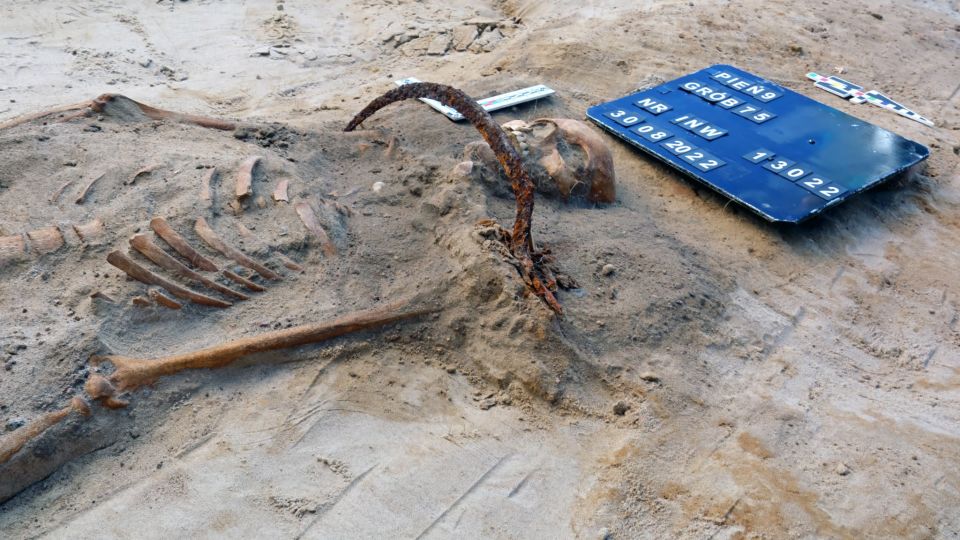
A 400-year-old grave held the body of a young woman, the rusted blade of a sickle over her throat and a padlock fastened to her foot — the macabre signs of a community terrified the deceased would rise again.
Archaeologists unearthed Zosia, as the skeleton was nicknamed, from an unmarked burial site in 2022 near the village of Pień in northern Poland. The grave's grisly contents made international headlines, and the 2024 documentary "Field of Vampires" followed researchers as they re-created what her face may have looked like.
Now, some of the same scientists have published the first systematic research on Zosia, using ancient DNA and other cutting-edge analyses in an attempt to understand who the woman was, how she died, and why she, and perhaps others buried in the same field around 400 years ago, appeared to have been feared as vampires or demons.
"It was unusual that there were two precautions, two methods of showing that this skeleton should be kept in the grave — so the fear of the body coming back to life was greater," said Dariusz Poliński, the lead author of the study published on July 30 in the Journal of Archaeological Science: Reports.
Poliński, a professor at the Institute of Archaeology at Nicolaus Copernicus University in Toruń, Poland, and his colleagues began excavating the site in Pień near Dąbrowa Chełmińska in 2005. The rural field was used as a cemetery for around four generations in the 17th century, with a total of 101 graves from this era discovered at the site, according to Poliński.
The burial ground was likely Protestant due to a complete absence of devotional items, such as crosses and medals characteristic of Catholic burials. In this area at that time, Protestant groups from Germany and the Netherlands — primarily Lutherans and Mennonites — lived alongside the predominantly Catholic Polish population. While padlocks have been found at Jewish cemeteries in Poland, the study authors noted the site carried no other characteristic features suggesting this was a Jewish grave.
A reconstruction of what Zosia may have looked like. – TSE Ewolucja
"They were undoubtedly perceived as potentially dangerous corpses, that might harm the living if not disabled in this way," said John Blair, a University of Oxford professor emeritus of medieval history and archaeology, referring to females buried with sickles over their throats. He was not involved in the study.
"Corpse-killing measures are widely attested in burials, at many dates and across the world, though this specific practice seems to be distinctive of early modern Poland," said Blair, author of "Killing the Dead: Vampire Epidemics from Mesopotamia to the New World."
Several dozen burials in the field featured body arrangements or objects that the study described as deviant or atypical. These included a child buried face down, a skeleton positioned as in a crucifixion, graves with stones placed around the skull as if to prevent biting or movement, as well as other graves with sickles and padlocks.
The location of the cemetery in Pień, set away from the village on a slope by a crossroads and far from a church or chapel, suggested the field might have served as a "burial place for individuals rejected by society, irrespective of their social status, who were likely feared even after death," the researchers wrote.
"Such burial places were generally omitted from written sources, which explains the absence of source data concerning them. This mode of burial was applied to suicides, heretics, outsiders without municipal citizenship, vagrants, tragically deceased," the team noted.
The triangular-shaped padlock was fastened to the corpse's big toe when Zosia was initially buried, although it was found unlocked. The sickle, which had a handle made from birch, alder or maple, was placed over her neck at a later date, poised to decapitate her should she try to rise from the dead.
The study hypothesized that the sickle was added before the body fully decomposed since no joints were detached or displaced, as archaeologists would expect if a grave were to be disturbed after the body became a skeleton. This finding, the authors said, suggested soft tissue was still holding the skeleton in place.
The researchers also found that an item containing copper and gold had been inserted into Zosia's mouth or nose after death. The study said the object, which left a greenish discoloration on her palate, was unlikely to be a coin, as the proportions of copper to gold did not correspond to those found in historical alloys. Placing such an object in the body was possibly also "an anti-demonic practice," the study authors wrote.