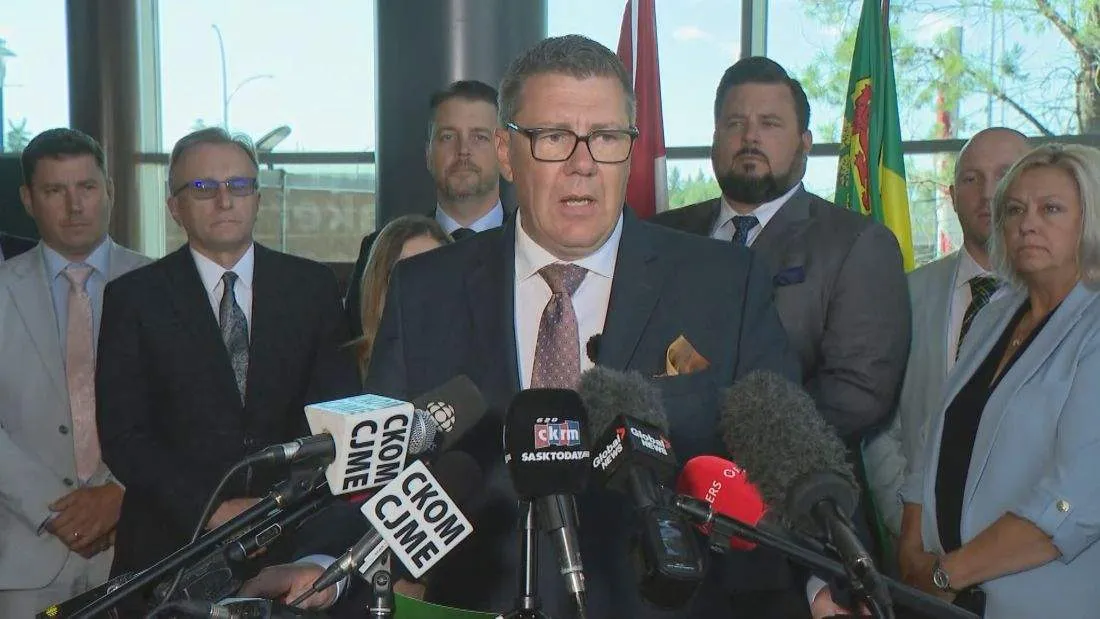
The Saskatchewan government will place a 50 per cent levy on U.S. alcohol, but Premier Scott Moe says the province will not support counter-tariffs on potash and oil.
Speaking with reporters Wednesday in Prince Albert, Moe said his province’s top two exports – potash and oil – should not be subject to any retaliatory levies. His announcement comes a day after the federal government announced the more than 700 goods that will be subject to counter-tariffs.
“What we as a province cannot, and will not, support is any kind of export tariff on our natural resources or any of our resources that are being exported to the U.S. or through the U.S.,” he stated.
The premier said imposing tariffs on potash risks Canadian job losses, and that farmers on both sides of the border would suffer. The U.S., he said, would likely turn to other nations, such as Belarus, for the resource.
“We would lose a long-term customer to some degree,” Moe said.
Oil tariffs are also a non-starter for Saskatchewan’s premier.
“It would be an unsustainable hit to our Canadian economy and, in particular, our Saskatchewan and Alberta economies. Canadians would lose jobs immediately,” Moe continued.
Petrol and diesel products from western Canada are shipped eastward and refined in the U.S., he noted, adding that it would likely increase gas prices in the east.
The premier reiterated his support for the federal plan amid “a challenge from policy direction coming from the White House.”
He called on Canadian and U.S. negotiators “to return to the table” with hopes of coming to “a trade agreement that is good for the entirety of North America” soon.
Moe said he believes the federal government has been negotiating fairly on behalf of the provinces in its Team Canada approach. The counter-tariffs will cover 11.3 per cent, or $1.5 billion, of Saskatchewan’s annual imports from the U.S. The effects of those tariffs will vary nationwide, according to the premier.
“I want to be clear. As a government of Saskatchewan, we are supportive of these very targeted countermeasures that are in place, but only when those tariffs are focused and targeted to have a minimal impact on Canadian industries and families,” Moe said.
The province is planning to host industry roundtables with effected stakeholders to work closely alongside them, helping them manage any impacts, he added.
Ottawa has not suggested tariffing potash or oil at this point in the trade war, but Ontario Premier Doug Ford said it should.
“(Potash) is one of the most powerful tools we have, along with other tools, and everyone in the world wants our potash,” Ontario’s premier said at a news conference Wednesday. “If we ever cut off potash, their (the United States’) agriculture sector would be dead overnight.”