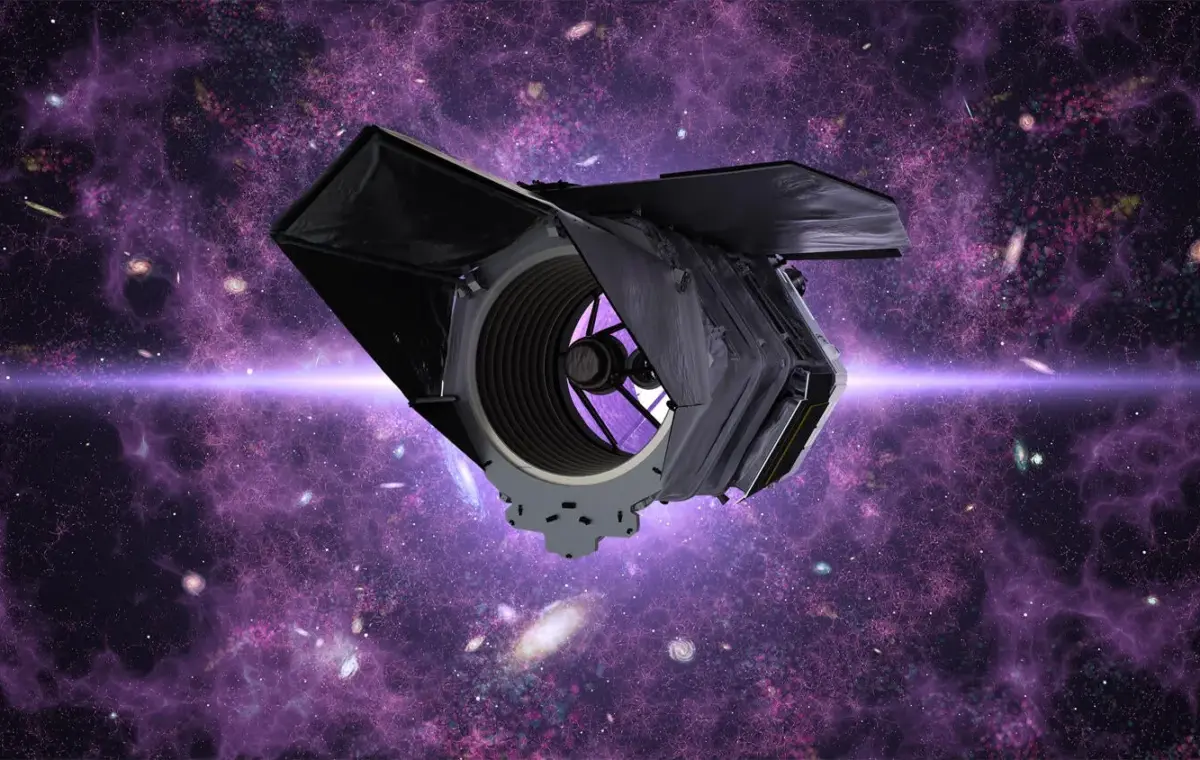
Using a donated Hubble-class mirror originally built for a spy satellite, NASA's Roman Space Telescope is poised for launch Sunday on a $4.3 billion mission to open a new window on the universe, taking wide-angle, ultra-sharp images that would require a half million 4K TVs to show in full.
Put another way, officials say a single full-resolution image from Roman's 300-megapixel wide-field camera would cover 45 city blocks or the entirety of El Capitan in Yosemite National Park. And it will collect that data faster than any previous NASA spacecraft.
The Hubble Space Telescope has beamed back about 172 terabytes of data over 30 years while Roman will downlink a staggering 2,500 terabytes over its five-year primary mission.
Put yet another way, Roman's sensitive wide-field camera and advanced detectors will scan broad swaths of the cosmos 1,000 times faster than Hubble, collecting as much data in one month as its older cousin could manage in a century.
The flood of data is expected to shed new light on the nature of "dark matter, dark energy and the structure of the universe itself and accelerate the … discovery of potentially habitable planets outside our solar system," said NASA Administrator Jared Isaacman.
"Roman will give the Earth a new atlas of the universe," he added.
NASA science chief Niki Fox described the telescope as "a sheer powerhouse" and "literally a speed machine."
"The speed at which we'll be scanning the sky, delivering vast amounts of data and returning results will be at an unprecedented rate, never done before," Fox added.
The 42-foot-long, 18,000-pound telescope is named for the late Nancy Grace Roman, NASA's first chief astronomer, who championed the value of space telescopes throughout her career and was instrumental in the development of the Hubble Space Telescope. As such, she is often referred to as "the mother of Hubble."
The new telescope is scheduled for launch atop a triple-core SpaceX Falcon Heavy rocket at the Kennedy Space Center at 7:26 a.m. EDT on Sunday.
It is bound for Lagrange Point No. 2 (L2), a gravitational eddy of sorts about a million miles on the opposite side of Earth from the Sun, where it will remain in place with minimal use of fuel. The James Webb Space Telescope is stationed in the same region for the same reason.
From the vantage point of L2, Roman will study the effects of dark matter, the mysterious substance that pervades the universe, holds galaxies together and accounts for most of the mass in the cosmos, acting as a brake on the expansion of space itself, which is carrying galaxies farther and farther apart.
At the same time, Roman will work to gain statistically significant insights into the nature of the equally mysterious dark energy, a repulsive force presumably present since the Big Bang that became dominant about 5 billion years ago as the universe expanded and thinned out. Ever since, the expansion of the cosmos has been speeding up.
Roman may help resolve a conflict between the strength of dark energy in the very early universe, as measured by probes studying the remnant 3-degree glow of the Big Bang's immediate aftermath, compared to Hubble observations of a specific type of supernova that indicate a slightly different value.
When the Hubble Space Telescope was launched in 1990, estimates for the age of the universe, from its Big Bang birth to the present, ranged from about 10 billion years to 20 billion years.