Before The Dog Stars, revisit this Ridley Scott sci-fi gem
Ridley Scott has spent nearly five decades returning to the same basic question: What does it mean to be human when the world around us stops making sense? From the industrial nightmare of Alien to the neon-soaked existentialism of Blade Runner, Scott's science fiction has always been interested in more than spaceships and futuristic technology. His best work uses those elements to make humanity feel stranger, more fragile and, occasionally, more precious.
Scott's new post-apocalyptic thriller, The Dog Stars, looks to leverage those same principles in the director’s first sci-fi film since 2017’s Alien: Covenant. Based on a book by Peter Heller, the script follows a group of survivors trying to carve out some kind of life after the collapse of human civilization, with isolation gradually giving way to the possibility of human connection. It's another Scott story about humans trying to figure out what remains after the systems they depended on have long vanished.
If that sounds like your kind of Ridley Scott science fiction, there's a very good chance you somehow missed Raised by Wolves.
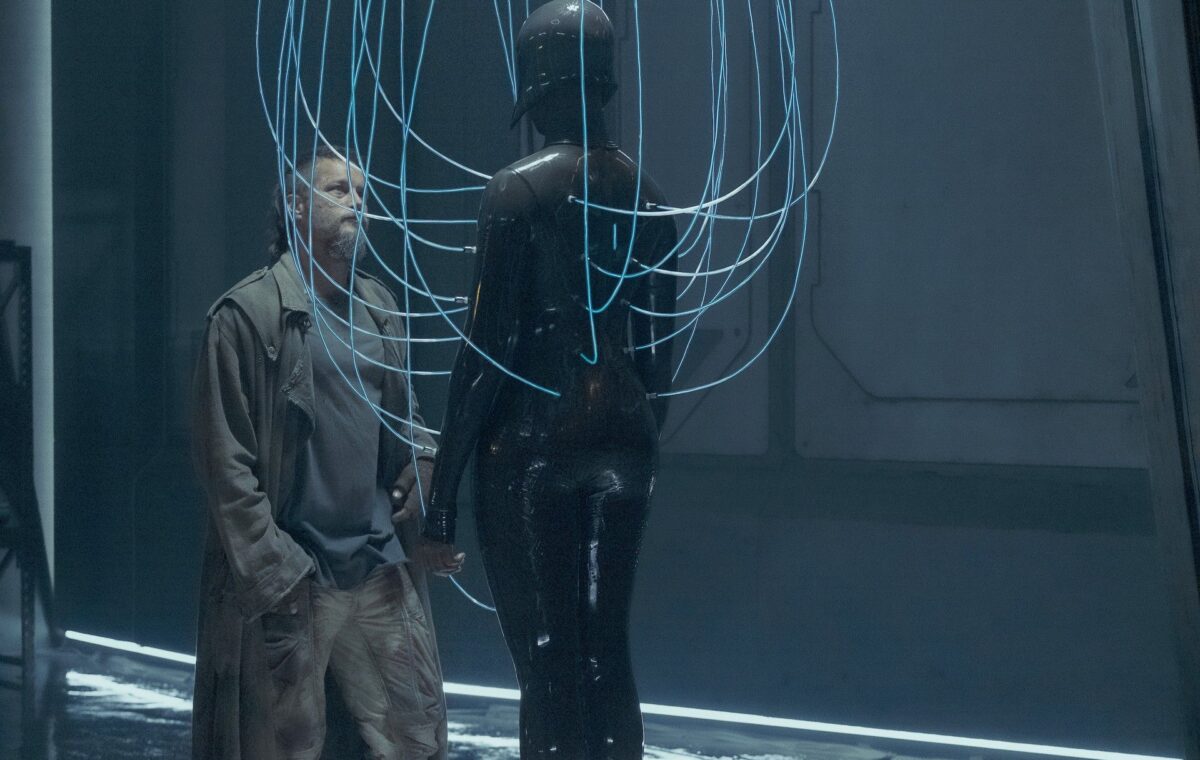
The HBO Max series is one of the best examples of Scott's particular brand of sci-fi television, even though he didn't direct every episode. Created by Aaron Guzikowski and executive produced by Scott, Raised by Wolves opens with two androids — Mother (Amanda Collin) and Father (Abubakar Salim) — arriving on the distant planet Kepler-22b with a handful of human embryos to raise a new generation in the wake of Earth's destruction. From there, the show becomes something much weirder than a simple survival story as each newly revealed layer only raises more questions.
Raised by Wolves feels like the TV version of Scott's obsessions. The series is riddled with ancient mysteries, artificial intelligence, religious fanaticism, questions about creation and an almost constant anxiety over whether humanity is actually capable of building a better world. It also looks incredible, with the kind of enormous, alien landscapes and unsettling production design that makes you feel like you're watching a lost Scott movie stretched into a TV series.
To understand exactly how mesmerizing the show can be, you only need to look at Amanda Collin’s terrifying, utterly captivating performance as Mother. In the pilot — directed by Scott himself — the seemingly docile, latex-clad android is revealed to be a repurposed "Necromancer." She transforms into a weapon of mass destruction, floating above the ground in a rigid, metallic, almost Christ-like pose, capable of reducing her enemies to bursting sacks of blood with a single, deafening sonic scream. It is a staggering sequence that instantly establishes the show's tonal signature: hauntingly beautiful, uncompromisingly brutal, and unapologetically weird.
The series never takes its foot off the gas, leaning heavily into surreal imagery and thematic paradoxes. We watch androids, which were programmed as staunch atheists to protect their human children from the religious zealotry that destroyed Earth, slowly develop their own forms of faith and irrationality. "Belief in the unreal can comfort the human mind, but it also weakens it," Mother coldly warns her children early on, a line that drips with irony as the ancient mysteries of Kepler-22b begin to unravel her rigid logic. Whether it’s the biomechanical birth of a giant flying serpent or the unsettling devolution of the planet’s indigenous creatures, Raised by Wolves commits to a level of hallucinatory science fiction that studios rarely dare to greenlight.
The show also makes for a fascinating companion to Westworld. Both series are interested in artificial intelligence, consciousness, humanity's relationship with its creations and the possibility that the beings we build might ultimately understand the world better than we do. But where Westworld became a puzzle box, Raised by Wolves was much more interested in making its mysteries feel genuinely unknowable. You weren't necessarily supposed to have all the answers. Sometimes the fun was realizing that the universe was far stranger than you initially assumed.
The show’s ambition is also what makes its cancellation so frustrating. Much like Westworld, HBO Max pulled the plug in 2022 after just two seasons of Scott’s series, leaving the story unfinished. The cancellation came amid the Warner-Discovery merger, and in 2026, Scott Free Productions executive David W. Zucker again pointed to that corporate upheaval as the reason a planned third season was abandoned.
Watching Raised by Wolves today might come with the unfortunate knowledge that you aren't getting the ending the creators intended, but I'd argue that's not a reason to avoid it. If anything, the show's brief run is proof of how rare truly uncompromised science fiction is; it deserves to be remembered for the height of its ambition, not the abruptness of its ending.
With The Dog Stars on the horizon, it’s clear Scott hasn’t lost his edge for bleak, beautifully strange storytelling. There's no better time to revisit Kepler-22b. Raised by Wolves might be an unfinished story, but its breathtaking weirdness is still impossible to find anywhere else on television.