Along the sandy banks of northern India’s Chambal River, crocodile-like gharials glide silently through the water—but if a gharial spots a stranger, the quiet may be punctuated by a series of explosive pops.
That popping sound—like a champagne cork being released from a bottle—has only recently come to scientists’ attention. It’s unique to male gharials and results when one of the large reptiles fills its nasal cavity with water and then exhales rapidly: The water shoots through a bulbous outgrowth at the tip of the creature’s long snout. The sounds, which are often produced in sequence, appear to broadcast the male’s identity—each gharial’s “pop pattern” is unique.
The gharials aren’t the only reptiles making surprising noises. While mammals and birds are better known for their vocal communication skills, reptiles aren’t just quietly slinking about in the wild—they create their own soundscapes with chirps, squeaks, bellows and roars.
As researchers discover more of these sounds, they are also beginning to determine the importance of such vocal chatter to the animals’ social lives, from mating to parent-offspring interactions. Reptiles have largely been thought of as secretive creatures and “underappreciated for a long time with regard to social behavior,” says conservation biologist Sean Doody of the University of South Florida.
Of the thousands of reptile species out there, “most of them are not studied at all,” says Henrik Brumm, a behavioral biologist at the Max Planck Institute for Biological Intelligence in Germany. Now that scientists are taking note of these varied vocalizations, says Brumm, the idea is to “better understand what they’re saying.”
When it comes to talkative reptiles, crocodiles are among the best-studied. Scientists have long known that, like their bird cousins, baby crocodilians produce sounds while they are still in the egg. These noises appear to synchronize hatching among siblings and to call their mom for help extracting themselves from their eggshells and leaving the nest. But over the past decade or so, it’s become clear that many turtles, too, make various clicks and chirps from within the egg.
To better understand turtle noises, evolutionary biologist Gabriel Jorgewich-Cohen, now at the National Institute of Amazonian Research, and colleagues looked at species with chatty turtle babies, such as the South American river turtle, as well as more taciturn species, such as the western swamp turtle. The researchers found that while South American river turtles—which lay clutches of more than 100 eggs—have noisy turtle youngsters that synchronize their nest exit, hatchlings of species that lay fewer than ten eggs are less likely to vocalize and to leave the nest together.
This suggests that chitchat made by turtle tykes from large broods may help synchronize hatching, which can help the hatchlings work as a team to dig their way out of their underground nests. And since they have many siblings, making noise is not so risky: Their individual chance of being gobbled up by predators is low, says Jorgewich-Cohen.
Vocalizations have also been detected in some 30 percent of lizard families. Chameleons, for example, hoot and bark when they interact with each other, and anoles squeak and growl when distressed.
The Chilean tree iguana, also known as the weeping lizard, can even modulate its distress call. When the lizard is stressed by a predator, for example, it emits simple squeaks. But if things are really dire, the iguana shifts to more complex calls that convey more urgency.
These complex calls have varying frequency and pitch, which result from the weeping lizard’s vocal cords vibrating out of sync. And they seem to inspire fear: The complex calls, more than ordinary calls, prompt nearby lizards to sit perfectly still for longer before escaping—and to spend more time trying to escape. One recent study found that hearing this distress call while witnessing a fellow lizard getting eaten by a snake also triggered a more prolonged fear response. Complex distress calls with more chaotic sounds have also been reported in mammals such as meerkats and human infants and may indicate urgency to the listener.
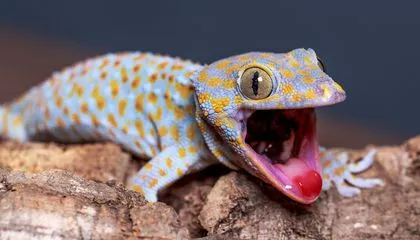
Geckos, too, can modulate their calls in sophisticated ways. The tokay gecko, with a loud call usually preceded by a series of soft cackles, typically vocalizes to find a mate or defend its territory. As with many birds, these calls are governed by testosterone and are more frequent in the spring, similarities that inspired Brumm to investigate further.
Brumm wondered if these geckos would automatically increase the loudness of their sounds when in noisy surroundings—a phenomenon known as the Lombard effect that has been observed in many birds and some mammals. “Humans do it every day,” says Brumm. “If a bus is driving by your window, without thinking about it you will speak louder.”
So Brumm and colleagues played white noise to geckos in the lab and measured how they adjusted their calls in response. The geckos didn’t dial up the volume of their whole call. Instead, they changed its pattern, reducing the number of soft cackles and letting out longer “geck-o” sounds—the louder part of their call. In the noisier setting, they also adjusted by drawing out the “o” syllable, which made the call more audible. Humans, monkeys and some birds do this as well, evident in the way people draw out their vowels and speak slower to be heard better.
“This was completely unexpected,” says Brumm. “It shows a flexibility in the communication of the reptiles that people would not have thought possible.” His findings suggest that gecko calls are more complex, sophisticated and “much more similar to the intricate things that birds and mammals do than we previously thought.”