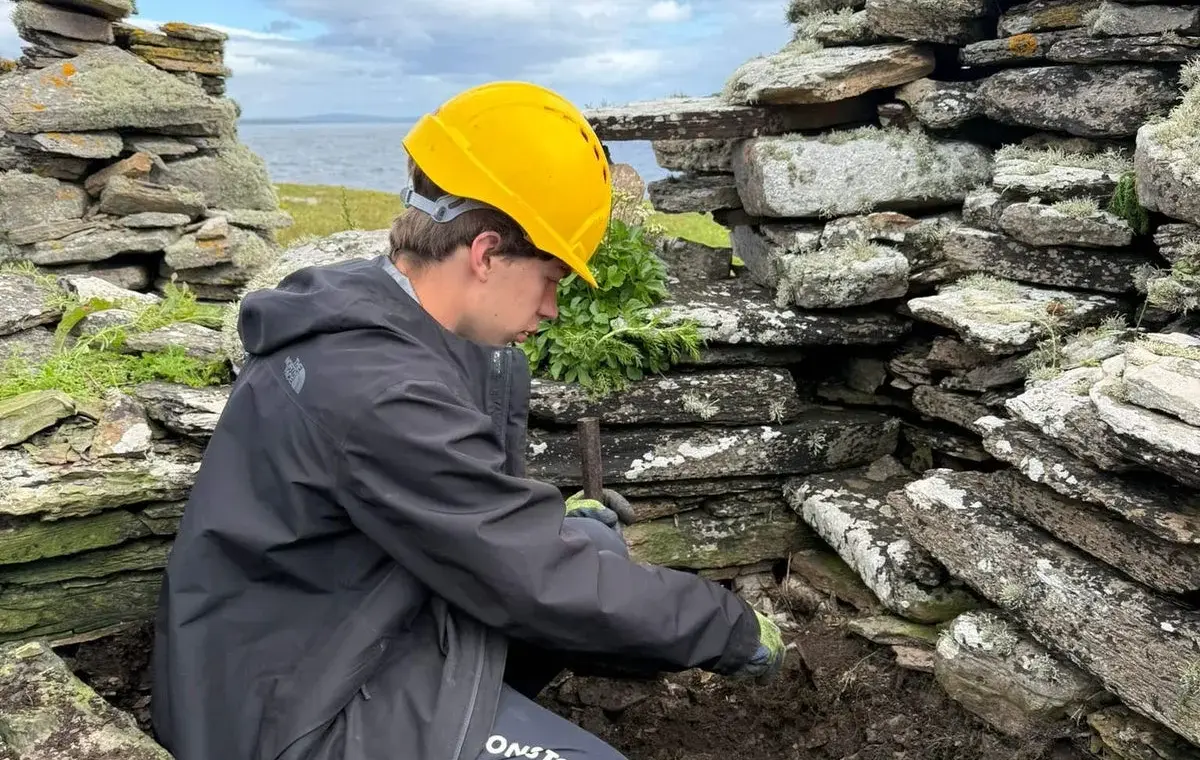
Students and staff from Gordonstoun, a private school in Moray which the King attended, uncovered the remains
I would like to be emailed about offers, events and updates from The Independent. Read our Privacy notice
A group of students from the school The King attended, have discovered the remains of what is thought to be a medieval Viking church on an uninhabited Scottish island.
Students and staff from Gordonstoun, a private school in Moray which the King attended, made the discovery on an archaeological field trip to Swona, a tiny Orkney island where only feral cattle live.
The building thought to be a church bears similarities to other Viking churches from the 10th and 11th centuries.
The children worked with professional archaeologists from the Orkney Research Centre for Archaeology (Orca) to uncover the remains during a recent six-day trip.
During the excursion they stayed in an abandoned house which had not been lived in for a century, with no electricity and fresh water pumped from an ancient well.
The remains of the church, including what is thought to be the foundation for its altar, were found beneath a more recent building on the island.
It is hoped that radiocarbon dating of samples taken by the pupils will offer more conclusions about the medieval structure.
The trip to Swona was organised by Dan McLean, a housemaster at Gordonstoun supporting pastoral care for the students.
He said: “The only real hint about a church being on the island is a map reference to a ruin known locally as the ‘Twinly Kirk’.
“Once I had identified the site, it first appeared that the remaining church walls were of a more recent building, as they have been added to over the years.
“However, after we worked with the archaeologists to dig a test pit and clear away the weeds, we discovered a step just under the surface, leading to what would have been the church’s altar.
“There are other clues, such as the construction method, layout and orientation.
“Another clue was that it was dry stone, and there was no clay bonding or mortar. There are also cairns nearby and a wall that blocks access to a landing point.