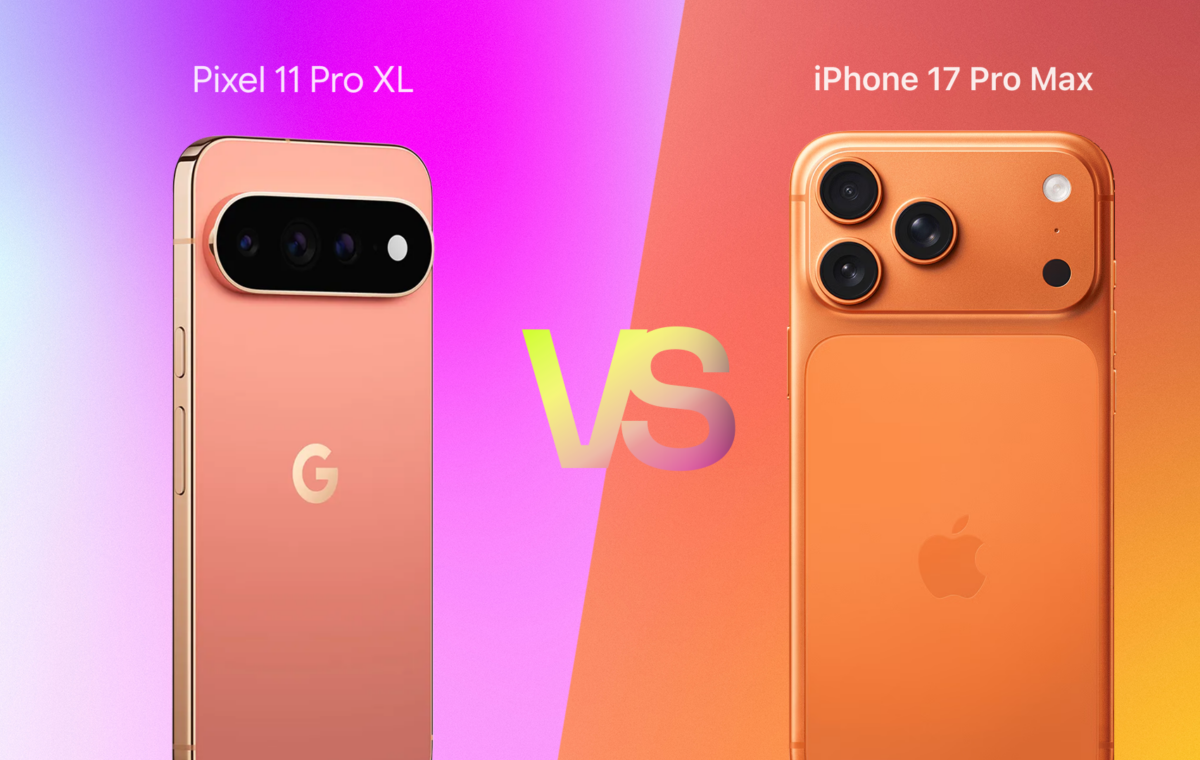
Choosing between Android and iOS? I'm here to help you decide between the $1,199 iPhone 17 Pro Max and the brand-new $1,299 Pixel 11 Pro XL.
Google just unveiled its latest lineup of Pixel phones, including the Pixel 11, Pixel 11 Pro, Pixel 11 Pro XL and Pixel 11 Pro Fold. If you’re looking for the model with a bigger screen, consider the Pro XL, which now starts at $1,299 for the 256GB storage configuration.
The Pro XL model has always been Google’s big-screen, big-battery flagship and typically features the company’s latest developments in screen technology, performance and camera quality. That holds true this year, with the Pixel 11 Pro XL fielding its brightest display yet (up to 3,600 nits), a more AI-optimized Tensor G6 chipset and a new camera system that can capture up to 120x distances with Super Res Zoom. There’s plenty of flashy AI tricks to go around, too.
If many of those aspects remind you of another big-sized phone, then that makes two of us.
The Pixel 11 Pro XL competes closely with Apple’s $1,199 iPhone 17 Pro Max, which continues to hold up as the best premium iPhone on the market. While Apple is expected to launch the iPhone 18 series as early as September, the current model remains a formidable option for those planning to upgrade today.
And if you’re now split between the new Pixel 11 Pro XL and the iPhone 17 Pro Max, here’s a breakdown of how the two flagships compare across key categories.
On the surface, the two phones are built rather similarly, with a combination of recycled plastics, metals and aluminum surrounding the displays, cameras and internal components. The iPhone has a slightly larger 6.9-inch OLED display compared with the Pixel’s 6.8-inch OLED, but you likely won’t notice the difference.
Where things begin to separate is with the screen brightness, at least on paper. The new Pixel 11 Pro XL is rated for 3,600 nits of peak brightness, making it one of the brightest phones you can buy. By comparison, the iPhone 17 Pro Max peaks at 3,000 nits. We’ll have to see if the difference in numbers translates into real-world advantages, such as the legibility of text and pictures outdoors. Stay tuned.
The design of the cameras is different, too, both on the front and the back. On the front of the Pixel 11 Pro XL, there’s a punch-hole camera that’s strictly used for facial recognition and selfies. Whereas on the iPhone (as has been the case with iPhones for the last few years), there’s the pill-shaped Dynamic Island that doubles as a status indicator for quick access to the music player, timers, Uber rides and more.
Besides making the Pixel 11 Pro XL’s camera bump slimmer this year, Google has also integrated a new HiLight LED that pulses colors based on who’s calling you or if you’re conversing with Gemini. It’s a modern interpretation of the notification LED found on BlackBerrys and old-school Android phones, and it could be even better if Google expands its customizability in the future. The iPhone 17 Pro Max doesn’t have this exact feature, but the Always-On Display option, as well as the Flash for Alerts toggle within the Accessibility settings, are decent alternatives for staying on top of notifications without waking up your phone.
The iPhone also has two extra buttons. The Action Button is the most flexible, which you can program to perform unique functions, such as starting cooking timers and triggering Shortcuts – ordering coffee from Dunkin’ Donuts shouldn’t be this easy. It also has a Camera Control button, meant for quickly turning on the camera, and its pressure sensitivity helps for adjusting settings before taking a photo.
Lastly, each device comes with a set of unique and mostly fun colors. The Pixel 11 Pro XL comes in Olive (an earthy green), Fog (gray), Obsidian (matte black) and Canyon (with warm, salmon-ish tones). The iPhone 17 Pro Max comes in Deep Blue, Silver and Cosmic Orange – the latter of which shimmers with bold, vibrant hues. Pumpkin? Fanta? Cheetos?
Google says the new Tensor G6 chipset should yield 25% faster browsing speeds and 3.5 times faster on-device AI processing, among other benefits, for the Pixel 11 Pro XL. While I would file most of those numbers in the marketing drawer, our early hands-on experience with the phones demonstrated the processor’s fluidity and snappiness on Android 17.
We’ll have to benchmark the phone to get a full read on its performance, especially under duress and in real-world usage. But the fact that the Tensor G6 is built on a 2nm (nanometer) architecture, compared to the iPhone 17 Pro Max’s 3nm A19 chipset, should give it an edge. The smaller nanometer value implies that Google was able to fit more transistors in the same space, thereby improving the phone’s overall performance and power efficiency.
That last point is important because the Pixel 11 Pro XL packs a 5,115-mAh battery. That’s a sizable capacity compared with the industry average (between 4,500 and 5,000), and just barely larger than the iPhone 17 Pro Max’s 5,088 mAh. So it all comes down to how efficiently the phones can operate, from the heat dissipation of the vapor-cooling chambers on both devices to the computational synergy with Android 17 and iOS 26. The Pixel 11 Pro XL still needs to go through CNET’s battery tests, but it does have a high bar to overcome: the iPhone 17 Pro Max recently won CNET’s Lab Award for having the best battery life among all of the phones we’ve tested in 2025 and early 2026.