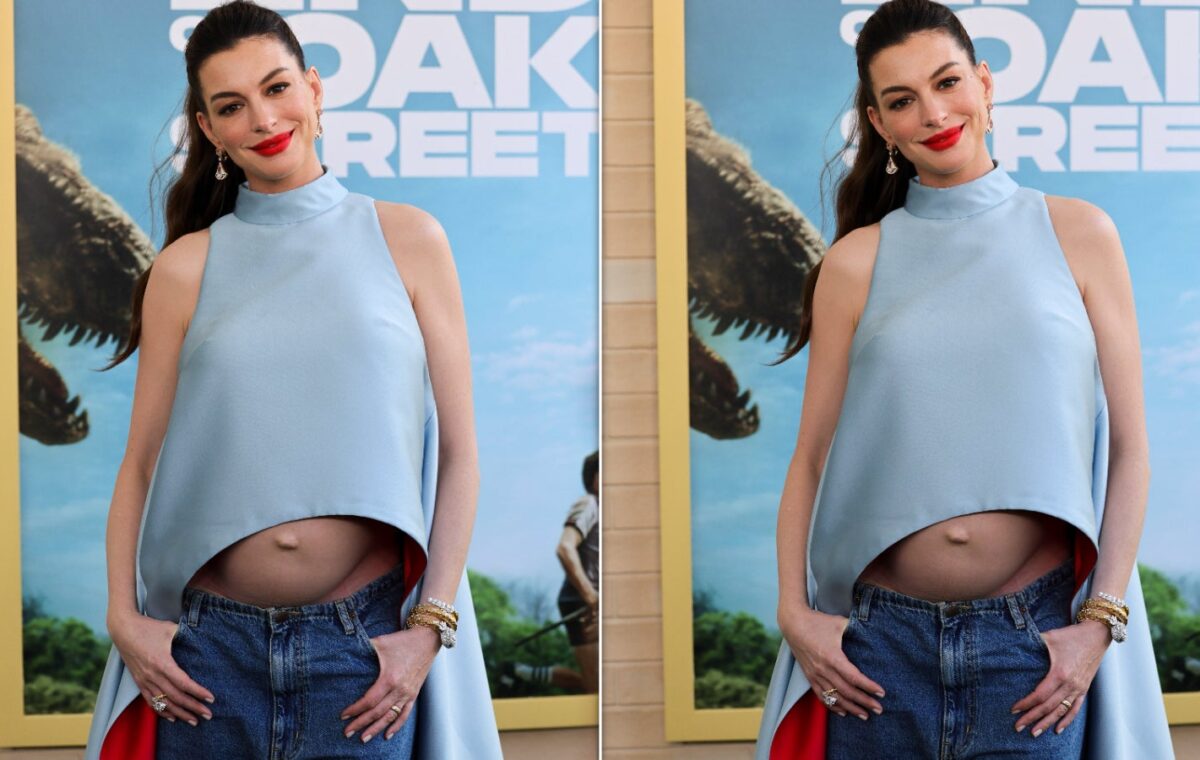
Anne Hathaway attended the premiere this past week of her new movie, The End of Oak Street, in Los Angeles, but online, conspiracy theorists were not focusing on the film or Hathaway’s style. Their target was on the actress’ pregnant body.
Hathaway wore a blue top and low-rise jeans that revealed the bottom of her pregnant stomach. Social media comments from the event questioned whether her bare bump was real.
“That belly looks fake,” one top comment from Entertainment Tonight’s post reads, while another on X declares, “Is this what a fake bump looks like? Why does her tummy look so odd?”
In her Instagram post sharing her premiere photos, Hathaway seemingly addressed the conspiracy with her caption that included a peace sign and a kissing emoji: “Fake hair, real bump.”
This is not the first “bumpvestigation” targeting a powerful, famous woman in the public eye. There have also been online conspiracy theories that Beyoncé and Meghan Markle faked their pregnancy bumps or used surrogates.
So why do so many people on the internet believe that women are faking their pregnancies?
The most generous interpretation is that people are confused with what they see online. The ease with which people can make artificially generated photos is making people mistrust photos and videos. Just last week, an AI-generated pregnant photo of Zendaya circulated on the internet before being debunked.
But it’s also likely that these conspiracy theories are in bad faith. Bumpvestigations are a tool to question and challenge the success of women, according to gender and pregnancy researchers.
In the comments, people used the physical shape of Hathaway’s belly button and the size of her bump as proof that she is faking it. And this real judgment about a fake conspiracy is yet another example of how so many people believe they’ve got a claim on a person’s pregnant body, said Elizabeth Weigle, a scholar at the University of Georgia who has researched maternity wear.
“To me, every baby bump looks beautiful,” Weigle said, but noted that people can hold unrealistic beliefs of what a “perfect” bump on a celebrity should look like.
What might also be fueling the internet backlash is that Hathaway, who is expecting her third child, appears happy.
When Hathaway reveals her pregnant body, “it’s a proud-mother flaunt of ‘I feel good in my body, and I’m carrying child.’ That’s why they don’t like it because it is a display of our power and people want to squash that,” Weigle said.
Questioning someone’s pregnancy as fake “is a way to try to upend and delegitimise their status and power and to keep the gender hierarchy of men above women firmly in place,” said Amy Diehl, a gender equity researcher and co-author of Glass Walls.
“It is also another way to send a message to all women that they should stay out of public roles, or their lives, their bodies and their families will be publicly scrutinised in the same way.”
In this way, making people wonder if a bump is fake is meant to shame a woman who doesn’t fit this mould of what a pregnant woman should do or look like, said Jay Daniel Thompson, a senior lecturer at the Royal Melbourne Institute of Technology in Victoria, Australia, who researches conspiracy theories.
Source: Read the original article on www.huffingtonpost.co.uk