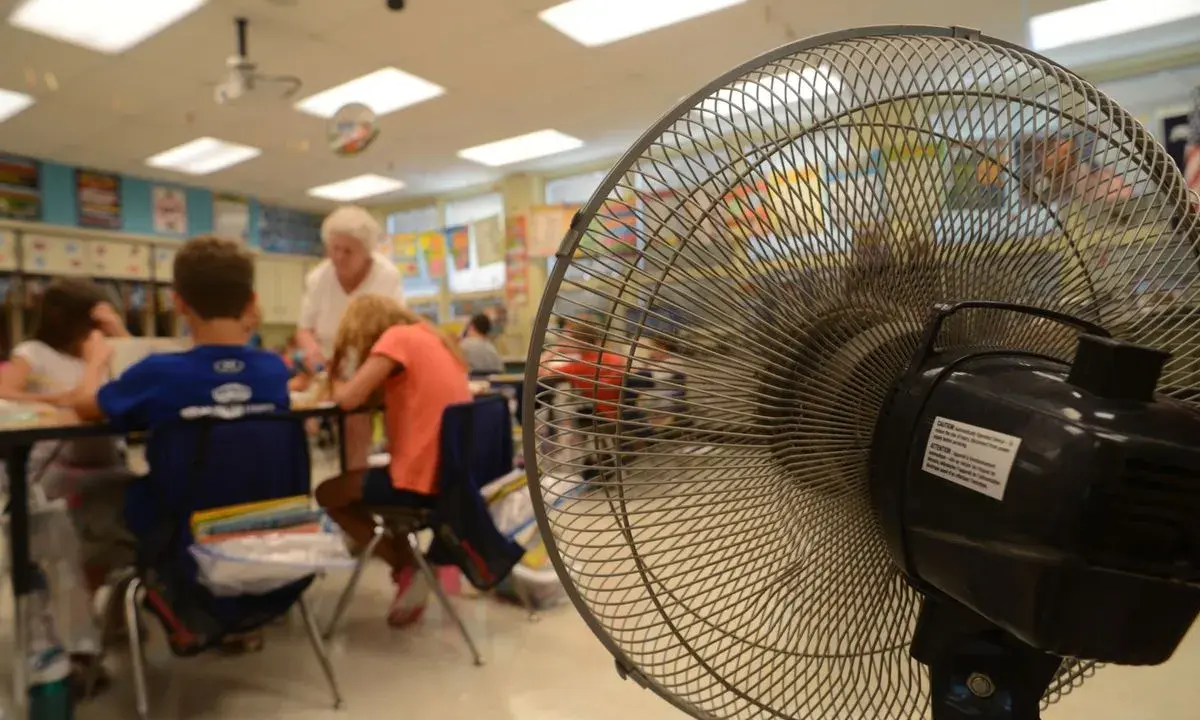
Many schools have crumbling infrastructure that makes learning in the heat difficult
While cooler fall days may be on the horizon, many students returning to school are still dealing with scorching end-of-summer temperatures. As climate change exacerbates the heat, experts say the negative effects of sizzling classrooms are here to stay, especially in school districts that may not have the resources to combat hotter weather.
Students can often “struggle to learn in hot, stuffy classrooms,” as “air quality, temperature and ventilation” can affect how people “think, focus and perform,” said Time. These factors are aggravated in poorer school districts, where a lack of air conditioning “can impair cognitive function, while excessive heat diverts the body’s energy from learning, slows reaction time and weakens attention.” Average temperatures of 80 degrees to 90 degrees Fahrenheit and above are “known to exacerbate student absenteeism and disciplinary referrals.”
While heat has always been an issue in underfunded classrooms, it “doesn’t just affect places like Phoenix, which is well known for its scorching temperatures that don’t always drop by much in the evenings,” Allison Poulos and Jennifer Vanos, a pair of health solutions and sustainability professors at Arizona State University, said at The Conversation. A number of cities, even in the northern U.S., are “oppressively hot when the new school year begins in August or September — and they are only getting warmer.”
Escape your echo chamber. Get the facts behind the news, plus analysis from multiple perspectives.
From our morning news briefing to a weekly Good News Newsletter, get the best of The Week delivered directly to your inbox.
From our morning news briefing to a weekly Good News Newsletter, get the best of The Week delivered directly to your inbox.
Many schools have also “moved the start of the academic year earlier into the summer over the last several years,” said Poulos and Vanos, exposing kids to peak heatwaves. But these schools “lack the infrastructure — from inadequate air conditioning to fields and play areas that are not shaded — to cope with high temperatures.” In 2025, 156 school districts nationwide saw an average of 30 more school days over 80 degrees Fahrenheit than they did in 1970, according to a study from the Center for Climate Integrity.
School districts are going about cooling processes in different ways. Many are working to combat issues with HVAC systems directly amid concerns from parents. The superintendent of the Tulsa School District in Oklahoma “visited several schools and found the buildings she entered were cool, but acknowledged that some sites are struggling with their air conditioning systems,” KOTV-DT Tulsa said. For schools that don’t yet have air conditioning, teachers are being asked to “close classroom doors once students are inside and shut blinds to help retain cool air.”
Conditions were even worse during summer school classes. In Boston, classrooms averaged 100 degrees Fahrenheit over several days in June, which parents “say forced teachers in non-air-conditioned buildings to turn off lights and spritz students with water to keep them cool,” said The Boston Globe. Once that heatwave broke, temperatures still “remained stubbornly high in some schools.” But the problems continued even after the dog days of summer passed. Toward the end of August, students in a Northern Colorado district “spent the first three school days of the year leaving class two hours early” due to heat, said CBS News.
Experts say modern HVAC systems should “offer schools a way to deliver reliable heating and cooling while reducing exposure to volatile fossil fuel costs,” said Time. Via “energy tax credits and a mechanism known as Elective Pay, public school districts can receive direct financial support to invest in these improvements,” turning “what was once out of reach into a practical, near-term option.” School districts in Indiana, Virginia, Wisconsin and more are already implementing these new systems.
Justin Klawans has worked as a staff writer at The Week since 2022. He began his career covering local news before joining Newsweek as a breaking news reporter, where he wrote about politics, national and global affairs, business, crime, sports, film, television and other news. Justin has also freelanced for outlets including Collider and United Press International.