Exclusive: Lack of funds left British museums unable pay eight-figure sum for collection, which went to Abu Dhabi institution
One of the most important collections of UK Jurassic fossils ever compiled has been sold to a museum in Abu Dhabi, the Guardian can reveal, in what British experts have described as a loss for the nation.
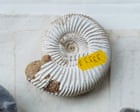
The collection, which was amassed by a private fossil collector, consisted of 318 specimens, including ichthyosaurs, fish and crustaceans among other creatures, some of which could be new species.
The fossils were initially offered for purchase to the Natural History Museum (NHM) in London and to Amgueddfa Cymru (Museum Wales) for what was described by one source as an “eight-figure sum”.
Neither institution bought the collection, with both citing a lack of funding. An email seen by the Guardian suggested the NHM had “no money at all” for acquisitions.
One curator said that while there had long been a hope that the collection could be kept in the UK, it also posed issues around storage space, curatorial time and packaging materials.
“I don’t blame the collectors at all. That’s all they can do. They can’t sit on these things forever,” the curator said, adding that the issue was expected to occur again and again as collectors get older and look for a suitable home for their life’s work.
“Whose responsibility is it to fund our heritage and the preservation of our heritage? Because otherwise it could get lost,” they added.
The extensive collection is understood to come from a sequence of rocks known as the Lower Lias, from Lyme Regis, Charmouth, and the south-west of the UK.
It was compiled by Chris Moore, a private Dorset-based collector with experience of hunting fossils in the area. In emails seen by the Guardian the collection is described as “stunning”.
Some countries, including Mongolia and Brazil, consider all fossils found in those countries in recent decades to be property of the state – a situation that has led to international disputes over repatriation of fossils housed abroad. However, this is not the case in the UK.
Richard Butler, a professor of palaebiology at the University of Birmingham who was not involved in the sale, said the collection was of national significance. “This is one of the most important collections of fossils ever made on the world-famous Jurassic Coast of Dorset. It would have been wonderful to see these fossils on display and engaging the public in a UK museum.”
He added: “This sale raises important questions about whether more should be done to preserve important and irreplaceable natural heritage such as this for the benefit of the UK public.”
In the United Arab Emirates, the Natural History Museum Abu Dhabi confirmed it had bought a collection from Moore, which went on display in November 2025. A spokesperson for the museum said the Lower Jurassic rocks of the UK preserved some of the best examples of marine life from when what is now the Dorset coast was roughly at the same latitude as north Africa.
“All natural history museums around the world tell this story, often using fossils from multiple countries to help narrate their journey through time. If we are to tell a 4.2bn-year story of the evolution of life on Earth, all museums must travel both spatially and temporally with their collections,” the spokesperson said.