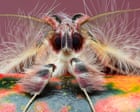
Converts describe a demanding form of capturing nature very close up that has grown in popularity in last few years
Vote here for your favourite invertebrate of the year
“I always just pray ‘please don’t fly away’,” says Dara Ojo. As a wildlife photographer, he can handle spending minutes, hours and sometimes days waiting for the shot, but insects are not always very cooperative.
Ojo is one of an increasing number of photographers turning their lenses towards something smaller: macro photography. This refers to photographing the natural world at an extremely close range, close enough to see the facets of a fly’s eye, or the geometry of a spider’s face.
This discipline has quietly evolved in popularity over the past few years, driven by a wave of macro influencers, more affordable lenses and the coronavirus pandemic, which left a lot of photographers with nowhere to go but their own back gardens.
It is a demanding form. Photographers rely on “focus stacking”, a technique that combines multiple images taken at slightly different focus distances to create one final frame. That is difficult enough with a still subject. However, insects, by nature, are not often static subjects. Add in wind, and a creature that can simply fly away mid-shoot, and a single successful image can represent hours, or even days, of failed attempts.
Macro photography is also an increasingly viable career, with more routes to income than people may expect. A well-run account can generate income through monetisation, alongside the production of print sales and books. Brand partnerships can also play a significant role, with camera and lens manufacturers seeking to work with macro specialists for content.
Ojo, 35, grew up in Lagos, Nigeria. He recalls planting yam, corn, tomatoes and beans with his late father. “I was just fascinated about putting something so tiny in the ground and coming back in a few days time and it’s starting to grow out. It was like magic to me,” Ojo says.
That sense of wonder resurfaced later. Ojo developed a love for photography during the pandemic, initially photographing birds in China, where he was based at the time. “I never want to be on the other side of the camera. If there’s a group photo, I will always volunteer to take it,” he says, joking. Feeling stagnant in his photography around this time, a friend suggested Ojo try capturing insects.
“When I started taking photos of them, when I’d never seen them that close up before, I was just fascinated by the design of their faces. It’s very intricate and it made me fall in love with them. I think people that live in tropical countries don’t appreciate [insects] as much because of the amount of times you get bitten by mosquitoes, stung by ants and wasps and whatnot,” Ojo says.
His favourite thing that he has ever captured is a video of a damselfly grooming itself. “I tried for two or three years to capture that moment,” he says. Ojo found it in an 8-hectare (20-acre) botanical garden, a large space to manage in macro photography.
He arrived there just as the sun was coming up, his research telling him that a damselfly would be most likely to clean itself at this time. After finding one, Ojo focused on it: “I waited for an hour and 30 minutes for it to do it. I always tell people if you’re doing macro, you’re not going to get your steps in.”
There is something meditative in how Ojo describes his photography process. On a trip, he likes to initially connect with nature first, often going out for a walk without a camera. “Sometimes when I’m looking for a particular species, I just say it out loud into nature and seven out of 10 times I find them. Or, I picture what I want to find in my head and eight out of 10 times I find it in the same way that I pictured it,” he says.
Ojo macro beginnings are echoed by other photographers. For Marit van Ekelenburg, who photographs as Macro by Marit from the Netherlands, it started with a favour for her mother eight years ago.
“My mum asked me if I could take some photos of her beautiful garden in the Netherlands, as she wanted it for her website,” she says. “I had never held a professional camera, and at that time my knowledge ended at recognising the difference between a wasp and a bee.”