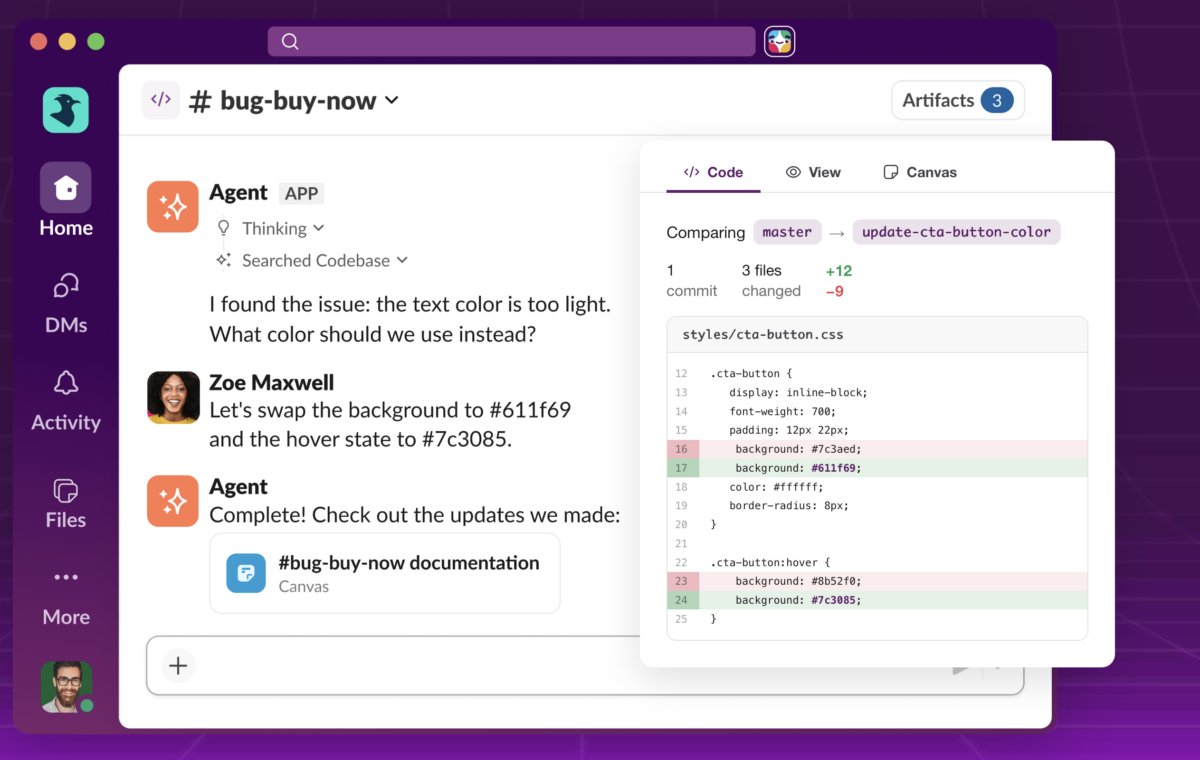
With the launch of “Slack Code” channels, Slack this week introduced a new way for developers and non-tech staff to work collaboratively with coding agents.
While Slack already integrates with several coding agents, developers have to interact with them independently to get work done. The aim of Slack Code is to make agents available to multiple coworkers in shared, project-based “code channels.”
“We built code channels to be this multi-player AI experience and bring more development into Slack,” said Sateja Parulekar, vice president of product marketing at Slack. “It’s not just engineers and product managers who are working with the coding agents; it’s the marketers, the product designers who are now able to interact with a coding agent in a safe, governed environment.”
Slack code channels are intended for one-off coding sessions and projects — building a new application feature, updating a web page, or fixing a bug, for example.
When the coding agent is tagged in a Slack channel or DM with a request, it automatically creates a new code channel, adds links to required documents, and invites relevant participants.
The code channel functions just like a normal Slack channel, with participants able to send messages and files as usual, while also letting them interact with a coding agent and track outputs via the channel’s “session artifacts.” These artifacts include “code diffs” that highlight changes to code made by the agent, as well as Slack “canvas” documents and live HTML that displays prototypes and previews created by the agent.
All participants can use natural language to direct the agent, making suggestions and signing-off on outputs, for instance. Any updates are then highlighted in the original Slack channel. And when a task or project is complete, the code channel is automatically archived.
Slack Code channels can also be customized — Slack admins can create guardrails to prevent non-technical workers from shipping code without engineering review, for example.
Code channels adhere to Slack’s existing security and permissions model, the company said, with agents able to access conversations and data based on controls set for a Slack workspace.
At launch, four agents integrate with Slack Code — Claude Code, Devin, GitHub Copilot, and Vercel — though Slack intends to expand the list of options over time. Slack Code is available at no extra cost on all Slack subscriptions.
“Slack Code closes the gap between where work gets done and where code gets written with dedicated spaces built for output along project-based channels right in Slack,” said Wayne Kurtzman, research vice president at IDC. “This furthers the Salesforce goal of making work more seamless and multi-player within the Slack environment, regardless of the other applications the business is using.
“While Slack Code may seem early to market for some companies, others are leveraging the first-mover advantage.”
While software development and coordination work “has happened in Slack forever,” according to Will McKeon-White, senior analyst at Forrester, the new features make it “easier to just stay in Slack only and [open] up who is involved with the actual code creation.”
For IT staffers who enable Slack Code, the immediate consideration involves permissions, he said — “a persistent challenge for anything multiplayer.” McKeon-White cites various approaches: “…Some inherit user permissions based on task, some have persistent permissions with different ‘invoking’ permissions for users, some inherit the permissions of the room. Each has flaws.”
The longer-term challenge, he said, is around multi-agent collaboration.