Senior Editor / Computers and Gaming Hardware
Senior Editor / Computers and Gaming Hardware
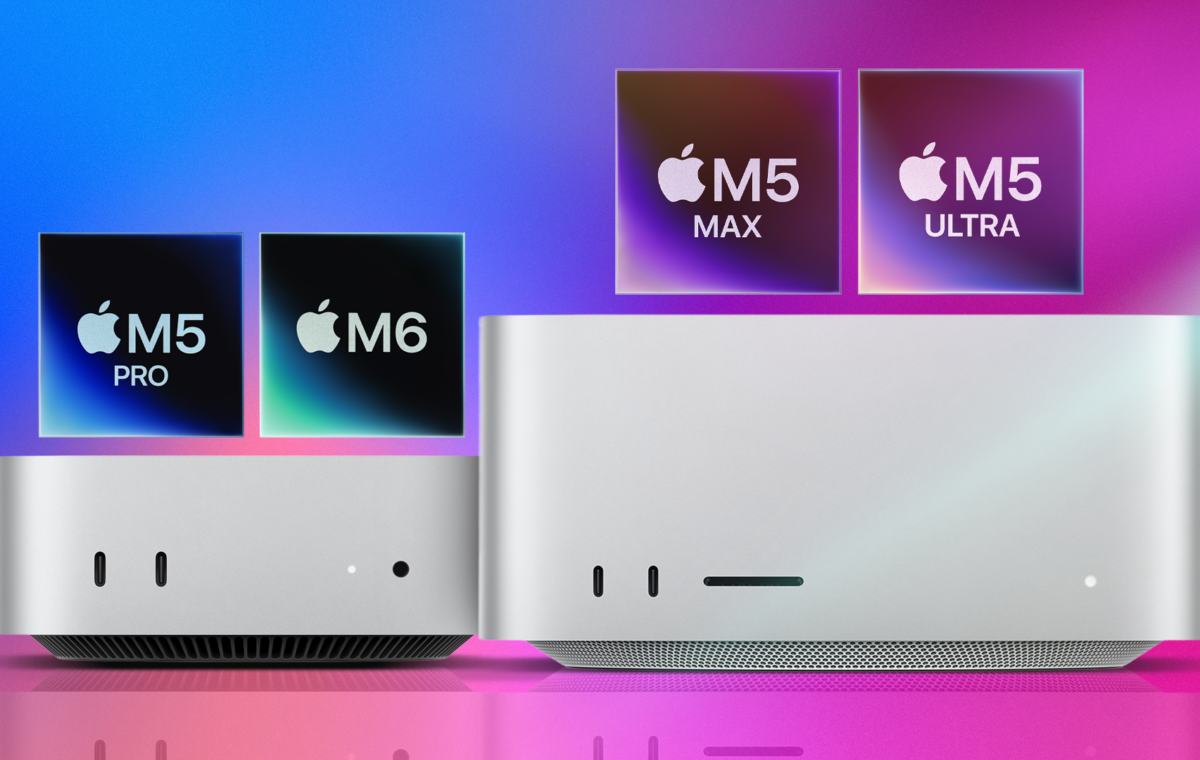
As if a new range of iPhones expected in the coming weeks wasn’t enough, Apple broke from its usual announcement timing to debut new chips and configurations of its Mac Mini and Mac Studio desktops.
In addition to launching a Mac Mini with a new M6 chip and Mac Studio with a new M5 Ultra, Apple brings its desktops into line with its MacBook Pro offerings, adding M5 Pro configurations for the Mini and M5 Max models for the Studio. Both the Mini and the Studio are identical to their predecessors physically: The performance and capabilities of the updated chips are the only changes.
That and the prices. With the exception of the M5 Max Mac Studio, which starts at the same $2,499, the prices for the base models of both systems have gone up. Prices have increased by $100 for the Mac Mini, which now starts at $899 for the M6 and $1,699 for the M5 Pro. The M5 Ultra Mac Studio has gone up by $200 to $5,499. Those are on top of the already significant bumps announced in June.
Not that the price increases come as a surprise. We’ve been going through a huge price shock, oversimplistically dubbed “RAMageddon,” thanks to ongoing component shortages. Semiconductor fab resources have been increasingly reallocated toward whatever’s ultimately the most profitable. Right now, that means anything critical to AI, notably data centers. And that pressure carries all the way down the supply chain, resulting in volatile prices for all other electronics.
Preorders start today with a long lead, at least for Apple. They’re not slated to ship until Sept. 22, with the 512GB M5 Ultra Mac Studio following about a month after that.
The brand-new M6 brings some notable advances over the M5. It’s fabricated using a 2nm process — the first M series processor to downsize from the 3nm process. A smaller process allows for denser circuitry in the same size die, which lets you do things like increase the number of cores and clock speeds of an existing chip layout without requiring a significant design change to the system or (usually) the mainboard.
That means, for instance, it was possible to double the capacity of the Neural Engine, which goes from 16 cores to 32. The Neural Engine is potentially key to the company’s success with Apple Intelligence in MacOS 27 running on entry systems, since on-device agents and other basic AI inferencing generally relies on the integer math performed by the NE.
And as far as I can tell from my testing, the NE’s performance increase from the M4 to the M5 was meh. I suspect the only way to improve it was by substantially increasing the cores.
Agents rely on the CPU to manage and allocate resources, so a handful of extra CPU cores matters. The M6 also updates the CPU architecture to match the M5 Pro and Max, switching to the three Super-Performance-Efficiency core types (think fast-slower-slowest) from the two Super-Efficiency types in the M4.
Apple says the two extra GPU cores plus accelerators will deliver about a 30% compute performance improvement. In theory, that sounds about right – I’m extrapolating based on my testing, plus the typical generation-over-generation increase in memory bandwidth.
Unlike the other versions of the chips, Apple’s top-end Ultra is on an every-other-generation upgrade cycle. So the last one was based on the M3 design, which has a GPU architecture that significantly lags the M5 for both graphics (especially ray tracing) and AI.
The Ultra chips are more or less two Max versions linked by high-speed circuitry. In this case, the M5 Ultra is based off the M5 Max with 40 GPU and 18 CPU cores for a total of 80 GPU and 36 CPU (12 super and 24 performance) cores, plus a 32-core Neural Engine. That’s the same number of NE cores as the previous Ultra, but while they’re a more recent generation, they’re not the same as the newer M6.
Like the other M5 chips, the Ultra incorporates the on-GPU neural accelerators. It still supports a maximum of 512GB memory, though you won’t be able to get it until late October. But Apple jacked up the memory bandwidth to a whopping 1.2TB per second, up from 813GB per second for the M3 Ultra and from 614GB per second for the M5 Max.