Stone tools from a lakeside site in Saudi Arabia hint that Neanderthals were adapted to the arid Arabian interior, not just to cold places.
When you purchase through links on our site, we may earn an affiliate commission. Here’s how it works.
Neanderthals may have trekked deep into the deserts of the Arabian Peninsula around 55,000 years ago, a new study of stone tools suggests.
The research, published online Aug. 12 in the journal Quaternary Science Reviews, hints that Neanderthals may have lived farther south than scientists thought, though more evidence is needed to confirm that conclusion.
"Our findings extend the Neanderthal range much further south than had been known, and into the much more open environments of Arabia," study co-lead author Huw Groucutt, an archaeologist at the University of Malta, told Live Science in an email.
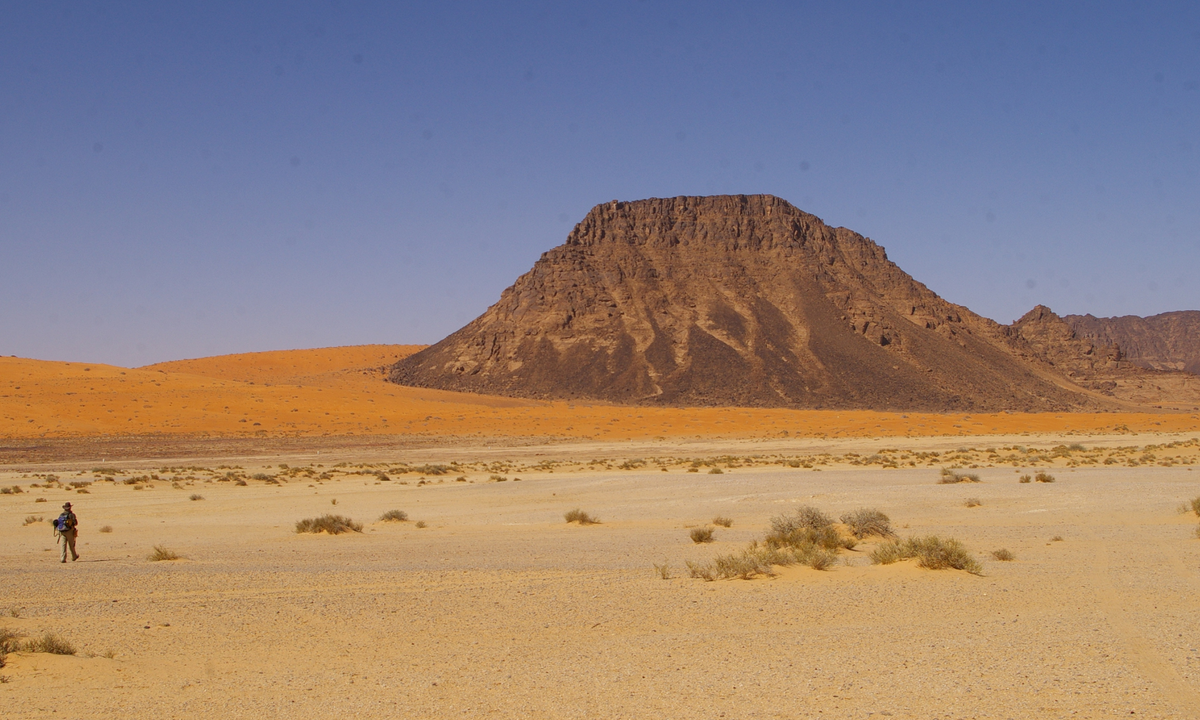
The study focused on stone tools discovered at Jebel Katefeh-1 (JKF-1), an archaeological site beside an ancient lake near the city of Jubbah, in Saudi Arabia's Nefud Desert (also spelled Nafud or An Nafūd). No Neanderthal bones have ever been found in Arabia, so researchers wondered who was making tools there.
The new study found that tools discovered at JKF-1 more closely matched those made by Neanderthals than those crafted by Homo sapiens.
Neanderthals have traditionally been viewed as a cold-adapted, primarily European species. But that picture has been changing for years, as evidence has placed them thousands of miles east in Siberia as well as in the Middle East.
Lacking bones or DNA, Groucutt and his colleagues identified the Neanderthal tools based on the unique shape of their stone flakes. The team measured hundreds of sharp pieces of tools struck from a carefully prepared stone core from JKF-1 and other sites across Arabia, the Levant and northeast Africa.
Get the world’s most fascinating discoveries delivered straight to your inbox.
Using statistical techniques, the researchers compared the flakes' shapes across time and space. Based on the differences between stone tools from other sites where the toolmakers' identities were well established, the researchers created a statistical model to help them identify whether a group of stone tools was made by Neanderthals or H. sapiens.
When they applied the model to the stone tools from JKF-1 and tools from a smaller nearby site called ALM-3, the results showed that it was far more likely that Neanderthals, not H. sapiens, had made the tools.
To pin down when those tools were made, the team dug a new trench at JFK-1 and dated grains of sand from the soil using a method called optically stimulated luminescence, which reveals how long ago those grains were last exposed to sunlight.
Specialized stone tools led researchers to conclude that Neanderthals, not modern humans, made tools in the Nefud Desert.
Previous work had dated the tools to somewhere between 90,000 and 50,000 years ago. But the new work narrowed down that range. The tools were discovered in a layer where older desert sand gave way to younger lake sediment, showing that people were at JKF-1 around 55,000 years ago, just as the desert was turning wetter.