Published: 10:58 BST, 2 September 2026 | Updated: 11:01 BST, 2 September 2026
The moon could have formed within just five hours of a colossal collision that rocked the early solar system 4.5 billion years ago, scientists suggest.
For decades, experts have believed the moon was created when a Mars–sized planet named Theia smashed into a young Earth, blasting huge amounts of molten rock into space.
This material was thought to have gradually clumped together over years to form our lunar satellite.
But a team from the Southwest Research Institute and the University of Arizona say there may be another possibility.
Using powerful computer simulations, the researchers discovered that in some scenarios, a largely intact moon emerged astonishingly quickly after the crash.
'Depending on how hot the Earth and Theia are prior to the collision, an impact can destroy Theia and produce this massive disk of debris that eventually forms the moon,' Dr Adeene Denton said.
'But when I used the same parameters as original impact modelling – down to the equal temperature structures inside both bodies – within around five hours, an intact moon emerged.'
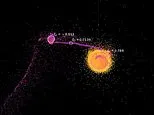
The researchers discovered that in some scenarios, a largely intact moon emerged astonishingly quickly after the crash – in as little as five hours
The team discovered that the geological properties of the colliding worlds play a crucial role in what happens after the impact.
Previous models largely treated the planets as fluid–like bodies and ignored the strength of their rocks.
When the scientists factored in the strength of planetary materials and their temperature, they found dramatically different outcomes.
Hotter planets are weaker and more easily torn apart, they said.
However cooler worlds are stronger and more likely to survive the impact in one piece.
'Models have evolved to include material strength, something that's really important when you're studying collisions between smaller bodies like asteroids or for my previous paper about the formation of the Pluto–Charon system,' Dr Denton said.