Ever since I spun up my first home server using an old laptop, I've been relying on it more and more. I've added numerous services over the months, and I've now reached the point where I depend on the server running 24/7 to keep everything accessible, but the brutal summer heat has made that increasingly difficult, prompting me to try some DIY cooling solutions.
I started noticing that my server was overheating because services like Jellyfin and Immich just refused to work on my phone. Even something as simple as opening one of the NAS folders through my PC would cause the interface to hang for several minutes. The laptop's shell would get too hot to touch, so I immediately suspected overheating was the cause, rather than something else.
This started happening more and more with each passing day as summer got progressively hotter, and I knew something had to be done to keep my server operational.
So, I dusted off a small, USB-powered evaporative cooler, pointed it toward the laptop, and set it to fan-only mode. This worked surprisingly well at keeping my DIY server cool. I didn't test the temperatures, but the laptop was never hot to the touch anymore, and my self-hosted apps worked whenever I needed them.
The only problem? The constant fan whine in the background was driving me crazy.
It's actually surprisingly loud for such a small fan, although it wasn't exactly designed with PC use in mind. My wife works in the kitchen where the server is located, and she started complaining about the constant buzzing, so I knew this solution wasn't meant to last.
My laptop-turned-server is actually a 2-in-1 model with all of its internals housed behind the display. Like most convertible laptops, its constrained design leaves even less room for effective cooling than a traditional laptop.
I couldn't upgrade the cooling system the way you could just upgrade the cooler in a desktop PC, but I realized I could simply add more heatsinks to the existing one.
That would increase the total thermal mass and surface area available to dissipate heat, massively helping with the heat-soak issue caused by running the laptop 24/7. Instead of relying entirely on the tiny built-in fan to keep up with the accumulated heat, the added aluminum could absorb and spread some of it so that it could dissipate into the air.
The screen was already broken anyway, so I decided to remove it permanently.
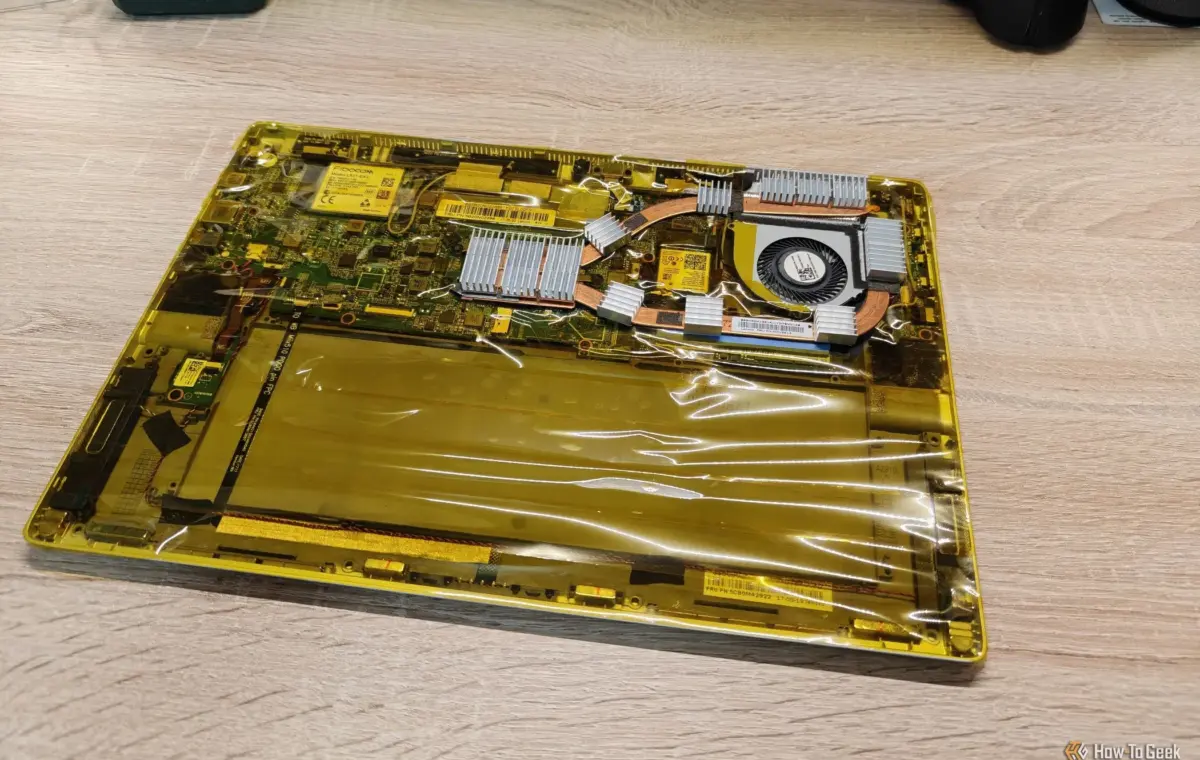
In its place, I installed 16 cheap mini aluminum heatsinks from Temu. These little heatsinks, popularly used in SBCs, have special thermally conductive double-sided adhesive on the back, allowing you to stick them to almost any heat-generating component.
The idea came to me pretty randomly, but I later realized my colleague Will had been using a similar heatsink setup to keep his desktop RAM cool, which made me a little more confident that this ridiculous idea might actually work.
I focused most of the heatsinks on the area surrounding the fan, where the tiny original heatsink was already located. I also placed a few across the copper heat pipes, particularly around the NVMe and CPU.
When I was done, I covered the entire laptop in Kapton tape, a special heat-resistant film often used in electronics. I did this mostly to keep dust out of the components that don't generate heat. It also looks very cool.
After booting the laptop up, the heatsinks were starting to get warm, which meant that my experiment was working.