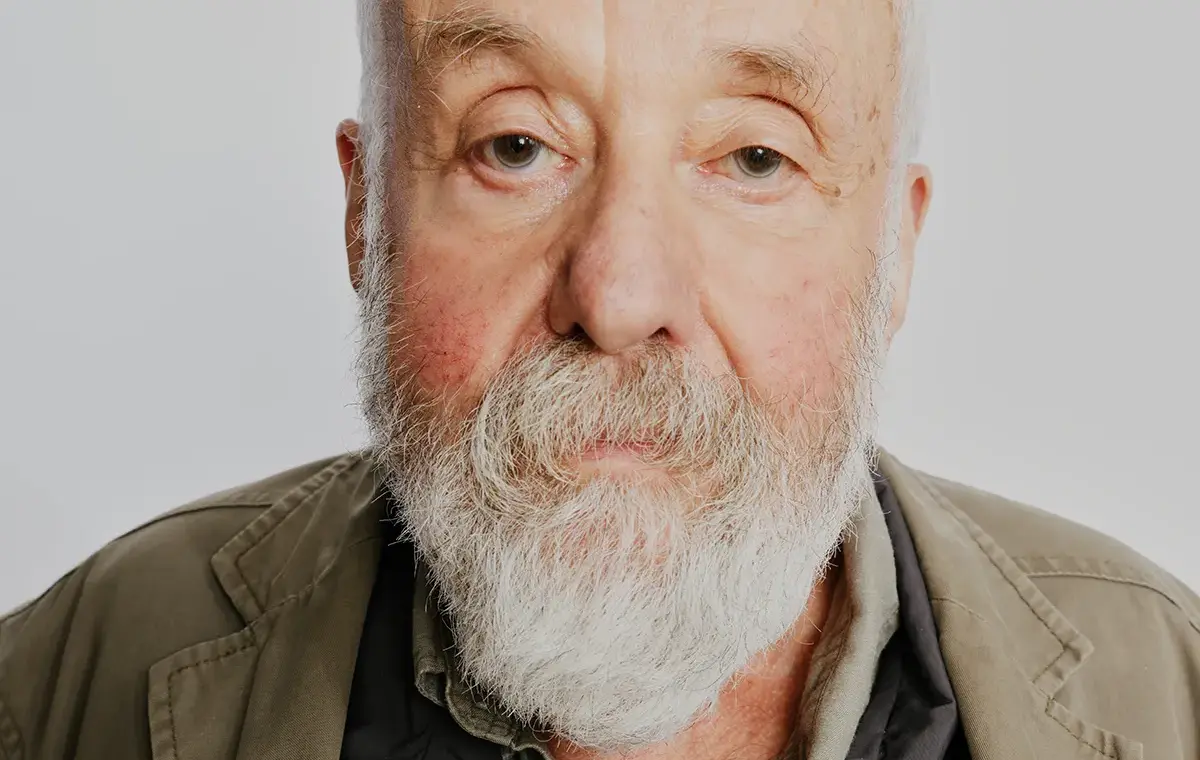
No one tells Mike Leigh what his movie is about. Not financiers, not distributors, not even Netflix, which he says could fund him “without batting an eyelid” but never has. At 83, Leigh is exactly the man he has always been: an artist with integrity. He’s telling this story to prove it.
At the Savoy Hotel in London, a year or so after the 1997 Academy Awards, Harvey Weinstein received Leigh in his room in a bathrobe, a young woman seated in the corner. Weinstein offered the director a line he has never forgotten: “I could have gotten you those Oscars.”
Leigh had come to the Savoy to talk about financing a film he had in the hopper — “Topsy-Turvy,” about the 15-month period leading up to the 1885 premiere of Gilbert and Sullivan’s comic opera “The Mikado”; he had not come to relitigate the night Miramax’s “The English Patient” won nine Oscars and Leigh’s British independent drama “Secrets & Lies,” nominated for five awards, went home empty-handed. This was back when Weinstein ruled independent film, and here he was, the most powerful man in that business, boasting that his awards machine could have delivered the statuettes. Leigh made “Topsy-Turvy” without him.
That refusal is the through line in one of the most distinctive bodies of work in modern cinema. Across more than 50 years and some 20 features, Leigh has been called the poet laureate of British working- and middle-class life. His subjects are deceptively ordinary: A lonely factory worker meets the daughter she gave up for adoption (“Secrets & Lies”); a kindly backstreet abortionist is arrested in 1950s London (“Vera Drake”); an irrepressibly cheerful schoolteacher refuses to be ground down (“Happy-Go-Lucky”). His career is built on a single nonnegotiable principle: Leigh walks into meetings with no script, no plot, no cast list — only his word — and for decades, first at the BBC and later across the independent world, someone says yes, they’ll put up the money.
Now someone has said yes one more time, and it may be the last. Bleecker Street is funding “Tender Loving Care,” Leigh’s sweet, funny study of two social workers, their family and the people they look after. It’s the lowest-budgeted feature of Leigh’s career, and, he says with some reluctance, almost certainly his final film.
On a Zoom from his home in London, he leans into the webcam. He nearly fills the frame — a shock of white beard, tortoiseshell glasses, a checked shirt under a soft gray vest, a sunlit sage green room with a wall of bright pictures behind his shoulder. He is warm, funny and still gloriously spicy: happy to curse, to needle his interviewer, to wave off a question he finds “daft.” Contending with myosotis — a muscle-wasting condition that has left him unsteady on his feet and will keep him from the film’s Telluride premiere — he is clear-eyed about the math. In terms of energy and ideas, the work “wouldn’t be a problem,” he says; the body is another matter.
“Tender Loving Care” plays like a farewell — to cinema, and to movie lovers — though Leigh insists it may not be. The film, wry and melancholy, follows Amy (Kate O’Flynn), freshly gutted by a breakup, as she moves in with her childhood best friend, Rosie (Alice Bailey Johnson), a fellow social worker estranged from her family. Around them orbit Amy’s long-married parents, Birdie (Marion Bailey) and Geoff (Paul Jesson).
There is beauty and connection in the casting. Marion Bailey — Leigh’s partner for more than two decades — plays the mother. Bailey’s daughter from another marriage, Alice Bailey Johnson, plays the best friend. They aren’t relatives on-screen, yet a real mother and daughter share the frame in a film about who holds us up when we can’t do it ourselves. At the center is O’Flynn, whom Leigh first cast in “Happy-Go-Lucky,” now an Emmy frontrunner for “Widow’s Bay” and, on the strength of this performance, a film award contender too. “He gave me pretty much my first job, in ‘Happy-Go-Lucky,’ when I was 21,” O’Flynn says. “Working with him on probably his last film, 20 years later, is special. No one works like Mike. You’re treated as an artist; you’re creating from the ground up. There’s no scaffolding. It’s terrifying-slash-liberating.”
Leigh and I spoke about the film, the finality and the half-century behind both.
I always title the films absolutely last, as late as possible. It’s about the two social workers, yes, but also the old couple, the girls, people caring for each other. “Tender Loving Care” felt so obvious, I thought, “We can’t call it that.” Everybody said, “No, call it that.” So we did.
We develop these characters through collaboration with the actors — discussion, improvisation and a long rehearsal before we shoot. These are women in their late 30s, still single, who’ve been through relationships and are still trying, who could have had kids and haven’t, committed to their work and to enjoying themselves. I wanted the tension between good-time girls and responsible women — and they’re both.
My sons are in their mid-40s, and there are people they’ve known since childhood who are part of our world. It’s that whole web of long relationships that matter.
Marion and I being partners, and Alice being her daughter, are good, but it’s neither here nor there.
A lot. Throughout the film you learn how Birdie and Geoff first met, about Amy as a wayward 14-year-old, about the woman who comes around having lost her husband. It’s always there in my films, but this one does it a great deal — because the audience needs to understand these people in more than three dimensions.
Those are two questions. I don’t do the conventional thing: think what the movie is, sit down, write it. I discover the film on the journey of making it. I start with notions, then work as people paint pictures or write novels: You embark, you get clues back and that dictates where you go next. And it’s not just me — it’s an interaction with the actors and things that happen through improvisation.