Fox News national correspondent Bryan Llenas reports from Manhattan federal court as former Venezuelan President Nicolás Maduro appears for a hearing on narco-terrorism and drug-trafficking charges. Prosecutors allege Maduro led a drug-trafficking organization for over two decades. His attorneys are expected to argue he is immune from prosecution as a head of state and that his capture by U.S. Special Forces was unlawful. The Treasury Department authorized Venezuela to fund Maduro's legal defense.
Former Venezuelan leader Nicolás Maduro and his wife Cilia Flores asked a federal judge Wednesday to dismiss the drug trafficking charges against them, arguing, among other things, that the pair have sovereign immunity, according to court documents.
"No American court has ever presided over the criminal trial of a foreign leader who was recognized by their own country as the sitting head of state at the time the charges were brought. That is not an accident of history. It reflects a rule older than the common law: heads of state are exempt from the criminal process of any national court but their own," a memorandum Maduro's lawyers filed in support of their motion to dismiss read.
"That immunity flows not from goodwill that can be withdrawn on a whim, but from the perfect equality and absolute independence of sovereigns. Thus, this Court lacks jurisdiction with respect to Mr. Maduro, who is recognized by the Bolivarian Republic of Venezuela as its head of state," the document continued.
MADURO ALLY DEPORTED TO US OVER ALLEGED BILLION-DOLLAR CORRUPTION SCHEME TIED TO OIL, FOOD PROGRAM
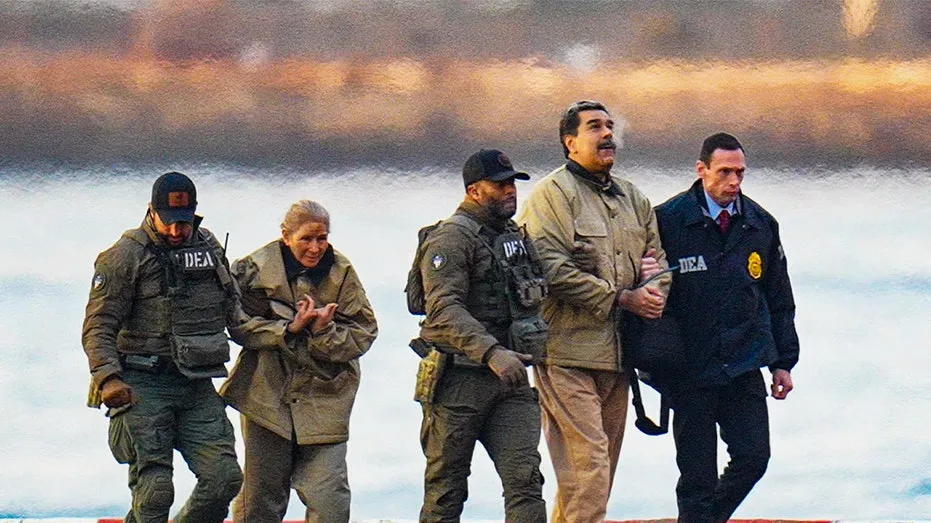
Venezuelan leader Nicolás Maduro and Cilia Flores were captured by U.S. forces in Caracas earlier this year and extradited to New York to face federal charges. (Juan Barreto/AFP via Getty Images)
In January 2026, the United States Attorney's Office for the Southern District of New York unsealed a fourth superseding indictment against Maduro and Flores. The indictment charged Maduro with narco-terrorism conspiracy, and both Flores and Maduro with cocaine importation conspiracy, possession of machine guns and destructive devices, and conspiracy to possess machine guns and destructive devices.
The indictment alleged that for decades, Maduro used his position — first as a deputy in Venezuela's National Assembly and then as the country's president — to conspire with narco-terrorists from some of the world's largest cartels to import cocaine into the United States.
Maduro's lawyers, however, claim that sovereign immunity prevents the U.S. from taking action against Maduro.
"The official character of these acts — such as issuing diplomatic passports, deploying the military, and announcing Venezuelan foreign policy — is apparent from the face of the Indictment. Because these actions were undertaken in his official capacity on behalf of a foreign sovereign, he may not be required to respond in this Court to the Indictment’s characterizations of his motives and intent in taking these actions," the document reads.
STATE DEPARTMENT ANNOUNCES 'TOTAL COMPLIANCE' FROM VENEZUELAN GOVERNMENT IN RELIEF EFFORTS AFTER MADURO ARREST
Captured Venezuelan President Nicolás Maduro is escorted to the Daniel Patrick Manhattan United States Courthouse for an initial appearance to face U.S. federal charges, including narco-terrorism, conspiracy, drug trafficking and money laundering in New York City on Jan. 5, 2026. (Adam Gray/Reuters)
The U.S. government officially declared Maduro to be an illegitimate president in 2019 after Maduro declared victory in the disputed 2018 presidential election.
Maduro's lawyers also argue that the indictment violates his and Flores' due process, according to court documents.
The document asserts that Maduro "vehemently denies that he had anything to do with drug trafficking or intended to benefit anyone engaged in terrorism."