Published: 10:12 BST, 17 August 2026 | Updated: 13:31 BST, 17 August 2026
A long-lost battlefield where Anglo-Saxon forces delivered a devastating defeat to a Viking army could finally have been found.
Researchers believe Castle Hill, a former Iron Age hillfort near Beaford in North Devon, matches ancient descriptions of the legendary Battle of Cynuit, fought in 878.
The clash came at a pivotal moment in English history, when Alfred the Great's kingdom of Wessex was on the brink of being overwhelmed by the Vikings.
More than 800 Northmen are said to have been killed in the battle, which was won by the Anglo-Saxon army, while another account puts the death toll at around 1,200.
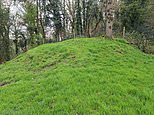
The site – which features a large mound – could also be where the ashes of notorious Viking leader Ubbe Ragnarsson were buried.
Historian Paul Harper, who has written a book detailing the findings, said: 'People have been searching for the battle site in Devon for centuries but Castle Hill has the most compelling claims and could finally solve this age-old mystery.
'It is fascinating that this infamous Viking Ubbe probably met his demise in this quiet corner of Devon.
'What is a very remote and rural part of Britain once played centre stage to a battle that had huge ramifications for the future of the island.'
A drone view of Castle Hill, which experts believe was where Anglo-Saxon forces defeated a Viking army in 878
The site appears to fit the description of the battlefield remarkably closely, with ancient earth and stone ramparts and no obvious water source within the fort itself
Mr Harper's book features research by Nick Arnold, who identified Castle Hill as the most likely location of the battle after examining historic records, maps and ancient forts across Devon and Dartmoor.
The site appears to fit descriptions written by Alfred's biographer Asser, who said the battlefield was in Devon, had no nearby water supply and was particularly vulnerable from the east.
A later chronicler, Geoffrey Gaimar, described the location as 'Penwood' – a name meaning a headland next to woods.
Castle Hill fits the description remarkably closely, with ancient earth, stone ramparts and no obvious water source within the fort itself.