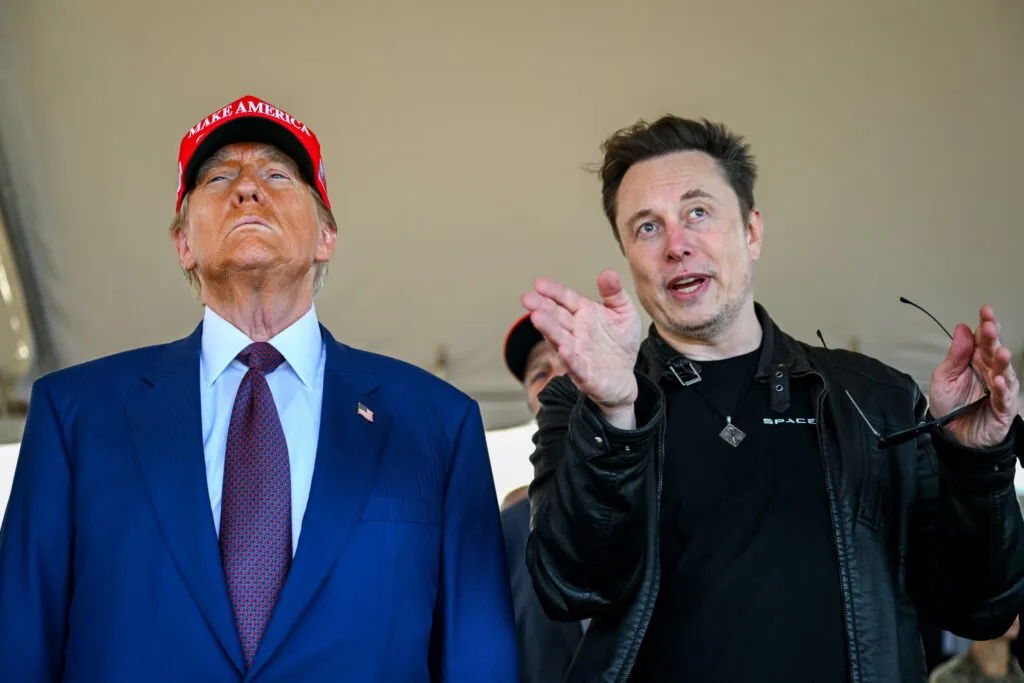
Tesla owner Elon Musk, right, was hardly alone in the tech sector in supporting the reelection efforts by Donald Trump, left. Many Silicon Valley investors and innovators were hoping for a lighter regulatory hand than they have seen under President Joe Biden. (Photo by Brandon Bell/Getty Images)
One of my most vivid memories of moving to Silicon Valley in 2007 is walking my dogs through town one Saturday morning and stopping to watch a young couple, early 30s maybe, take delivery of a brand new Lamborghini.
It felt like I'd arrived in Oz, a fantastical land where a young person could make millions at a startup or by being an early employee of Facebook or eBay or Google — companies that sold mysterious airwave connections — and where a man named Mark Zuckerberg was just one of the many young wizards with extraordinary powers.
Today, most young people can't afford to buy a starter house.
I thought of this as I watched Kentucky Senate President Robert Stivers, in a recent interview on WKYT, attempt to assuage the public's growing fear of what data centers (new to us, like Facebook was back in 2007) might bring.
"[T]hese can be economic development opportunities that have a huge financial tax base impact to the positive to a local community, if done right," Stivers said, noting that concern about utility rates is legitimate. He then said there is also a fear of water usage but that this is not really a concern, and "you don't want them placed where it ruins the fabric of the community."
Correct. We do not want data centers to ruin the fabric of our communities. An interesting choice of phrase considering what social media firms — now needing to build massive data centers for their AI products — have wrought on the social fabric of our communities.
In her 2025 book "Careless People" about her time working at Facebook, Sarah Wynn-Williams writes that she now thinks mostly about the worst of what they've done. "How Facebook is helping some of the worst people in the world do terrible things. How it's an astonishingly effective machine to turn people against each other."
Just a few days ago, Facebook's parent company Meta agreed to settle a multi-state lawsuit for $17.1 billion — yes, that's billion with 'b' — and make changes to its social platforms for children's safety. In a press release, Kentucky Attorney General Russell Coleman indicated that Kentucky will receive $358 million.
Which brings me to the data center debate. Are we to expect these same tech companies — one of which had to be sued in multiple states to protect our kids online — to tell us the truth about AI and data centers?
I don't remember when we started talking in billions vs. millions of dollars, but the word "billions" is in seemingly every story coming out of the Trump administration, and we're not even two years in.
His Iran War quagmire that is costing, by some estimates, a billion dollars a day.
The billions the president and his family have made off crypto, while most ordinary investors have lost money.
Meanwhile the powerful elite, from Washington D.C. to Silicon Valley to Senate President Stivers insist we calm down about data centers and trust them, because they're doing what is best for us and for our communities. If that's the case, the next time Stivers trains his gaze on a TV camera he should explain why he let this year's popular, bipartisan bill to restrict social media for kids, which easily passed the House, die in the Senate after Meta lobbied against the bill.
I no longer live in Silicon Valley, where I watched the 2007 ordinariness of a Lamborghini delivery. But contrary to popular GOP talking points, we did not leave California because of culture wars or politics, but because of the punishing cost of living.