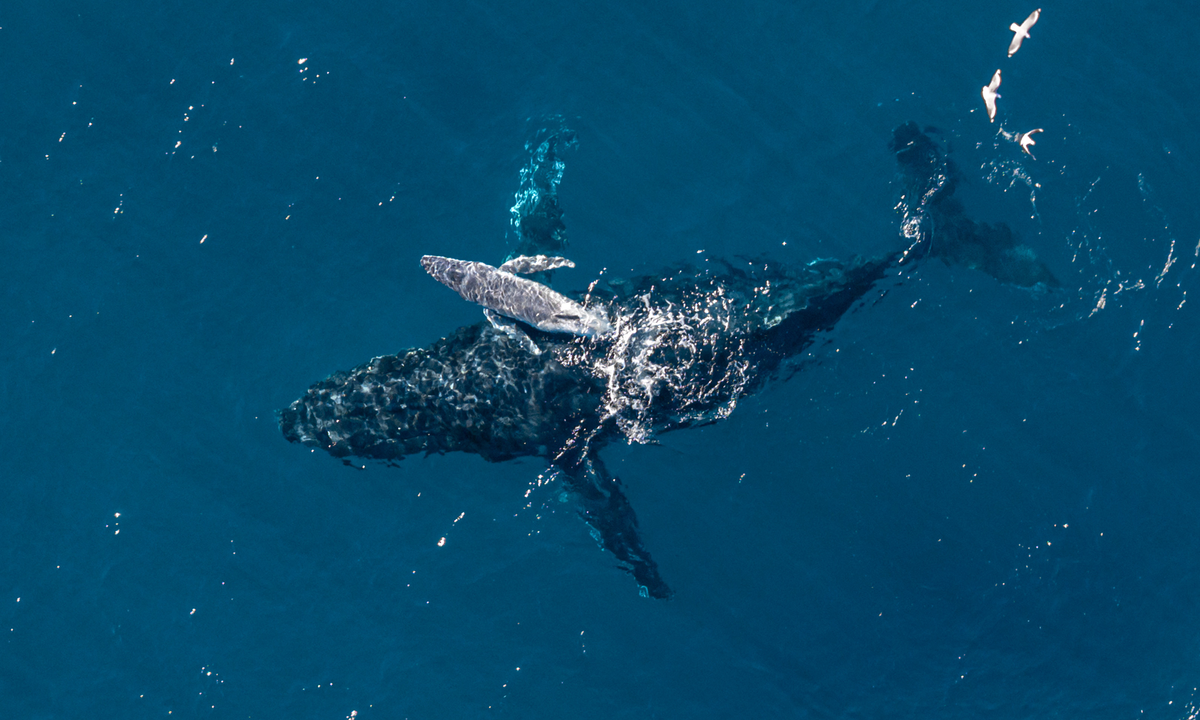
A camera drone captured extraordinarily rare footage of a humpback whale giving birth off the Australian coast.
When you purchase through links on our site, we may earn an affiliate commission. Here’s how it works.
A camera drone operator captured footage of a humpback whale giving birth off the north coast of New South Wales in what is thought to be a world first.
Alexander Forrest, a commercial drone pilot for the Organisation for the Rescue and Research of Cetaceans in Australia (ORRCA), was conducting aerial observations of migrating humpback whales (Megaptera novaeangliae) on July 28. ORRCA is a nonprofit organization focused on the rescue, conservation and welfare of marine mammals.
During the survey, Forrest noticed a whale swimming slightly behind her pod and going unusually slowly. Then, he saw her give birth.
"It's incredibly rare to see a moment like this in the ocean. It's a very rarely documented encounter," Forrest told Live Science. "It's the first drone video as far as we know of a full humpback whale live birth. It gives critical inside moments in the first moments of a calf's life, and also discovers the behaviour of a new humpback whale mother and her freshly newborn calf."
An ORRCA spokesperson said that this is only the fourth time the phenomenon of a humpback whale giving birth had been filmed, in general. Scientists also have footage of other whale births, including a gray whale (Eschrichtius robustus) birth filmed off the coast of California and a sperm whale (Physeter macrocephalus) recorded giving birth in the Caribbean.
The expectant humpback whale mother swam behind her pod, eventually giving birth by herself.
The drone video shows the newborn whale surface from blood-reddened water for its first breath. The mother then turns back to reunite with it. The scene was filmed around 0.4 miles (700 meters) from the shore at Kingscliff in northeastern New South Wales.
The birth is "a symbol of one of the strongest conservation efforts in history, returning humpback whales from near extinction to nearly 50,000 on the New South Wales coast," Forrest said. Gathering data on this humpback whale population is critical to "discovering more about where they birth, what happens when they birth, and what those early moments look like."
Get the world’s most fascinating discoveries delivered straight to your inbox.
Humpback whale calves stay with their mothers for their first 11 months.
The footage will now be analyzed so that a report on the observation can be peer-reviewed and published in a scientific journal. Notably, the mother whale was trailing behind her pod when she gave birth, a detail biologists will compare with observations of other birthing whales that were accompanied by members of their pod. For instance, the 2023 drone footage of the sperm whale giving birth showed that she had 10 adult females near her that formed a protective circle and took turns lifting the calf up so it could breathe at the water's surface.
Throughout their first weeks, calves stay close to their mothers and learn critical behaviors, such as breathing at the surface.
"Humpback whales seem to have an incredible maternal bond with their offspring," Forrest said. "There is an 11-month period where this calf will be raised and feeding on very nutrient-rich milk until it is a yearling and can fend for itself."