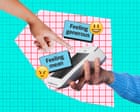
Service charges used to be a matter of choice, but now consumers feel obliged to pay them for even a cup of coffee. How do we navigate this minefield and who is really profiting?
In a London pub, Greg Double was brutally confronted with the reality of Britain’s evolving tipping culture. “I was annoyed about the pint being eight quid, but then when you put service on top, it’s absolutely criminal,” he says. In the past, you might have told the bar staff to keep the change or have a “drink” on you, but since when did we routinely tip in pubs? Or coffee shops? Or, worst of all, at self-service machines? Tip creep is happening.
Tipping was awkward enough in the UK when the general rule was 10% at a restaurant, plus anxiety about whether you should tip the hairdresser, babysitter or food-delivery driver. Now, with tipping suggested ever more frequently, US-style, it has become a minefield to Britons. The amounts edge higher – in fancier London restaurants, a 15% service charge is relatively commonplace. And it’s often asked for – in coffee shops for example, when you pay – before any service is delivered.
Tipping may be a social behaviour, but politics and economics also inform it. Since October 2024, all service charges and tips in Great Britain must go to staff, which boosts low salaries. Hospitality businesses, struggling with the rises in minimum wage and national insurance, are surely happy that it’s tipping customers who are supplementing wages, rather than themselves. As the news site London Centric pointed out recently in an article headlined “How American tipping culture came to London”, adding an “optional” service charge avoids tax, puts more money in the pockets of staff and means businesses don’t have to raise prices, which puts off customers.
But how “optional” is a service charge when the person serving us is looking expectantly as they hand over the card machine? Now, the variables around tipping seem endless and changeable, with each of us having to create our own rules.
Double, a creative director for a PR company, says that in a coffee shop without table service, he wouldn’t tip – but he might if he were sitting there, working, “to take into account that I’m going to make this coffee last”. He wouldn’t tip if he’d walked up to a bar and bought a drink for himself, but he might acquiesce if he bought a round. Since drinking Guinness became fashionable, it almost calls out for a tip. “Because you’re like: well, you’ve had to wait around for five minutes for every pint being poured,” says Double. “If you order four pints of Guinness, you immediately see the bar staff think: ‘Oh, for god’s sake.’”
Double also highlights a new tipping anxiety. Sometimes a bar worker will press zero on the tip screen before handing you the payment machine, “if they don’t think they’re worthy. There’s even that Britishness of the bar staff.” But what if they don’t? “It almost makes me think that if they’ve not pressed ‘no’ to the tip, that means they think they deserve one.”
Many of those I speak to think tech has pushed this change forward – and rapidly. The shift away from cash towards card and digital payments is usually framed as removing “friction”, says Prof John Vines, the chair of design informatics at the University of Edinburgh’s School of Informatics. “It’s about being more convenient. This is all a trend towards making it easier for us to spend our money.” The software in point-of-sale terminals prompts the customer for a tip. “These systems are presented as a way of making giving a tip easier. We don’t have to think about it too much, we don’t have to fiddle with coins and notes. But, really, it’s about encouraging us to spend more.”
Faced with three options on a screen, with the third perhaps an outrageous 35% tip, I often panic and go for the middle box. I wouldn’t want to seem cheap by going for the first option, but I end up feeling bullied into giving a generous 20% or more.
“Again, that’s presenting those options to you partly to reduce that friction – it’s taking away the need for you to mathematically calculate things. But, of course, it’s a way of controlling the options as well,” says Vines. “While we have the ability to press zero, the act of getting asked at the point of sale likely increases the chances of someone giving something, especially in situations where, at least in the UK, we culturally don’t expect a tip to be given in the first place.”
Is it too cynical to suggest that tech companies who run the software, and who take a cut of every transaction, are making more money from pushing tips? “That probably is a bit cynical, but also probably true,” says Vines, with a laugh.
It goes deeper than tech companies skimming a percentage. “A lot of our technological infrastructure is dependent on platforms and systems that come from the US and, in particular, California,” says Vines. “We tend to import a lot of the values and customs that are embedded with them. Even if it’s not intended, they get inscribed into these systems and flatten out the diversity of other cultures, the things that would be acceptable or normal elsewhere.” The example of tipping, while small, he says, “actually is an example of how [US tech companies] that get imported actually have quite significant long-term consequences, because it rewrites social expectations.”
It’s embarrassing, says Peter, who works in a pub in Lincolnshire, to ask customers for tips. A few months ago, they got new card machines that automatically suggest adding one. Peter always presses no before he hands it over to customers. “It can rub people up the wrong way,” he says. The pub’s manager occasionally asks people if they want to add a gratuity, “but even he doesn’t do it very often. It just feels pointless to us. You only tip someone if they’ve looked after you, you’ve been sat down and it’s been good service. You don’t tip someone for just pouring you a pint.”
Tipping culture was also changed by the pandemic, even in the tip-heavy US. “During Covid, we started tipping people that we didn’t traditionally tip,” says Michael Lynn, an emeritus professor of consumer behaviour and marketing at Cornell University and the author of The Psychology of Tipping. It was akin to “hazard pay”, he says, plus there was a perception that some people were more likely to be struggling financially. “People started being willing to tip and businesses took that as a message that consumers will bear it.”
The accepted level has always increased over time, says Lynn. This could be due to any number of factors. “The population of the US is more urban than it used to be and urban people tend to tip more than rural people,” he says. Then there’s the move away from cash. “People who pay with a card or digitally tend to tip more than people who pay with cash.” And big tippers – who do it for reasons of status, or to ensure good future service – ruin it for the rest of us. “It creates this upward pressure,” says Lynn. “It’s got to stop somewhere, right? We’re at close to 20% today [in US restaurants].”