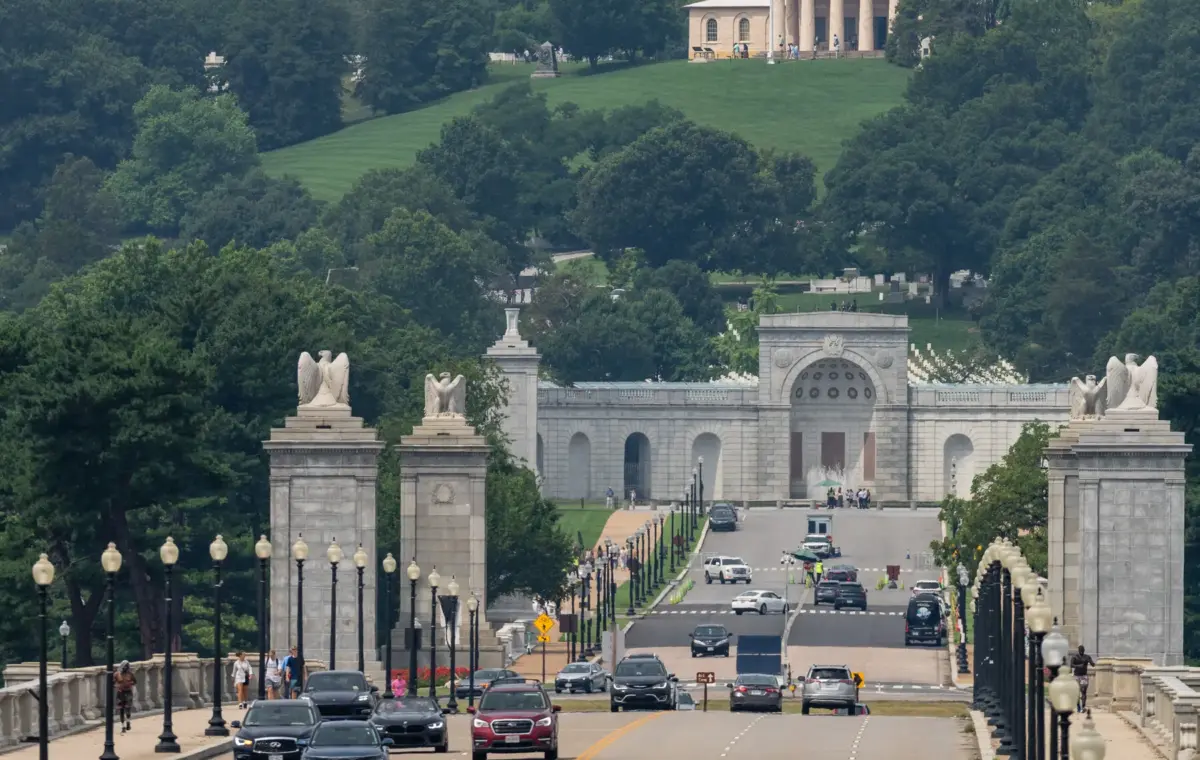
The Justice Department told a court the government would only conduct archaeological excavation, a day after a Trump official announced the project was in motion.
The Trump administration told a federal judge that it was not preparing to start construction on the president’s planned triumphal arch in Washington, a day after Interior Secretary Doug Burgum announced that excavation work for the project would begin within the next two weeks.
The work the government plans to do, the Department of Justice said in a court filing on Friday, consists of archaeological excavation of the site necessary for the required historic review of the project. And it stated, despite President Trump’s frequent promotion of the project, that no final decision had been made to begin building the arch, which would stand near Arlington National Cemetery.
That starkly different message follows a pattern across other cases in which the administration has made one pronouncement in public and another in court.
Responding to the conflicting messages, Judge Tanya S. Chutkan of the U.S. District Court for the District of Columbia ordered the administration late Friday night to give her at least 48 hours’ notice if it proceeds with anything other than the limited archaeological work. And she reminded the administration that it is under an existing order to give the court 14 days notice before beginning construction on the arch.
The flurry of filings on Friday followed Mr. Burgum’s surprise announcement that excavation work for the arch would begin, even before it receives final approvals.
“We are pleased to announce that after a very long wait (over 125 years!), we are preparing to start, over the next two-week period, the excavation work necessary for the Great Triumphal Arch,” Mr. Burgum wrote on social media.
The Department of Justice put things differently, after a group of veterans suing to block the arch sought a temporary restraining order on Friday. “This activity is not construction, or demolition in preparation for construction, of an arch,” the department said.
Judge Chutkan appeared to tread a middle path, allowing the limited work the government said in court it was pursuing, while warning it against going any further at this point.
The White House did not respond to a request for comment on Saturday morning.
Organizations suing the administration over its construction projects — and in some instances, the judges overseeing those cases — have struggled with how to reconcile the administration’s public pronouncements and seeming construction activity with its more restrained statements in court. Preservation groups have also been leery of taking the government’s word given that the president said last year that his ballroom project would not affect the existing White House, only to demolish the East Wing with no public notice.
In other cases, the president has claimed vandals damaged the Lincoln Memorial Reflecting Pool, even as federal prosecutors ultimately said in court that the damage was caused by botched renovation work.
In court on Thursday, government lawyers said that about 150 trees that have been removed from East Potomac Park were unrelated to the president’s plans to replace the existing public golf course there with a luxury course suitable for professional events.
Emily Badger writes about cities and urban policy for The Times from Washington. She’s particularly interested in housing, transportation and inequality — and how they’re all connected.