Find this story in your account’s ‘Saved for Later’ section.
This article was first featured in Stage Whisperer, Vulture’s weekly newsletter for theater news, gossip, interviews, and more. Sign up here.
When news first dropped that a Broadway festival would be coming to the Catskills and that it would feature a reunion of the original cast of Rent and a concert starring my (everyone’s?) favorite star, Audra McDonald, it took me approximately nine seconds to come to the conclusion that I wanted to be there. Here, like magic, was an event that merged my two normally conflicting summer desires: getting out of the city and experiencing the unmatched mood boost that musical theater provides. With unnatural speed, I acquired the press passes, booked lodging, and convinced my husband (who is the only capable driver in our family) to drop off me and our somewhat reluctant 12-year-old son at a place called Hutton Brickyards, which my quick searching told me was a rustic wedding venue in Ulster County.
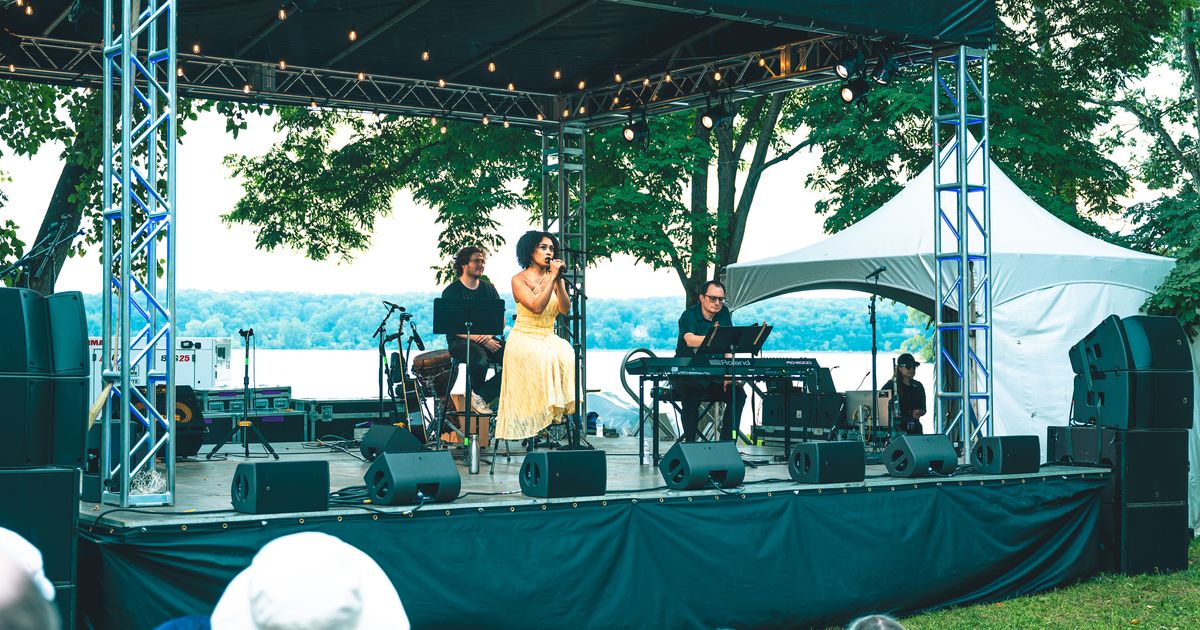
It was only after I got through security, moseyed past the step-and-repeat, and wandered down the hill toward the river and the festival’s main stage that a question I, a seasoned journalist, would normally ask before I arrived in the middle of nowhere with an ornery tween popped into my brain: Who exactly is running this thing?
The answer, it turned out, was a pair of Broadway-obsessed friends: Joshua Saltman and David Schwartz, whom I interviewed on Tuesday morning, after they had a day to decompress and process a weekend that, they said, “exceeded every expectation.” They are both lawyers who worked together for years at the Walt Disney Company, but surprisingly, given what they pulled off, neither is particularly connected to the Broadway world. The idea originated with Saltman. “I’ve always been a Broadway guy, and when I moved from New York to Los Angeles 18 years ago, I became a music-festival guy,” he told me. “I started going to Coachella. And as I got older, and Coachella got a little younger, I started joking with friends, like, ‘What if we did something like this with a genre that is more relevant to us — meaning Broadway.”
Saltman made a pitch deck for Disney, but it didn’t bite. Still, Saltman couldn’t get the dream out of his head. Then, about 15 months ago, after a voyage on the Broadway cruise, he had what he calls a “revelation”: Unlike music festivals — which typically draw 20,000 to 100,000 people — his Broadway festival could serve just two or three thousand fans. The smaller scale would allow him to produce it without the backing of a larger company. He reached out to Schwartz, who had recently started producing a musical on the side, to ask him to be his partner, and Schwartz loved the idea. The next day, Saltman rented a car and drove up into the Catskills to look for a venue.
Though Schwartz had a few theater connections through his producing work, Saltman had only one: Adam Pascal. In what can only be described as a business-meet-cute fit for a musical comedy, the two met on the Broadway cruise. Saltman was there on vacation with his wife; Pascal was one of the performers. The two got to talking, and Pascal decided to join the organizing team and produce a 30th-anniversary Rent-reunion concert.
From there, it — a three-day musical-theater bonanza with sort of wacky tiered pricing, school-bus shuttles, and Broadway divas and powerhouses casually mingling among the plebes — all came together surprisingly fast. Saltman and Schwartz hired the directors (D.B. Bonds took the lead, with a goal to meld the worlds of rock and roll, pop, and musical theater with a connecting Sondheim motif, and Jerry Mitchell consulted), the music supervisor (Dan Lipton, who played more piano than seemed humanly possible), and a host of other key roles.
Still, despite all their booking and logistical planning, there was a palpable uncertainty as to whether they could really pull this off — until they got word that Audra McDonald had signed on. “That was the pivotal moment,” Saltman said. “Audra is Audra, and we knew that if we could make that happen, it would provide comfort to everybody else that this festival was going to be real, and they could join as talent too.”
As the months wore on, everyone’s formal job titles started to lose their meaning, Bonds told me. “What ended up happening is, a lot of people probably wore more hats than they needed to wear, but at a certain point, I just sort of said, ‘We’re pushing this thing across the finish line, and we’re not failing.’” On Sunday, Bonds was on one of the smaller stages singing a duet. Minutes later, he was sprinting across the campus to introduce Andrew Barth Feldman, who was appearing in a solo show on another small stage. As he ran in the blistering heat, he told me a passerby called out to him: “Hey, you’re the boss. Don’t they have a golf cart for you? And I was like, ‘No, they don’t.’”
Though the Festival has been billed as the Coachella of Broadway, it felt, to me, between the sweat and the attire, more like being at summer camp. There were arts and crafts projects from Etsy vendors (a memorable standout was a set of sheet music from every show that Jeremy Jordan has starred in, with a handpainted portrait of the actor in costume overlaid on top), a long line for what I thought of as “canteen” (starring gourmet soft serve), spotty Wi-Fi, and almost no cell-phone service. Plus, just as at sleepaway camp, where your bunk counselor might teach instructional swim in the morning, lead a cheer in the afternoon, and perform in the talent show in the evening, the Festival’s “counselors” — Kelli O’Hara, Renée Elise Goldsberry, Norbert Leo Butz, Solea Pfeiffer, Seth Rudetsky, to name a few — seemed game to do anything that was asked of them. (Bonds later told me that one star who had signed on to perform in multiple concerts became ill at the festival, and so there was a fair amount of chaotic, last-minute reshuffling and improvising.)
To wit, on Saturday, I watched O’Hara perform no less than five separate times. In fact, she came onstage so frequently that by the evening’s “big show” — the most highly produced event of the day — the adrenaline rush that has, in the past, always accompanied her entrances for me almost completely dissipated. In its place was a warm, familial feeling, as if I was now watching an old friend or my distant cousin.
In fact, over the course of my two days at the Festival, the lines between fans and performers, strangers and colleagues, almost fully blurred, as the vocalists from one show sat in the audience at the next, and as the audience routinely joined the performers in song. Jason Robert Brown had his daughter, Molly Brown, as one of his backup singers; O’Hara sang Joni Mitchell with her daughter late at Saturday evening’s campfire. When my friend (who subbed in for my tapped-out son on day two) and I found ourselves ecstatically screaming as Audra McDonald brought out Brian Stokes Mitchell (“Well, he’s here …” she teased) to sing “Wheels of a Dream” at Sunday’s final concert, the lovely older woman sitting next to us screamed too and squeezed my friend’s arm in glee. It turned out she was D.B. Bonds’s mom.
With three separate stages and an unavoidable need to wait on line for food, each day was full of difficult choices. Bonds told me this was intentional — it not only created a feeling of abundance, but it also enabled every festivalgoer to have a singular experience, akin to attending Sleep No More. On my own journey, highlights included the aforementioned performance of “Wheels of a Dream” (I, like McDonald and Mitchell, “went to the cosmos”); a Jimmy Awards–style medley by a group of mind-blowingly talented college students, including a standout named Jeffery Walker III who, as Schwartz put it, could “star in Hamilton tomorrow”; Andrew Barth Feldman singing from Dear Evan Hansen for the first time since he was 17; Norbert Leo Butz performing as Jamie Wellerstein for the first time in more than 20 years; and just about every moment of the Rent reunion, which wrapped the audience in a warm blanket of nostalgia, love, and joy — even if Taye Diggs seemingly had not prepared at all. When that particular set ended on “Seasons of Love” and I looked around, more people than not in my vicinity were crying.
No festival is perfect — and a first-time event of this scale was bound to have some kinks. When I got back to the city, I debriefed about the weekend with two friends who had not been comped and had general-admission tickets. For them, the biggest issue was the tiered pricing, which gave attendees like me reserved seats at the main stage that were protected from sun and rain but left them to stand or sit in the elements with an obstructed view. One told me she had overheated so much at a midday concert that it left her uncomfortable for hours afterward. But even these critiques were tinged with love and affection for what they had experienced, and the hope that it would all be fixed when they inevitably returned next year. (At the final concert, Saltman and Schwartz made a last-minute decision to announce a 2027 festival because, Saltman said, the “vibes” required it.)