Faster, smoother, better… and way pricier
When you purchase through links on our site, we may earn an affiliate commission. Here’s how it works.
It has been a few months since Intel rolled out XeSS 3 with its Multi-Frame Generation to any Arc-supported device. With the unveiling of dedicated handheld gaming PCs using the tech, such as the MSI Claw 8 EX AI+, Acer Predator Atlas 8, and OneXPlayer 3, hardware manufacturers are finally cashing in on the promised performance capabilities that were previously only dreamt about: no-compromise playable framerates and high-resolution PC gaming in your pocket.
Multi-Frame Generation and AI-powered upscaling technology like Nvidia DLSS and AMD FSR have become essential for PC gaming in 2026. Even the best graphics cards on the market need a boost from a hand-tuned algorithm that interlaces generated frames with purely rasterized ones. In short, that means a higher-than-native framerate with a (hopefully) minimal impact on image fidelity.
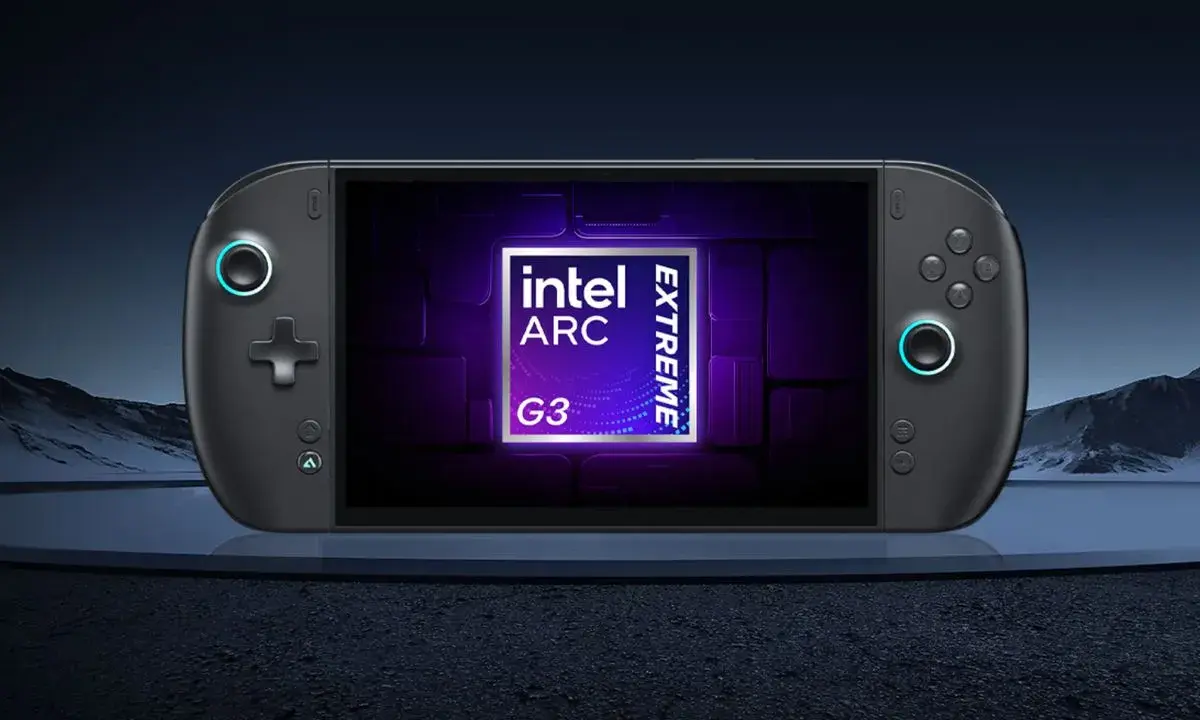
Intel XeSS 3 is Team Blue's latest version of the tech, and its USP for how it works with Arc graphics isn't relegated to the best gaming PCs or the best gaming laptops. Now, as the Intel Arc G3 lineup makes its way to new handhelds, MFG becomes a reality for the form factor. Finally, Full HD (1080p) at playable framerates on a small, portable, handheld gaming device. However, it's not all good news; it comes at a cost, and it could bury the appeal of these devices completely.
The core of the Intel Arc G3 Extreme chips, and the rest of the lineup, can best be summarized in four core pillars: Performance, Integration, Efficiency, and Software.
It's the third generation of the purpose-built SoCs from Team Blue, primarily built for handheld devices. Intel promises AI-based upscaling, MFG, DirectX 12 Ultimate support, and full ray tracing at a low wattage with high performance capabilities. It's claimed that the company's partner devices, such as the aforementioned MSI Claw 8 EX AI+ and Acer Predator Atlas 8, can expect up to 11 hours of gameplay, while being "up to 42% faster than the competition on average".
It's early days for Intel's partner devices, which are yet to properly hit the market; however, the company's internal benchmarks give us a rough idea of how much more capable the G3 Extreme is at 35W when weighed up against the previous-generation Arc graphics found in the Intel Core Ultra 7 258V at 30W. In 1080p in High settings, there's a clear performance gap of anywhere from 18% to 47% when directly compared generation-on-generation.
Intel claims the G3 Extreme is up to 44% faster on average, and this performance gap is most evident when looking at how the newer SoC handles demanding games. The Ultra 7 258V can't quite hit a stable, playable 30 FPS in the likes of Crimson Desert or Assassin's Creed Shadows here, but you can expect a respective 34 FPS and 35 FPS average from the G3 Extreme. Crossing that all-important 1080p at 60 FPS mark is also now possible, particularly in intensive software such as Battlefield 6, Pragmata, Baldur's Gate 3, and Dying Light: The Beast, just to name a few examples.
Sign up for breaking news, reviews, opinion, top tech deals, and more.
The numbers are similar when comparing the MSI Claw 8 EX AI+ with the Intel Arc G3 Extreme at 35W versus the Asus ROG Xbox Ally X with the AMD Z2 Extreme chip as well. There's a similar 42% performance improvement on average in 1080p in High settings with upscaling enabled by default.
In fact, in some cases, the Intel Arc G3 Extreme nearly doubles the performance potential of the previous fastest chip in a handheld gaming PC to date. This is particularly noticeable with Death Stranding 2: On the Beach and Arc Raiders; Team Blue's SoC achieved average framerates of 56 and 100 in those games (respectively), whereas Team Red's silicon lagged behind with 37 and 67. The Z2 still produces playable figures, at least as much as a stable 30 FPS and above can accommodate from a handheld; however, it's a night-and-day difference with the Xe3 cores here.
XeSS 3 as a package incorporates Super Resolution (AI upscaling) as well as MFG and low-latency responsiveness. The revised silicon has meant that Team Blue has been able to facilitate not only playable framerates at 35W, but also 17W and 12W as well, with some concessions, as you would expect. For transparency, the maximum wattage means it has to be plugged into mains power or be receiving power delivery through USB-C PD, etc.
On battery, the Intel Core G3 Extreme is still 24% faster than the Intel Core Ultra 7 258V at 17W, meaning 1080p at High settings, making 30 FPS and above possible from many of the aforementioned demanding games. It also means 1080p at 60 FPS and beyond for many titles, such as Resident Evil Requiem and Diablo 4, which are pretty intense for their respective genres as well.
Playability at 12W has been a challenge for even the best gaming handhelds, especially when trying to balance the longest battery life and settling for a dimmer display just to get a long play session in. This is where the MSI Claw 8 EX AI+ with the Intel Arc G3 Extreme demonstrates the power efficiency of Team Blue's new chip; 1080p in Low settings on a display that small is a necessary compromise, but it means 30 FPS in the likes of Battlefield 6, Clair Obscur Expedition 33, and Dying Light: The Beast, which wasn't previously possible from AMD's Z2 chip, while also managing 60 FPS+ averages in older games, such as Shadow of the Tomb Raider, F1 25, and Grand Theft Auto V.