Get our award-winning daily news email featuring exclusive stories, opinion and expert analysis
I would like to be emailed about offers, event and updates from Evening Standard. Read our privacy notice.
London has quietly become Europe’s largest data centre market.
The capital houses 247 data centres with at least 26 major developments in the pipeline, according to Greater London Authority (GLA) data.
Yet behind the capital’s digital infrastructure dominance lies a battle for the supply of the land, water, and electricity needed to tackle London’s housing crisis.
The giant server houses have attracted criticism over high energy and water use, noise pollution and letting off harmful fumes, but few understand what the data centre boom means for the capital.
In fact, few truly know what data centres do. Yet many know why they don’t want one in their backyard.
Housing Secretary Angela Rayner has waved through several data centre developments, including sprawling campuses in Abbot’s Langley and Buckinghamshire, but critics say her embrace of Britain’s digital revolution is taking its toll on housing.
According to research by the GLA, parts of the capital’s grid in Hillingdon, Hounslow, and Ealing have already reached full capacity, halting new housing developments. The power demand of energy-intensive sectors, like the data centre industry, could see demand rocket by more than 600% by 2050, placing strain on the grid.
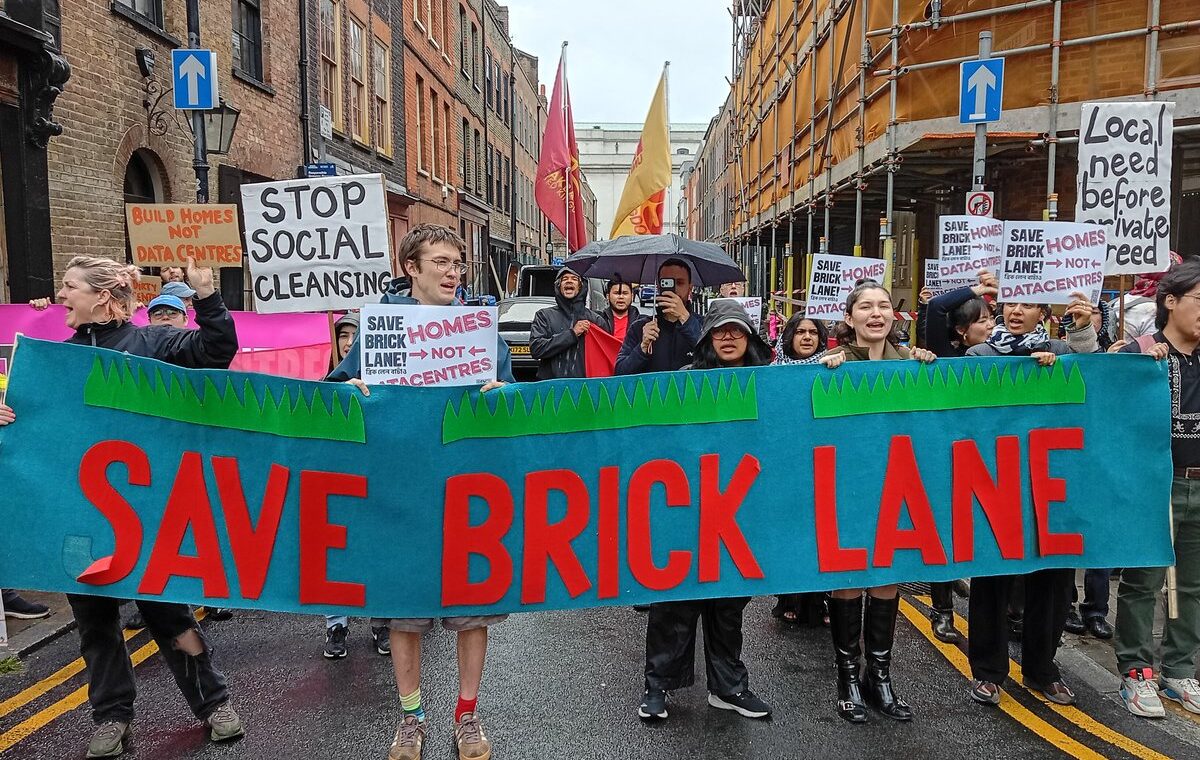
Tensions have reached breaking point in Tower Hamlets when Andy Burnham’s government gave the green light for the Truman Brewery data centre project. There are some 28,000 families on the council waiting list for social housing, so news of another data centre on a site which could have accommodated 350 homes has sparked pushback.
“It’s a lost opportunity for a serious amount of housing,” says local campaigner Jonathan Moberly, member of the Save Brick Lane campaign. “You could activate the street by bringing housing into it, or kill it off for good by putting a data center there.”
According to campaigners, the proposed 5.2MW facility, likely to be operated by US giant Digital Realty, will suck up enough electricity to power 15,000 homes.
City traders based just minutes away will have access to ultra fast internet for high frequency trading.
However, local residents won’t benefit from that – although the project, put forward by property owners Truman Estates and Zeloof LLP, is also delivering offices, a supermarket, a cinema and a number of homes.
Lorde hails ‘best line-up I’ve ever been part of’ at All Points East