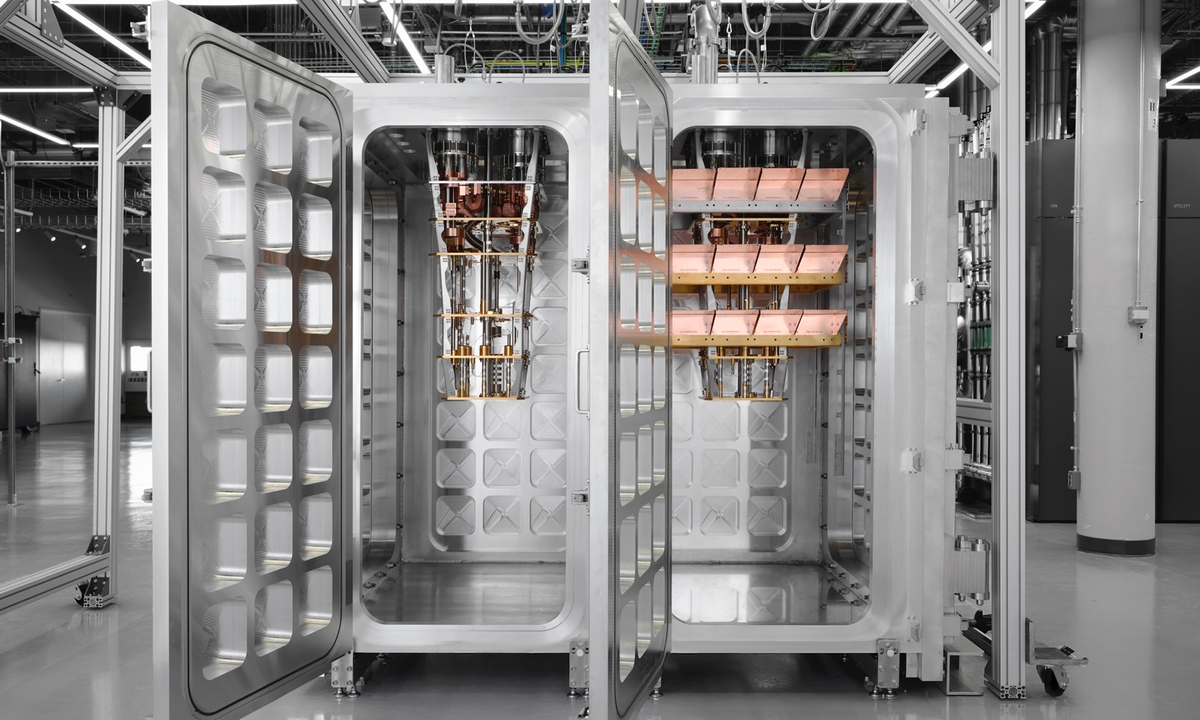
IBM's new modular cryogenic system links quantum chips to overcome major infrastructure hurdles and pave the way for a powerful system by 2029.
When you purchase through links on our site, we may earn an affiliate commission. Here’s how it works.
IBM has revealed a new modular, ultracold system designed to link hundreds of quantum computer chips together to solve one of the field's biggest infrastructure bottlenecks.
The company says its new "quantum fridges" will let it deliver the world's first fault-tolerant quantum computer in 2029. These stable systems use quantum error correction techniques to fix noise in real time and run quantum operations without interruption.
Achieving fault tolerance would allow computer scientists to carry out new research across a wide array of fields. Whether in chemistry, materials science or theoretical physics, researchers could conduct quantum operations well beyond the scope of modern supercomputers, without worrying about excessive errors rendering computations worthless.
Until now, one of the biggest hurdles standing between today's error-prone systems and fault-tolerant superconducting quantum computers capable of performing a hundred million operations flawlessly has been the infrastructure. IBM representatives say they have solved this problem with its modular, interconnected quantum fridges.
The new cryogenic system comprises individual units measuring 8 feet (2.4 m) tall by 8 feet wide, with an internal capacity of about 9 cubic feet (0.25 cubic m).
It looks like a household refrigerator and works similarly, but it can reach temperatures as low as 10 millikelvins (minus 459.65 degrees Fahrenheit, or minus 273.14 degrees Celsius) — close to absolute zero, the coldest theoretical temperature possible — which is more than 180 times colder than deep space.
These extremely low temperatures are necessary for IBM's superconducting quantum processing units (QPUs) to operate properly, and the modular design allows engineers to expand a system's capabilities and power one stage at a time.
Get the world’s most fascinating discoveries delivered straight to your inbox.
According to IBM representatives, this milestone represents the first time that scientists have demonstrated interconnectivity among QPUs between separate cryogenic modules.
Just like their classical computing counterparts, superconducting quantum computers use built-in circuits, or "gates," to conduct processing operations. Engineers can squeeze a finite number of qubits per chip, however, and each chip needs to be cooled to below 15 mK (minus 459.64 F, or minus 273.14 C) to function properly in IBM's architecture.
That's because qubits are inherently noisy — meaning they are naturally far more error-prone than conventional computing components. To tap into the quantum mechanical properties of the superconducting metals in the qubits without calculations failing, scientists must minimize interference from heat alongside other stimuli, like electromagnetic waves.
To achieve these temperatures in the new refrigerators, engineers use third-party cryogenic hardware that relies on helium cryo compressors paired with commercial dilution refrigeration engines for cooling. They maintain thermal protection using vacuum-sealed enclosures, electromagnetic interference gaskets, and multilayered Mylar super-insulation heat shields.
It takes more than four days for the modules to reach a temperature of about 4 K (minus 452.47 F, or minus 269.15 C), with the final push to sub-15-mK temperatures occurring shortly thereafter, IBM representatives said in a statement.