It ran its jobs 200 times as fast as any other computer on Earth
At the height of the Cold War, one very specialized computer was so secret that the world didn’t know it existed. It ran its jobs up to 200 times as fast as any other computer of its time. It was the U.S. National Security Agency’s main cryptographic processor in operation from the time of the Cuban Missile Crisis in 1962 through the Vietnam War and on past the 1975 Helsinki Accords. The machine stopped running only when its moving parts finally gave out.
The Harvest computer mattered because of what it was as well as when it ran. For 14 years, it was the engine processing the NSA’s most sensitive intercepts at a time when signals intelligence was as close to a strategic weapon as anything short of a warhead.
Designed and built by IBM for the NSA, Harvest was one of the first machines designed to apply operations to enormous datasets rushing past, a precursor to the computers today that manage continuous video streams and security systems in real time. It was also one of the first machines built as an add-on—a specialized helper intended to do one job exceptionally well, bolted onto a general computer. Harvest’s modular design is like a 1960s version of today’s graphics chips that CPUs use to run intensive video-game and AI processing loads.
All that raw processing power meant that Harvest also needed nonstop rivers of data to run on. And that led to another pioneering achievement: the world’s first automated tape library that could robotically fetch any one of hundreds of large cassettes of magnetic tape from the machine’s racks.
Given Harvest’s unprecedented processing and storage capacity, the machine’s designers naturally needed to rethink how their system handled information. So IBM wrote a customized programming language called Alpha to let code breakers rigorously describe cryptographic problems, just as scientists at the time were using the emerging language Fortran to describe equations and data-processing algorithms.
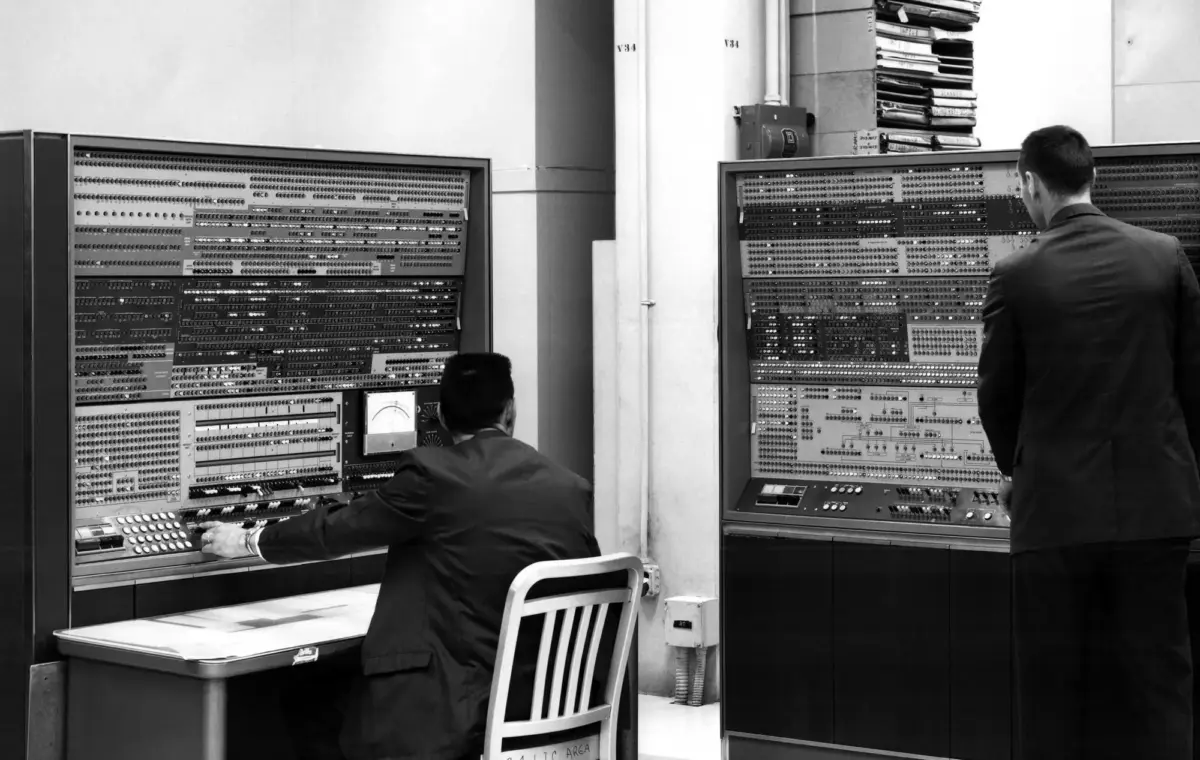
In Fort Meade, Md., an NSA data center hosted one of the world’s fastest computers of its time—although not often discussed, because of its sensitive, high-security code breaking and cipher hunting work. National Cryptologic Museum
The story of Harvest, pieced together from declassified documents and contemporary manuals and technical overviews, provides a new and unexpected vista on the history of computing. It also offers a case study in how national security needs, especially during the Cold War, pushed computer technology beyond the far reaches of what unclassified, civilian computing could achieve. Harvest’s distinctive history reveals a visionary algorithmic, coding, memory, and hardware architecture occasionally decades ahead of its time. But this machine was also built only once, for one singular purpose, and then ultimately quietly retired.
IBM’s landmark 1960 transistorized mainframe, the IBM 7030, better known as Stretch, provided the front end for Harvest (which was officially known as the IBM 7950). IBM delivered Stretch to eight or nine customers, mostly scientific research labs, from 1961 through ’63. Designed and prototyped throughout the second half of the 1950s, Stretch introduced the now standard notion of an 8-bit byte. For its first three years of operation, Stretch was the non-classified world’s fastest computer, although it failed to meet IBM’s aggressive goal of running 100 times as fast as Stretch’s predecessor, the IBM 704. While IBM engineers in Poughkeepsie, N.Y., were designing and building Stretch, the company was also quietly discussing a new system that would be built for NSA.
At the time, NSA’s existing cryptanalytic computers—large, batch-processing machines that required human operators to manually stage each tape run—were struggling to keep pace with the sheer volume of intercepted message traffic coming in from around the globe. What the agency needed was a machine that could process an unbroken river of incoming data, automatically, around the clock. That requirement alone profoundly shaped Harvest’s design.
IBM’s Harvest system, custom-built for the NSA for code breaking, paired the IBM 7030 Stretch mainframe with a bespoke data-stream processor. Stretch handled ordinary computing and input/output, including the Tractor automated tape library. Both units shared two kinds of memory: a large main bank and a smaller, faster bank. When Stretch switched to streaming mode, Harvest drew two streams of data, P and Q, from memory, processed them in parallel, and returned the results as a third stream, called R. Chris Philpot
After two failed proposals to NSA, in 1958 IBM finally landed the contract: a Stretch-based machine, augmented by a custom coprocessor, with a revolutionary tape-based storage system, called Tractor.
Stretch’s forte was floating-point math for scientific computations. IBM had designed it primarily for labs working on frontier research like nuclear weapons design and weather prediction. By contrast, the custom coprocessor to be built atop Stretch would help NSA analysts sift through alphanumeric characters—that is, essentially integer data.
Harvest’s coprocessor was the opposite of a general-purpose system. It was, rather, a streaming computer. Instead of executing long series of instructions, it followed one fixed sequence of steps and applied that same sequence to every pair of characters as they streamed past. Harvest shared memory with the main Stretch processor and ran in bursts. Either Stretch was operating, or else it suspended itself while Harvest’s coprocessor shot through data in memory at extreme speeds.
Stretch and Harvest were among the first large computers built entirely from transistors packaged in circuit cards and housed in large, refrigerator-size frames. A 1962 technical manual about Stretch describes the machine’s CPU as divided into functional sections—the instruction unit, the look-ahead unit, the (parallel and serial) arithmetic unit, and the memory bus unit. Harvest inherited Stretch’s basic circuit design but then added something unconventional: Its streaming units processed data in overlapping stages called a pipeline. So while one pair of data bytes was being compared, the next pair was being fetched from memory.