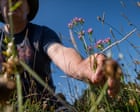
Farmer Derek Sayer let a boggy field run wild and just one annual hay-cut has led to remarkable biodiversity
Tucked away on a country lane, a small field bursts with yellow and pink flowers. Quail and whitethroats call from the thick hedges and the plants, including common centaury, yellow rattle and marsh and common spotted orchids, bounce with hoverflies and butterflies.
More than 150 plant species have been recorded on Sayer’s Old Meadow, in north Norfolk, England, which is remarkable when there was just one – oilseed rape – growing there 21 years ago.
This transformation has happened without sowing any commercial wildflower mixes or making any other expensive interventions such as deep ploughing or top-soil removal, often undertaken when arable land is “restored” to nature-rich meadow. Instead, the four-acre field was simply cut for hay once every summer, with an abundance of wildflowers naturally – and rather mysteriously – finding their way into the field.
These findings, published in a scientific paper in Restoration Ecology, could transform the approach to recreating flower-rich meadows. Conservationists and landowners are pushing to revive old meadows because 98% in England and Wales have been destroyed over the last century.
“Everyone is planting and seeding wildflowers, but sometimes we’re not patient enough,” said Carl Sayer, a professor of limnology and freshwater ecology at University College London and lead author of the paper. “You don’t always have to reach for that expensive commercial wildflower seed mix. We’ve forgotten that nature has known what to do for quite a long while.”
The fact that Sayer shares his surname with the meadow is no coincidence: it is owned by his father, farmer Derek Sayer, 86, and has been part of a tiny traditional farm for generations. The land was ploughed and fertilised and sprayed with pesticides as was conventional in postwar farming, but Derek Sayer stopped cultivating it in 2005 because the small field was always “hit and miss” at producing good yields.
Springs feeding the Glaven chalk stream rise in the meadow and parts of the field were always boggy. The land was “abandoned” for five years and became a forest of thistles before Carl Sayer began studying its growing diversity, beginning an annual hay-cut in 2011.
Fifteen years on, thistles and other arable annual weeds have almost completely disappeared – without any human intervention – to be replaced with a flower-rich perennial sward, which is growing more biodiverse every year.
For Sayer’s father, watching farmland run wild with “weeds” was challenging but he gradually became more interested in his son’s experiment. “He started off saying: ‘What are you doing, Carl? What a load of rubbish.’ Now he’s like: ‘How many orchids are there this year?’” said Sayer.
When Derek Sayer arrived to look at the field during the Guardian’s tour, he still cast a fierce countryman’s gaze over it, checking for “weeds” such as ragwort. “It looked a bit strange at first but I quite like it now,” he said.
Each August, a neighbouring farmer cuts and removes the hay, which he feeds to his cattle, grateful for the biodiverse hay crop. “Much more diversity is a tonic to cattle because it’s full of medicinals,” said Carl Sayer. “The monoculture of a rye-grass field may not give them everything they need. The old farmers had it right.”
Cutting it each year prevents the meadow becoming an oak woodland. The sward is full of baby oaks and sallow, and a patch of the field which hasn’t been cut regularly is now filled with hummocks of sallow as high as a house: still wildlife-rich habitat but not as rare or much-needed as flower-rich meadows.
Removing the grass growth each year with the hay-cut also reduces the nutrients, enabling more delicate wildflowers to flourish. Several years ago, yellow rattle found its way into the meadow. This is known as “the meadow maker” because it parasitises grass and creates space for other wildflowers, although Sayer said the meadow was thriving without it.
The planet's most important stories. Get all the week's environment news – the good, the bad and the essential