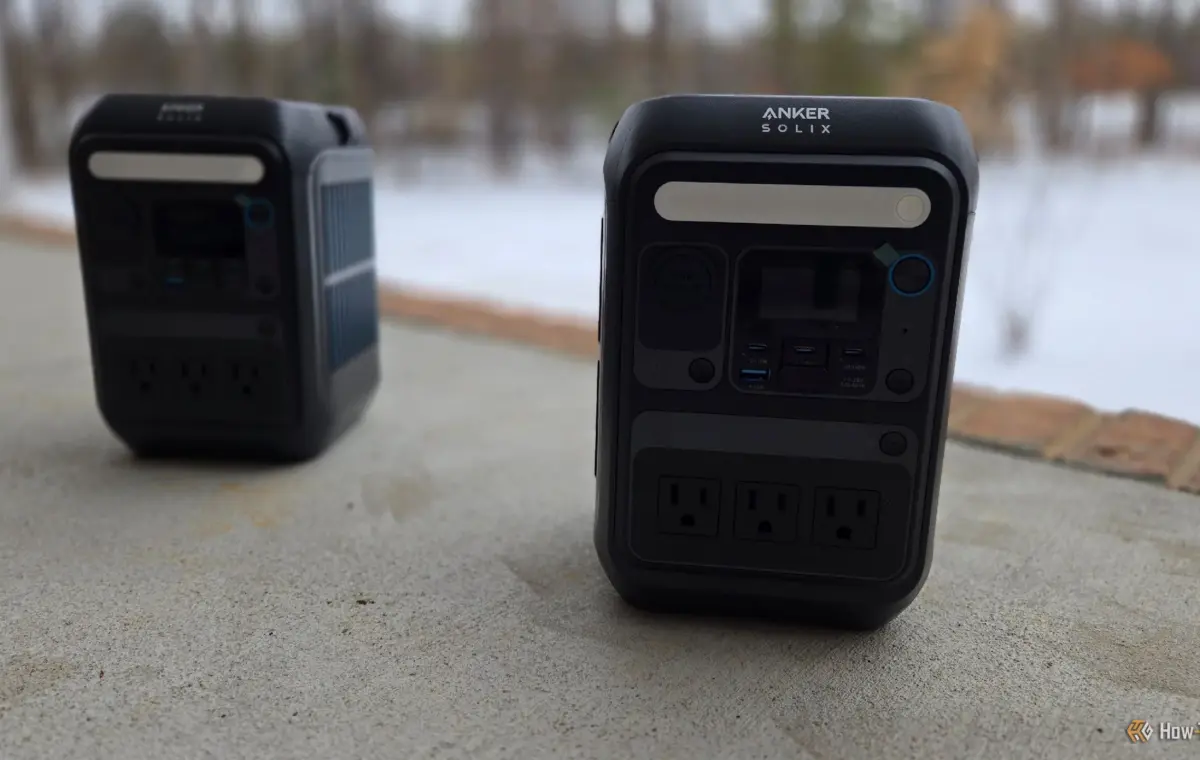
This is a story of user error. I am the user who made the error, and I'm putting this out there so that you don't make the same mistake. Here's how I killed not one, but two small portable power stations before I charged a single device.
The device in question is the Anker C300. This is a small portable power station with a capacity of 288 watts and enough power to charge phones, laptops, and small appliances. With a max output of 300 watts, it's not of much use in the kitchen, but it's the kind of power station that's great for kids during an outage. It can charge their tablets, Nintendo handhelds, and nightlights.
The Anker SOLIX C300 DC is a versatile and portable power station with a 288Wh capacity and 300W output. It features multiple charging ports, including two 140W two-way USB-C ports, and can be recharged via an AC outlet, solar panel, or car charger. This makes it perfect for outdoor adventures, travel, and emergency backup power.
I like these stations because they are lightweight and easy to carry around. They're the first ones I would grab in an outage for anything minor. They can power a lamp or let us watch TV for a few hours. They can recharge the Nebula portable smart projector we bought instead of a smart TV. They're also small enough to toss in the trunk before a road trip in case we need to charge anything while we're in the car that the car's USB port can't handle.
These units are the exact opposite of the giant Anker F3800s we bought to power our home during an outage. That thing weighs over 130 pounds (around 60KG).
I've written before about how I intend to buy one of Anker's solar powered umbrellas when they come out later this year. This little power station is precisely the kind of thing I'd like to connect it to for passive power generation.
The Anker C300 technically qualifies as a tiny solar generator, since it has an input for charging directly from solar panels. This is one of the primary ways I intended to charge my units.
This model has a max input of 100 watts, but I was curious if a 200-watt panel would still work. After all, I also have the Anker C1000—that model has a max charging rating of 600 watts, but the fastest way to charge it is by using two of Anker's 400-watt panels. I followed this advice when testing out how quickly I could charge my C1000. As you can see below, this worked as advertised.
Solar panels rarely reach their maximum charging capability, so two 400 watt panels are more likely to produce closer to 600 watts than 800 watts. Still, these panels can produce over 600 watts of power, so the C1000 must apparently throttle what it takes in to 600 watts, since using two 400-watt panels is one of the ways Anker recommends charging the unit. That's why it made sense to me that even though 200 watts is more than 100, a 200W panel would probably still work with my C300.
So I pulled out my panels. I have both an Anker PS100 and a PS200. The PS100 is made of two solar panels, while the PS200 is made of four.
When I plugged my 200W Anker PS200 panel into my first Anker C300, nothing happened. I tried pressing the power button. Nothing. I must have gotten a dud.
I had ordered two power stations at the same time, but the second one arrived a few days later. This time I plugged the unit into a wall first to make sure it wasn't also a dud. It came on! So I took it outside and plugged in the same panel. This time I heard a sizzling sound. I immediately unplugged the panel, but it was already too late. When I pressed the power button, nothing happened. It hasn't come back on since.
This was new to me. Like I said, I expected the power stations would probably only pull in the amount of energy they could safely handle. If they couldn't do that, I expected some sort of message indicating that the power station is incompatible with these panels.
After all, when I plug my Kia Niro EV in to the 11kW car charger we have at home, it only pulls in its max charging speed of 7.2kW despite the faster capabilities of the charger. When I plug a 65W charger into my Galaxy Z Fold 6, it only pulls in 25W. And like I mentioned before, when I plugged two 400W panels into my C1000, it continued to work.
Solar panels and portable power stations apparently do not function like the other electronics in my life.