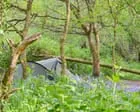
A fragment of temperate rainforest lies on the edge of Dartmoor, and following years of conservation work, its owners have now opened up a sustainable campsite next to this fragile ecosystem
Mist blankets the valley as I wheel my camping gear down the small hill towards a clearing ringed by trees and shrubs. A picnic bench sits at its edge, angled towards the reason why I’m here: one of the last remaining fragments of temperate rainforest in Britain. I’m pitching my tent at Wray Valley Camping, a low-impact site on Dartmoor’s eastern edge between Lustleigh and Moretonhampstead, where I’ll spend five days on one of the site’s “nearly wild” pitches.
Also known as Atlantic woodland, temperate rainforests depend on a rare combination of high humidity, rainfall and consistently mild coastal temperatures where the sea moderates the climate. They once stretched from the western Highlands of Scotland down to Cornwall, covering 20% of the UK, and sheltering rare and delicate lichens and plants. Today more than 95% of our temperate rainforest cover is gone, but Devon’s near-constant dampness and its exposure to the Atlantic make it one of the last strongholds for this rare habitat.
Wray Valley Camping owners Michelle Grist and her partner Kevin Chamberlain have spent seven years restoring this fragile ecosystem while developing the adjacent campsite.
“We always intended to run a sustainable campsite from here,” says Michelle, a retired environmental consultant, admitting that neither she nor Kevin (a member of the Dartmoor search and rescue Ashburton team) had ever run one previously. “We did not take it over,” she adds. “We built it from scratch.” Years of camping, both in the UK and abroad, gave them enough experience to know what they liked and what they didn’t. The valley’s topography dictated their designs from the start, Kevin explains – tents only, nothing driven in.
The early years were slow-going: Kevin built a compost toilet by hand before a shower block and other facilities arrived. Running alongside it all was the harder, longer graft of coaxing the temperate rainforest back to life.
“It was actually difficult getting on to the land,” Michelle tells me. “While the drains upland had been cleared, our land was completely flooded.” Michelle and Kevin worked along with several other organisations to restore the woodland, adding 1,200 native plants, 200 metres of new hedgerow and 45 native saplings as well as removing invasive species.
Their efforts culminated in February this year, when Wray Valley Camping saw six acres of its 4-hectare (10-acre) estate designated a Devon county wildlife site (CWS), recognising its importance as one of Dartmoor’s fragile remnants of temperate rainforest and wet woodland. The campsite now offers a unique opportunity to sleep beside this rare ecosystem in one of its four Nearly Wild camping pitches.
A short signposted sustainability trail around the campsite and woodland explains the restoration work. Along the way, I spot a pied flycatcher between the oaks, hazels, rowans and willows while stonechats call to each other and an oil beetle meanders across a mossy stone in search of food.
In the distance, the whiz of bike chains and children’s voices echo from the Wray Valley Trail. This 7-mile (11km) walk and cycle track snakes along the edge of the temperate rainforest, retracing where the Moretonhampstead and South Devon Railway steam train once ran. Today it links the historic villages of Moretonhampstead and Lustleigh, and beyond to Bovey Tracey.
As I walk along the old trackbeds of the valley trail, I imagine iron cleaving the valley and clouding it with steam and soot. When once the scream of the train whistle heralded fallen timber and quarried stone, today it’s given way to the shrill call of the treecreeper. It’s a small measure of how fast this corridor has recovered since industry nearly gutted it in the 19th century.
The Wray Valley Trail acts as a low-impact gateway for exploring eastern Dartmoor, and it is worth building a few days’ itineraries around it. From the Wray Valley campsite, it’s an easy cycle or walk to Lustleigh and on towards Hound Tor, where towering granite boulders guard the low moss-strewn walls of abandoned medieval settlements. Waymarked paths from here weave between Dartmoor’s scattered prehistoric monuments and weatherworn waycrosses.
Get travel inspiration, featured trips and local tips for your next break, as well as the latest deals from Guardian Holidays
A 40-minute drive away, Dartmoor’s most popular temperate rainforest, Wistman’s Wood, is a cautionary lesson on what happens when these fragile environments go viral: eroded paths, damaged mosses and trampled roots from footfall they were never intended to sustain. Even as conservationists work there to double the woodland’s size, it remains under pressure from its popularity.
For Michelle and Kevin, restoring the woodland is only part of the challenge. The harder task is ensuring that welcoming visitors help protect the landscape rather than putting it under pressure. Their approach is simple: keep visitor numbers low and deliberately limit the impact they have on the landscape, even if that means sacrificing some of the conveniences of modern camping. There are no electric hookups, cars are left in the parking area and campers wheelbarrow their kit to their pitch. Kevin admits that the arrangements can divide opinion but says the extra effort is intentional: “If you’re asking people to make a bit more effort to protect this environment, it tends to attract those who appreciate it.”