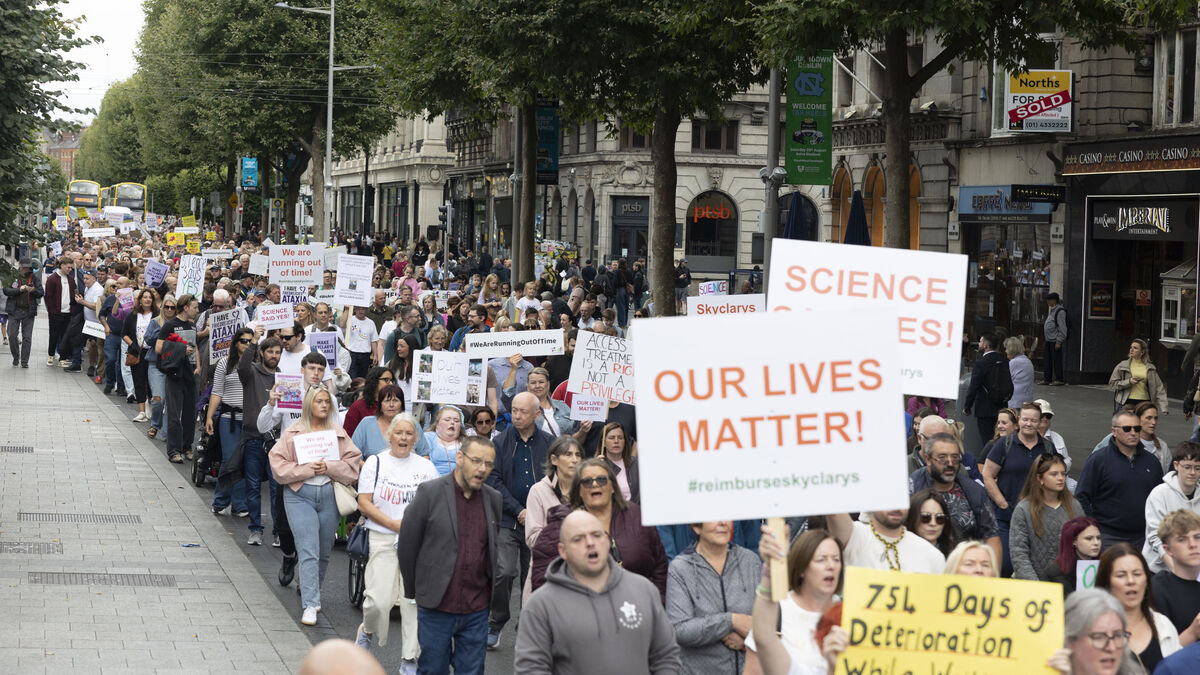
Friedreich's Ataxia campaigners protest in Dublin to push for Skyclarys approval in Ireland.
Campaigners have made a last-ditch plea to the HSE to allow a potentially life-changing treatment for Friedreich’s Ataxia to be made publicly available.
A protest in Dublin city centre saw hundreds of people call for the HSE to approve the drug Skyclarys for reimbursement, with Friedreich’s Ataxia patients saying it would be hugely beneficial to their quality of life.
Skyclarys is the only drug approved for the treatment of Friedreich’s Ataxia, a rare progressive neuromuscular condition affecting around 200 people in Ireland. While it is not a cure, it does treat the condition.
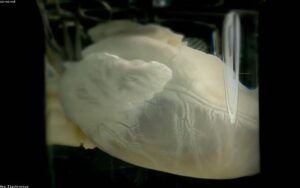
The genetic disorder causes progressive damage to the nervous system, while also leading to heart complications.
The HSE’s senior leadership team is set to meet on Tuesday to consider allowing the treatment to be reimbursed, after the HSE drugs group met earlier this month and recommended against reimbursement.
Speaking at the Custom House, campaigner Emily Felix, who was diagnosed with Friedreich’s Ataxia at 12, said Skyclarys would be more than just a medication, but would be a “lifeline” to Friedreich’s Ataxia patients.
“Before 2023, there was absolutely no treatment available for Friedreich’s Ataxia. Skyclarys gives us the chance to slow this horrendous progressive disease and preserve the abilities we still have,” Ms Felix said.
The protest also heard from Eric Fitzgerald, a writer from Galway who was diagnosed with Friedreich’s Ataxia at 11.
Mr Fitzgerald said when he was diagnosed with the disease, he was told there was no cure or treatment for the disease.
“It was like getting a death sentence at the age of 11,” Mr Fitzgerald said.
He urged the HSE to provide the drug for patients, saying the health service has only said no to Skyclarys due to cost.
Sinéad Maher, whose husband Jason has Friedreich’s Ataxia, said that nobody there had asked to be a campaigner or advocate.
She cited the recommendation by the Rare Diseases Technology Review Group, which suggested the HSE pay for Skyclarys, saying this proves the debate was never about the science behind the drug, but it was down to cost.
“It’s 100% about the money. That’s all that it’s about,” Ms Maher said.