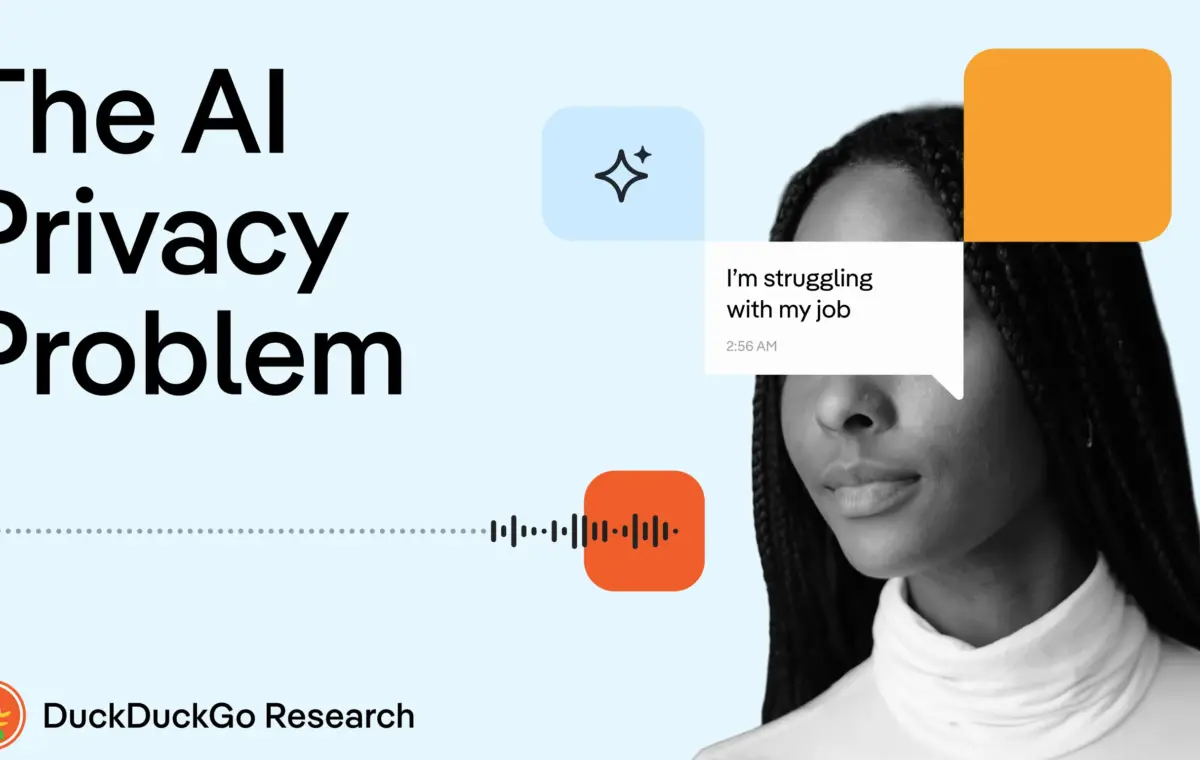
A recent DuckDuckGo survey finds that people are sharing intimate details with chatbots without knowing all the privacy risks.
Are people oversharing sensitive information with AI? Short answer: yes.
A new survey called The AI Privacy Problem by DuckDuckGo Research said about a third of people are sharing secrets with chatbots that they don’t share with friends, family and medical professionals. The number rises to 56% among self-described AI enthusiasts. Researchers also found that 43% of parents reveal things to AI that they don’t tell the most trusted people in their lives, including their kids.
Though the survey didn’t specify what kind of personal information is shared with AI, past reports have shown that we often turn to chatbots for help with physical and mental health issues, financial advice, parenting questions and marital problems.
The problem isn’t about seeking help. The problem is losing control over what happens with the data after it’s shared in chats. Companies can use your private info to train their AI systems. Law enforcement can get it through subpoenas. And if you’re using AI chatbots at work, your employer can likely access your chat history, too.
AI companies try to convince people that chatbots are trusted confidantes, but that’s a false narrative, the DuckDuckGo report said.
“These messages all rest on one assumption: That these chats are private. In most cases, that just isn’t true,” researchers said.
In fact, the survey found that many respondents didn’t realize how their chatbot data could be used or accessed or that they didn’t know about settings to prevent their information from being recorded or stored. When it comes to protecting their data, nearly 40% of respondents had no trust in companies and nearly 50% had no trust in the US government.
Many of us know that companies bombard us with targeted, personalized online ads. If you run a Google search for vacuums, you’ll see vacuum ads pop up on your screen. If you search for Mediterranean cruises, you’ll surely get cruise ads on YouTube (owned by Google). Companies also buy, sell and share our social media data to help guide their advertising.
But AI data-sharing goes well beyond being the focus of selling you products. If you provide sensitive information to a chatbot, it could be revealed or exposed. A researcher at Wake Forest University found that AI agents, which use LLM data to perform autonomous tasks, can sometimes leak data, either maliciously or unintentionally.
Your conversations with AI chatbots don’t disappear into the ether. Unless you opt out, the AI system will record and save them for future use, such as additional training for the AI model. Last year, hundreds of chats on Anthropic’s chatbot Claude appeared in Google search results.
One main concern with LLMs is data memorization, said AI expert Uttara Ananthakrishnan, assistant professor at the University of Washington’s Foster School of Business. “When someone asks the same question as someone else, it is possible that the LLM gives them exactly the same answer it gave someone else,” Ananthakrishnan told CNET. “The LLM might not know that the answer contains information that someone can use to identify someone else.”
What you say in a “private” chat could also wind up in court or part of a police investigation. Companies with AI models such as Anthropic (Claude), Google (Gemini) and OpenAI (ChatGPT) are legally required to turn over chat data if subpoenaed by law enforcement or the US government. Only 25% of DuckDuckGo survey respondents knew this. As MemX, an AI memory agent, stated starkly in a blog post: “A conversation with a mainstream chatbot is a business record, not a confidential consultation.”
It’s already happened several times. ChatGPT transcripts were used during a double murder investigation in South Carolina earlier this year and in the Palisades arson case last year. A Snapchat AI conversation was used as evidence in a 2024 murder trial.
As OpenAI founder and CEO Sam Altman said on a podcast earlier this year, “If you go talk to ChatGPT about your most sensitive stuff and then there’s like a lawsuit or whatever, we could be required to produce that.”