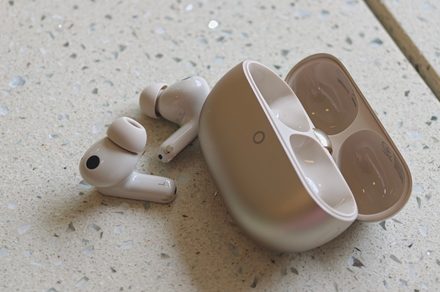
I usually find myself sticking to the trinity of Apple, Sony, and Bose, every time someone seeks my advice for premium earbuds. For the first time, I am pushing Huawei in that list. I’ve had the Huawei FreeBuds Pro 5 in my ears for the better part of four weeks now, swapping them in against the AirPods Pro (3rd gen) and a set of Sony WH-1000XM6 that I keep on my desk for top-shelf comparisons. The proverbial “Premium value” is a phrase every audio label reaches for, and almost none earns. This is one of the rare times I’d sign off on it.
At nearly $220 to $240 (€199 / £179), the FreeBuds Pro 5 slot in well below Apple, Sony, and Bose. Notably, across most of what I actually judge earbuds on, they match those flagships and edge past a couple of them. The two core aspects that carried them for me are an exceptional fit and fantastic sound. These are among the most comfortable buds I’ve worn, light and pressure-free through hours of listening and a long-haul flight where I usually give up and reach for over-ear headphones.
The acoustic architecture pairs a dynamic woofer with a micro-planar tweeter. To mine — and nearly half a dozen ears that tested the earbuds — that combination delivers rich, controlled bass alongside sparkling, detailed highs. On top of it, the dual-engine AI Active Noise Cancellation system and Bluetooth 6.0 never once gave me any trouble with isolating noise or device connectivity. Club all these conveniences together, and the value on offer is hard to ignore.
They’re not flawless, of course. The US availability is still restricted to third-party importers, and Android users face a frustrating app install conundrum outside the Google Play Store, which I had to work through myself. Furthermore, the best high-bitrate codecs (L2HC 4.0) also stay locked inside Huawei’s own ecosystem, which means it’s basically useless to the rest of us. But despite those hiccups, for anyone chasing flagship sound and isolation without paying flagship money, these are the easiest earbud recommendation I’ve made this year.
Huawei rebuilt the chassis of the FreeBuds Pro 5 to tackle the most persistent problem in true wireless audio, and that’s offering long-haul comfort. By analyzing more than 10,000 ear profiles, the company shaped an asymmetrical housing that braces against the common anatomical pressure points. The result is a body roughly 10% smaller and 6% lighter than the last generation, topping the scale at just 5.5 grams per earbud.
The comfort is the first thing you notice, and it’s the aspect that kept me reaching for them. As a control, I had nearly a dozen friends test them, and they all loved how light and comfortable they are. They settle into the ear canal without digging in or building the nagging pressure that has me yanking audio buds out every hour. The seal leans on soft liquid-silicone tips rather than aggressive deep insertion, so I wore them through full work sessions and four long-haul flights without the ear fatigue that usually sends me reaching for over-ears.
That shallower fit has a secondary benefit too. The Huawei FreeBuds Pro 5 don’t create the plugged-up “occlusion” feeling where your own voice booms inside your skull, which is a big part of why I could leave them in through a whole afternoon of calls and typing. Huawei includes four tip sizes (XS, S, M, L) in the box to dial in that seal, and I’d urge you to actually run the fit test rather than assuming.
In my tests, it bumped me down a size from what I’d have picked naturally and tightened up the bass response noticeably in the process. They also stayed put during light jogs, never threatening to work loose, though I’d still recommend a wingtip option for anything more strenuous than that.
The charging case is also smaller compared to its predecessor, and against the AirPods Pro, as well. It offers a rounded, pebble-like contour that all but disappears into a pocket. Huawei went with a concealed hinge, so the whole thing stays clean and seamless whether it’s open or shut. There are four finishes to choose from. Sand is a subtle metallic light-gold treated with a film coating that gives the plastic a smooth, smudge-resistant satin texture.
You can also get them in grey, white, and blue shades. The latter looks stunning, by the way. The standout touch on the front of the case is a four-color LED indicator ring. Rather than the usual single status dot, this ring gives you intuitive visual feedback on battery levels, charging speed, and pairing state at a glance, a small flourish that makes the whole thing feel more considered than its price suggests.
For workouts and commutes, the earbuds carry an IP57 ingress rating, which means full dust protection and survival in fresh water down to 1 meter for 30 minutes. Heavy sweat or a sudden downpour isn’t a concern, but Huawei recommends that you don’t wear them while showering, swimming, or any other activity with high-pressure water flow.
The case, on the other hand, holds a lower IP54 rating. That’s enough to shrug off ambient moisture and light splashes to protect the charging contacts, but I’d still keep it out of the sink. The polish on top also gets scuffed pretty quickly, so I’d recommend some care or just slapping a thin case on top.
Before I get to the good part, let’s go through the challenge first. On the iPhone, you can easily get the Huawei AI Life app to connect and control the earbuds. For Android, you need the Huawei Audio Connect app. Here’s the bad part. In my region, which is India, the app is simply not available on the Play Store.
When I downloaded an APK build from a third-party repository, the app was stuck on an older firmware and wouldn’t recognize the earbuds. I eventually had to download the Huawei Audio Connect app from the Samsung Galaxy Store on my Galaxy Z Fold 8.
Once the app is installed, the situation is breezy. Customization, firmware updates, and the advanced controls are all easily accessible. The layout is clean and sensibly organized, putting battery percentages, connection management, and ANC modes right up front where I actually want them. Getting the app, though, depends heavily on your platform, and this is the first real friction point.