Published: 12:37 BST, 27 August 2026 | Updated: 12:46 BST, 27 August 2026
Just two weeks after millions of Britons marvelled at the best solar eclipse in a generation, another celestial spectacle is set to take place.
In the early hours of tomorrow morning, stargazers across the UK will be able to witness a dramatic partial lunar eclipse.
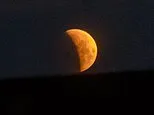
During the event, more than 90 per cent of the moon will disappear into Earth's shadow.
The phenomenon is expected to turn much of the lunar surface a striking copper red colour, creating what is known as a 'blood moon'.
The eclipse will begin at 2.23am UK time, when the moon enters the outer part of Earth's shadow, known as the penumbra.
The real show starts at 3.33am, when the moon begins moving into the darker central shadow, called the umbra.
And the spectacle will reach its peak at 5.12am, when only a thin sliver of the moon will remain brightly illuminated.
If you didn't manage to get your hands on a pair of eclipse glasses, don't worry – as this is perfectly safe to watch with the naked eye.
During the event, more than 90 per cent of the moon will disappear into Earth's shadow. Pictured: A partial lunar eclipse seen from Hampshire in 2025
The phenomenon is expected to turn much of the lunar surface a striking copper red colour, creating what is known as a 'blood moon'. pictured: A couple watch a partial lunar eclipse in Devon in 2019
Experts say the eclipse will be visible across the whole of the UK, although the moon will be sitting low in the western to south–western sky as dawn approaches
Experts say the eclipse will be visible across the whole of the UK, although the moon will be sitting low in the western to south–western sky as dawn approaches.
Observers are advised to find a location with an unobstructed view of the horizon, away from buildings, trees and bright city lights. No telescopes or binoculars are required, although both can enhance the view.
'You'll need to get to a high vantage point with a clear view towards the south–western horizon to see as much of this eclipse as possible,' experts from Royal Museums Greenwich said.