President Donald Trump’s Administrations have overseen construction work on hundreds of miles of barriers along the U.S.-Mexico border. But one small portion of the planned wall—stretching merely 17 miles—has become the center of a hard-fought battle.
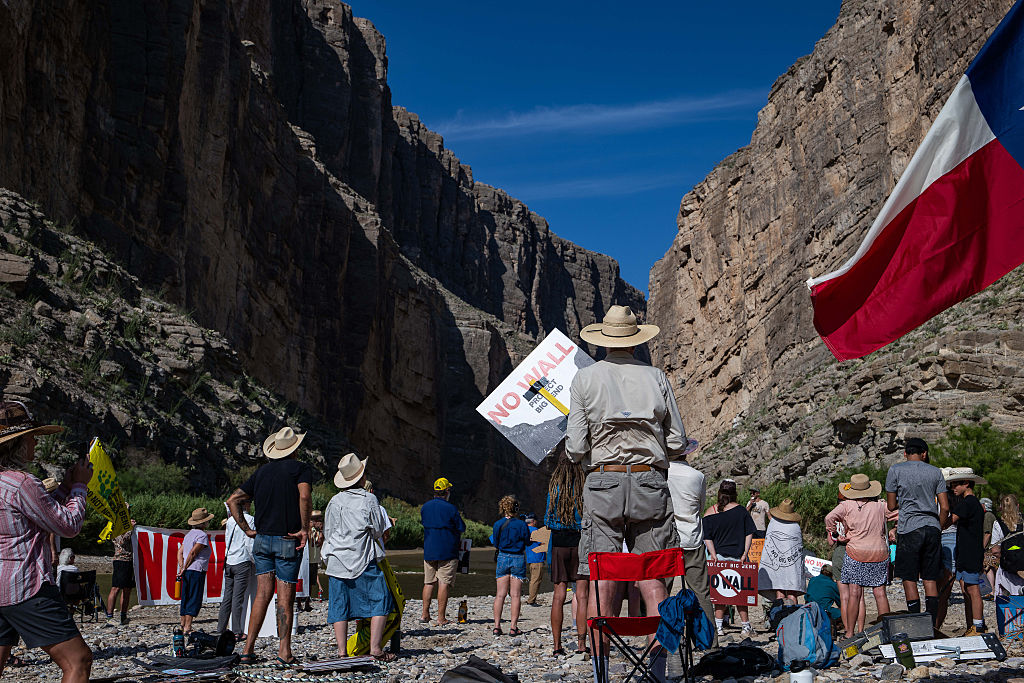
That section of the project, which extends across challenging terrain in Texas’ Big Bend National Park that has historically seen relatively few attempted border crossings, has faced pushback from everyone from public lands advocates to congressional lawmakers to local residents.
The Trump Administration has been pushing the construction of the border wall in Big Bend despite the public outcry, going so far as to bypass a score of environmental laws to expedite the project.
But on Monday, after months of opposition, Customs and Border Patrol (CBP) Commissioner Rodney Scott announced that CBP had paused “all construction” in the park while he visited the site to conduct a “personal, on-the-ground evaluation.” In post on X, Scott wrote that he would be working to “evaluate the terrain and listen to local leadership, community members and stakeholders” over the next “couple of days.”
Texas Gov. Gregg Abbott also said on Monday that he had spoken with Department of Homeland Security (DHS) Secretary Markwayne Mullin, who Abbott said had “committed” to not building “a wall or a fence” in Big Bend. Abbott said there were “other tools” to ensure border security.
Here’s what to know about the Trump Administration’s efforts to build the border wall in Big Bend, and the opposition the project is confronting.
Big Bend National Park sits in a remote southwest corner of Texas along the U.S.-Mexico border in Brewster County. The Administration has sought to build 17 miles of barriers across that section of the border as part of the larger border wall project.
Perhaps the most recognizable image of Trump’s wall is the “primary wall,” a structure built from tall steel bollards up to 30 feet tall that makes up the first line of the barrier system that would be encountered by those travelling north from Mexico. The section of the project planned to run through Big Bend, however, would look notably different, according to Scott.
“CBP is building one new access road, improving existing roads, installing detection technology, and placing vehicle barriers in limited, strategic locations,” he said. “We are NOT building a 30-foot wall or stadium lighting through Big Bend National Park, Big Bend Ranch State Park, or the Black Gap Wildlife Management Area.”
The portion of the wall in the park would be made up of a non-contiguous “vehicle barrier system,” according to the CBP, which consists of “steel posts supported by continuous steel rails,” power cables, cameras, roads for patrol cars, and shelters along the border.
According to the agency’s Smart Wall tracker, an interactive and frequently updated map that shows the status of the border wall, CBP has several construction projects interspersed along the border labeled as a “vehicle barriers … technology & patrol road.” A couple of these are located at the southern tip of the park; one sits far west near Presidio County, while others are located at the eastern edge of the park. These sites are in the Chihuahuan Desert, which presents a difficult landscape to navigate filled with steep canyons and mountainous terrain.
In June, the Trump Administration waived more than 20 environmental and preservation laws intended to protect Big Bend’s landscape in order to accelerate the construction of the border wall in the park.
To do so, the Administration invoked a section of the Illegal Immigration Reform and Immigrant Responsibility Act of 1996, which allows the government to bypass laws that obstruct the building of border wall.
DHS defended the move at the time by describing Big Bend as an “area of high illegal entry” and saying that “there is presently an acute and immediate need” to build more barriers.
Migrant encounters are relatively rare at the section of the border that runs through the park, however—and have become more so in recent years. The park includes roughly 118 miles of what’s known as the Big Bend Sector of the border, which spans 517 miles from Sierra Blanca, Texas, to Sanderson, Texas, and covers roughly one-quarter of the full length of the U.S.-Mexico boundary. CBP recorded a 74% decrease in border crossings through its Big Bend Sector between fiscal years 2023 and 2025, with apprehensions dropping from 11,823 to 3,096. There were a total of 237,538 migrant encounters along the U.S.-Mexico border in FY 2025, meaning that the 3,096 apprehensions in that sector accounted for just 1.3% of the total number. And CBP’s planned border wall in the park would only cover a fraction of a fraction of the full sector.