Account subscription benefits alongside Premium Stories, Editorials,
Opinions and more. Unlock these with Subscription
The View From India
Looking at World Affairs from the Indian perspective.
First Day First Show
News and reviews from the world of cinema and streaming.
Today's Cache
Your download of the top 5 technology stories of the day.
Science For All
The weekly newsletter from science writers takes the jargon out of science and puts the fun in!
Data Point
Decoding the headlines with facts, figures, and numbers
THEdge
At the cutting edge of education and careers
Health Matters
Ramya Kannan writes to you on getting to good health, and staying there
Gender Agenda
Stories from beyond the binary.
The Hindu On Books
Books of the week, reviews, excerpts, new titles and features.
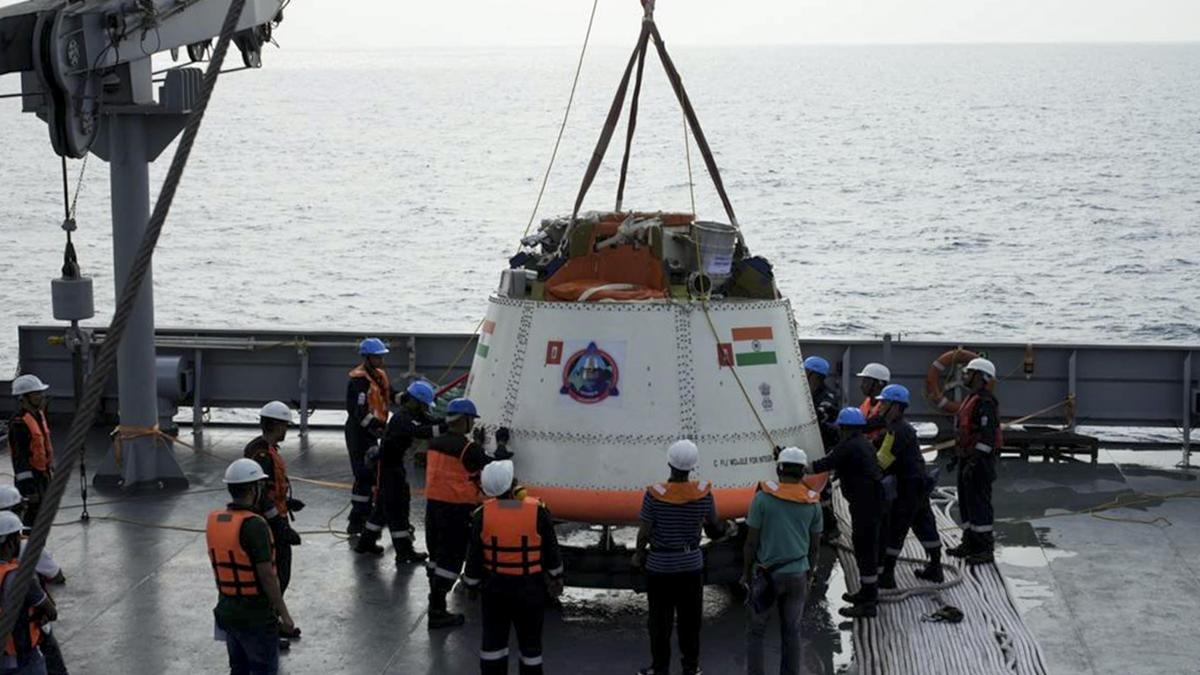
Compared to rockets, re-entering modules have a unique and unforgiving set of challenges
| Photo Credit: PTI
The atmospheric phase of all space missions is challenging for both ascending rockets and descending space capsules.
As the rocket lifts off from the earth and heads towards its orbit, it accelerates slowly through the atmosphere to keep the mechanical loads on the vehicle to a minimum. When a space capsule, like the Gaganyaan crew module, re-enters from its orbit around the earth, it will hit the atmosphere at a blistering speed of 7,500-8,000 m/s. More than 99% of this kinetic energy will be dissipated into the atmosphere as heat energy. However, a small portion directed back towards the module will still be intense enough to melt it if it is not protected by a robust thermal protection system (TPS).
Text and Context
/
The Hindu Explains
/
ISRO
/
space programme
Copyright© 2026, THG PUBLISHING PVT LTD. or its affiliated companies. All rights reserved.