Published: 15:41 BST, 17 August 2026 | Updated: 22:50 BST, 17 August 2026
The idea of someone hacking a plane in less than a minute might sound like the plot from an unrealistic Hollywood blockbuster.
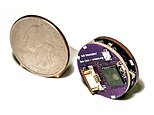
But a terrifying new study has revealed how this could be achieved, using a device the size of a 10p coin.
Scientists from the University of California San Diego have developed a custom hardware device that can take over the communications between two key onboard computers.
One computer is the flight management computer, while the other is the computer that displays this flight path information in the cockpit.
To take over these crucial systems, all hackers would need to do is plug the device into a port inside the plane's belly.
According to the researchers, an attack of this sort would take less than 60 seconds to carry out on a Boeing 737 either parked at a gate or in an airport hangar.
'We believe we have made a strong case that time–limited physical access (e.g., 60 seconds) represents a realistic goal for a motivated attacker,' the researchers said.
'The consequences of even such short access can be significant (and hence worthy of attention).'
The idea of someone hacking a plane in less than a minute might sound like the plot from an unrealistic Hollywood blockbuster. But a terrifying new study has revealed how this could be achieved, using a device the size of a 10p coin
Typically, physical access to an aircraft is not considered a major cybersecurity risk.
However, in their new study, the team set out to understand whether or not an attacker with physical access to a plane could exploit its systems.
'Our goal with this research is to alert the aviation community to this class of risks, so they may be appropriately mitigated well before they become dangerous,' said Aaron Schulman, one of the senior authors of the work.
While studying a Boeing 737, the team discovered an unused maintenance port in the plane's Electonics and Equipment (E&E) bay, which houses key electronic systems.
The bay can be found under the plane's nose – and crucially, it can be reached from the ground, and isn't locked.