By WILIAM HUNTER, SENIOR SCIENCE & TECHNOLOGY REPORTER
Published: 12:04 BST, 25 August 2026 | Updated: 12:06 BST, 25 August 2026
Part of King Henry VIII's long–lost Sandown Castle has been rediscovered hiding in plain sight.
Stones from the 16th–century fort were reused to build part of Dover Castle, about nine miles (14.5km) down the coast, according to a new study.
Archaeologists discovered a previously unknown report from 1883, stating that materials from Sandown were being sold off and sent to Dover.
Those stone chunks from Henry VIII's maritime defences now form part of the Constable's Gate at Dover, which provided quarters for the castle's commanding officer.
After Sandown Castle fell victim to coastal erosion in the 1800s, its valuable stones were sold off to form everything from coastal defences to a pier at Deal.
However, until now, this hidden connection to Britain's most famous castle had gone totally unnoticed.
Dr Moore says: 'When you stand beside the Victorian extension at Constable's Gate and realise that parts of its masonry came from Sandown Castle – a fort Henry VIII built and the sea later claimed – it sends chills down your spine.
'It's a tangible connection across centuries of history.'
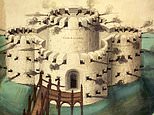
Part of King Henry VIII's long–lost Sandown Castle has been rediscovered hiding in plain sight. Pictured: A 1539 early design for either Sandown or nearby Walmer Castle
Today, Sandown Castle has been reduced to ruins by coastal erosion. However, its stones have been found making up part of Dover Castle
Before the 1500s, the Crown had typically felt that coastal defences were the responsibility of local lords and that raids from sea were simply a manageable nuisance.
However, after King Henry VIII broke with the Catholic Church to divorce his wife, Catherine of Aragon, tensions between England and Rome made the threat of invasion very real.
France and the Holy Roman Empire forged a new alliance, and the Pope encouraged both to invade England to avenge the insult.