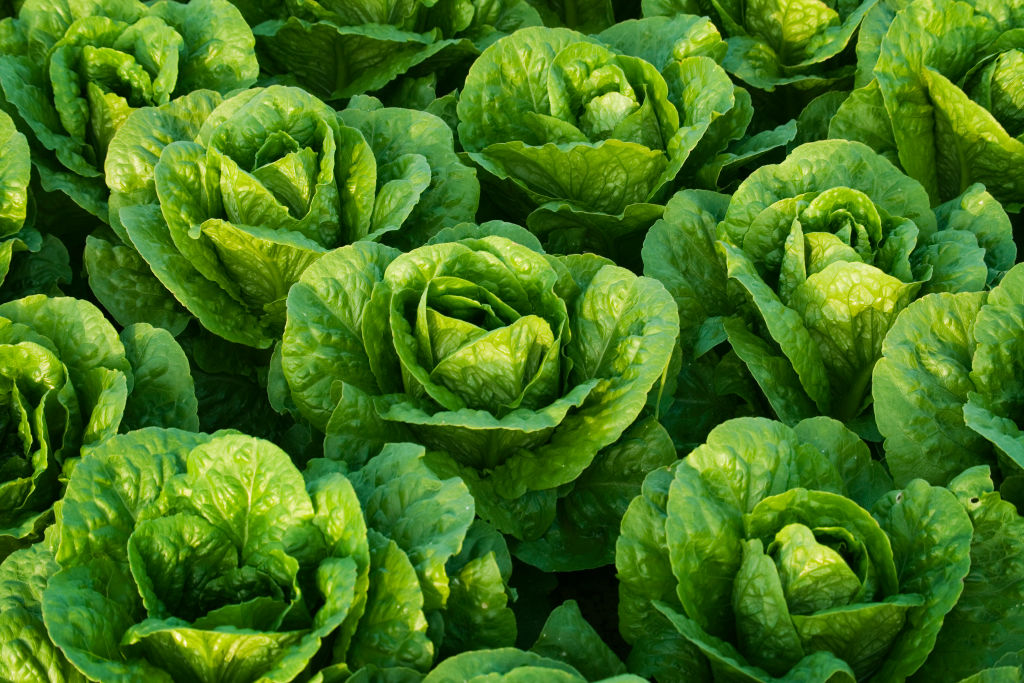
In the town of Nipomo on the central coast of California, in Bill Waycott's fields, lettuces of the future are taking root. Red-furled or dark-leaved, these rosettes of crunchy goodness might someday make it to a store near you.
Waycott is an independent plant breeder, one of the small community of dedicated folks who devote their time and effort to the reproduction of a given plant or plants. For decades, he's focused mainly on breeding better lettuces, and he spoke to TIME about what could be in America's salad bowls in coming years and just how damaging the recent Cyclospora outbreak, traced to a farm run by greens behemoth Taylor Farms in Mexico, has been for lettuce growers.
TIME: How did you intertwine your fate with that of lettuce?
Waycott: My introduction to agriculture occurred as a Peace Corps volunteer in India in the ‘70s. When I came back from that assignment, I wanted to dedicate myself to agriculture. It was the most amazing thing that could ever have happened to me—a California surfer goes to India and learns how to survive in a language, in a culture, in a food system that I had no clue about. I got a job at the [U.S. Department of Agriculture] and the first year and a half it was a sugar beet breeding project. When the lettuce position opened up, I jumped on it.
We were trying to slow down the process of early flowering in lettuce. You probably know that it doesn't last very long in a garden during warm temperatures. It goes to seed pretty quickly. But then we had George Bush Senior come across and clear the deck. I was laid off at that point with a lot of my colleagues back in the '90s, and that's when I went to work for a private breeding company.
In your decades of making lettuce better, what’s been the main focus?
Well, you know it's 96% water to start with, so you don't have a lot to work with. My focus has been as much as possible on disease resistance—developing lettuces that can stand up to plant diseases that can wipe out a crop—and improved nutrition. Since so many people eat salads these days, even if we were able to improve the nutrition by 5 or 10%, that's a huge impact on the North American diet.
At Nipomo Seeds, which is a company my wife and I started in 2014, we’re working on a lettuce we have nicknamed “Spinach Lettuce,” because it resembles spinach both in the way it grows and also its taste (a softer, spongier, and slightly bitter eating experience). The nutritional values for most of the important nutritional components in lettuce are high in the Spinach Lettuce, especially when compared to iceberg; there’s a lot more fiber, protein, calcium, iron, vitamin C, and vitamin A.
There are others; we have some new lettuces that we're hoping growers will take an interest in. We've been growing field trials, and Chef Dan Barber from Row 7 Seeds has come out to California and looked at them. I think in September we're going to have somebody from Whole Foods come over and have a look.
What’s the biggest challenge facing lettuce breeders these days?
I have to say, I am just flabbergasted by the number of diseases that have come in in the last five to 10 years, and the rapidity with which they're mutating and forming new races. Example: I have been testing for plants that can resist Fusarium oxysporum, which is a fungus of the roots and vascular tissue. The plant's growing along, it's getting close to harvest, and then it just sort of wilts. Pull up the roots, and you see this discoloration. I really did my best to come up with resistance to that issue over the last five or so years. But in the last two years, the disease has changed and formed a new what we call variant race. So all the seed that I produced for that particular issue is no longer interesting to my customers because it doesn't have the brand-new race resistance.
Right now we have three fungi, one bacterium, and one virus here in California lettuce that are wreaking havoc and making life very difficult. In the past, there was one major issue at a time that we could hopefully solve in five years of breeding. Now I'm working on five issues, six issues in tandem.
How has the Cyclospora outbreak, linked to Taylor Farms’ operations in Mexico, affected the lettuce industry?
Oh, it's disastrous. I've heard sales are at least 30% down, and not just in lettuce. Anything that's green is suspect to some people. If you can't cook it, or buy it out of a can, it’s not on the list. There are fields of mature lettuces being plowed under constantly now that have no value because they can't sell.
But this isn’t the first time. In 2006, there was a big E. coli outbreak with spinach. That started the whole system of trying to evaluate the product before it was cut. Nowadays, at least north of the border, there are companies that go into every field and sample methodically across the field. Maybe every 30th row or every 50th row, they sample and send these samples into a lab, and it's checked for pathogens.