Published
Sep 3, 2026 9:03 AM EDT
Get the Popular Science daily newsletter💡
Breakthroughs, discoveries, and DIY tips sent six days a week.
A little less than 2,000 years ago, Mount Vesuvius became the antihero of the ancient world’s most well-known tragedy. The infamous explosion covered Pompeii and Herculaneum in volcanic debris, immortalizing the final moments of the ancient Roman cities and some of their unfortunate inhabitants in stunning detail.
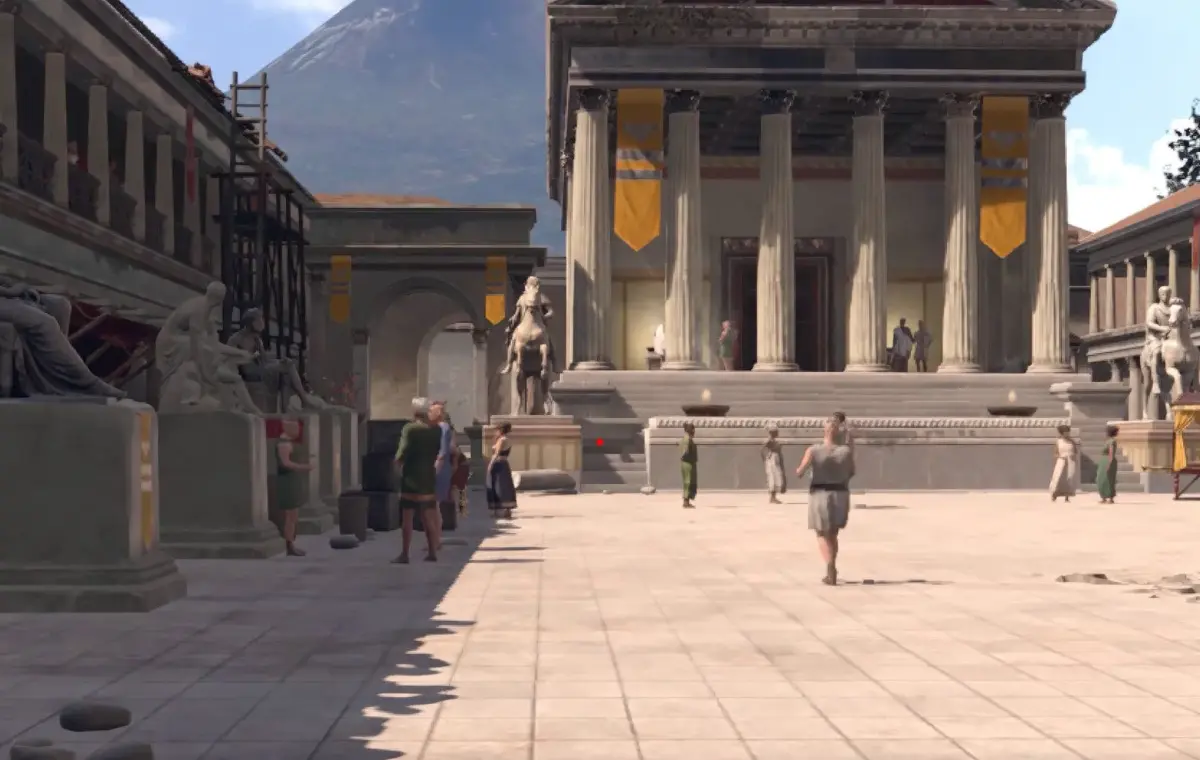
Now, however, visitors can witness the glory of Pompeii before it all came crashing down in 79 CE. A former game engineer from Illinois and his team have developed an application that brings sites at the Archaeological Park of Pompeii to unprecedented life via Immersive Extended Reality technology. In other words, you can now stand in the forum alongside other ancient Romans and watch in horror as Mount Vesuvius starts to rumble along the horizon.
Todd Porter, the former game engineer and now founder of the software company Histoury, went through a different kind of horror to make it happen—walking every inch of the archaeological sites to execute 155 scans under southern Italy’s blazing sun.
Porter founded Histoury less than three years ago, but the lightning bolt of inspiration originally struck him 15 years ago on a visit to Herculaneum, Porter tells Popular Science. It was while wandering around the archaeological sites that he had the idea of using his video game background to reconstruct his surroundings in a virtual world one could visit with their phones.
Of course, in 2012, smart phones didn’t have enough processing power to support the sort of software required for something like that. “It only took 13 years for phones to catch up to my vision,” Porter jokes.
But that vision could only manifest with the Pompeii archaeological park’s consent. Thankfully, a member of the team—a former hotel front desk employee who, after learning about the team’s project, offered to quit his job and do their business development—wouldn’t take no for an answer. He knocked on Pompeii’s door every day until, possibly out of exhaustion, the park agreed to a demonstration.
[ Related: DNA reveals new stories about Pompeii’s victims ]
Histoury’s digital reconstructions start with two different kinds of scans—a high resolution scan and a spatial scan.
The high resolution scan creates a virtual 3D model of the site with an accuracy range of less than 2 centimeters, and involves walking around the archaeological site with an instrument called a LiDAR scanner.
“That’s just me walking around with a device that looks like a bomb,” Porter says. “It’s shaped like a giant pill with a light whirling around and it makes a noise. You hold it with one hand and you’re looking at your phone with the other.”
The resulting 3D model is then converted into 3D mesh—essentially a kind of digital model compatible with the game development software they use. Histoury’s artists then build the reconstruction directly on top of this 3D mesh, in consultation with a team of archaeologists to make sure everything is as historically accurate as possible.
The other scan—the spatial scan—employs a less powerful instrument called an Xgrid Portalcam, and serves several different purposes. The main one is to secure spatial accuracy. Traditional GPS data is largely inaccurate. Instead, Histoury’s application uses artificial intelligence to determine where the user is standing and which way they are facing within six inches of accuracy. The AI matches the image captured by the smart phone to images of known locations in its data.