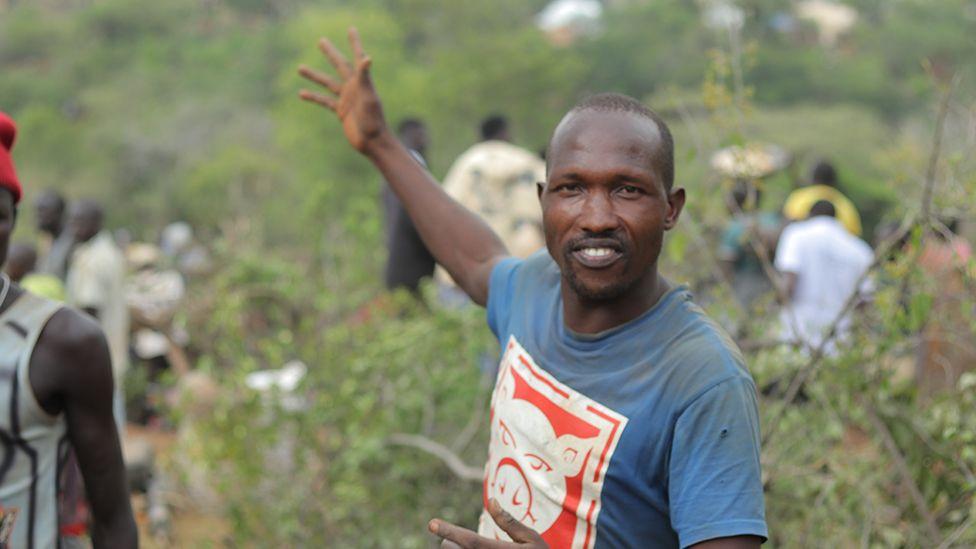
A goat herder from a remote area of western Kenya has told the BBC his discovery of a golden nugget has sparked a gold rush, overwhelming his small village over the last few weeks.
When people found out that 33-year-old Manasse Lomachar had sold his three grams of gold for 36,000 Kenyan shillings ($280; £205) several weeks ago, he believes this led to thousands of prospectors arrived in Cheporor.
And it is true that what last month was just bushland and rough grazing ground near the village is now scarred by pits, mounds of earth and makeshift mining camps.
It is not clear if was Lomachar's lucky find or other recent discoveries that sparked the excitement. But local authorities estimate that about 10,000 people arrived at the height of the rush.
Even a small amount of the precious metal can transform the futures of these men and women – from Kenya and neighbouring Uganda – many of whose precarious lives rest on an unreliable farming income.
Large numbers of people have been searching through the earth and rocks for any sign of the precious metal [Edwin Naitale / BBC]
People do sometimes pan for gold in these parts – but rarely find anything significant.
Lomachar's says his discovery came about purely by chance. While he was searching for a missing goat he encountered a group of women panning along a riverbed.
"I joined them, and that's how [the village] realised there was gold in this area," he says.
Farmer and herder Patrick Lokolia, from neighbouring Napawoi village, joined the gold rush hoping to earn some extra money to support his family.
"I have children in school, and paying school fees has been a big problem for me," he tells the BBC wearing an old Chelsea football top and standing amid the mining activity.
Eighteen-year-old Abigael Chelengat says she had never mined before coming to Cheporor from a nearby district, but arrived hoping to find enough gold to pay her school fees and help keep her younger siblings in school.
Abigael Chelengat hopes a gold find will help her pay for her education [Edwin Naitale / BBC]
Behind her hundreds of people work side by side, hacking into the rocky ground with hoes and shovels.
Others carry the earth to a nearby seasonal river, where mostly women crouch in the murky water, washing and sifting mud and sand hoping to detect a tiny trace of the element.