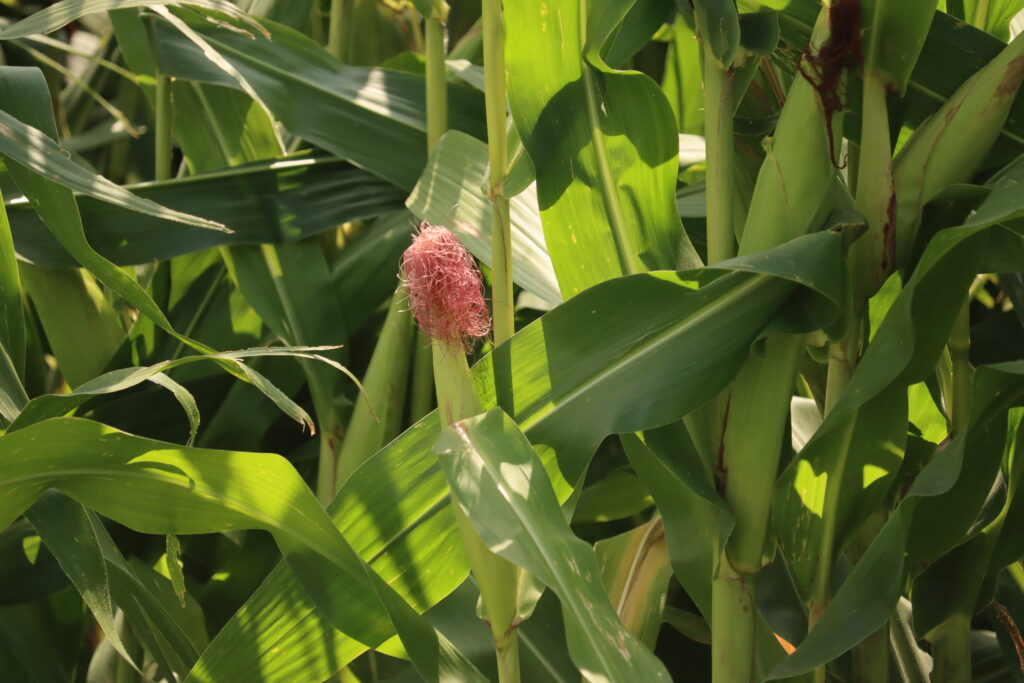
Corn silking in central Iowa August 4, 2025. (Photo by Cami Koons/Iowa Capital Dispatch)
Iowa row crops are in good conditions as of the latest crop progress and condition report from the U.S. Department of Agriculture, though plant pathologists in the state are starting to see disease pressure creep up.
Corn, soybean and oat acres were ahead of last year's crop across most developmental stages, according to the report for the Aug. 3 through Aug. 9 reporting period.
Just 3% of corn acres in the state have yet to reach the silking stage, according to the report, and 69% of the crop reached the dough stage, which is 3 percentage points ahead of the 2025 crop. Corn in the dent stage for the reporting period was 2 percentage points behind the year prior, with 12% of corn acres reaching the stage where the ear is firm and milk has dried out from the kernels.
Soybean acres were 1 percentage point ahead of the 2025 crop with 93% blooming in the reporting period. Slightly more than 70% of soybean acres were setting pods, according to the report, which was 2 percentage points behind last year.
Corn rated 78% good to excellent and soybeans 77% good to excellent.
Oat harvest was nearly finished during the reporting period with 93% of the crop harvested — 13 percentage points ahead of the year prior.
Soil moisture conditions improved slightly from the previous reporting period with topsoil rated 67% adequate on average and subsoil moisture rated 62% adequate.
State Climatologist Justin Glisan said Iowa had "all modes of severe weather" during the reporting period, including several tornadoes in eastern Iowa.
Parts of southern Iowa received more than a month's worth of rain, according to Glisan, and the "continuous rainfall" caused flash flooding in some areas. A weather station in Murray logged 5.72 inches following the Aug. 5 storms, and Glisan wrote that more than 50 stations recorded at least 2 inches of rain from the storm.
The weekly average precipitation for the state was 1.87, about one inch more than normal. Average temperatures for the state were near equal with the climatological normal at 74.5 degrees Fahrenheit.
While the whole state received at least some rain, Iowa Secretary of Agriculture Mike Naig said it was not enough to improve drought conditions in parts of western and northwestern Iowa.
"As excitement builds for the opening day of the Iowa State Fair, cooler temperatures and additional chances for showers will stick around for the first few days, while the forecast for the next week shows better chances of significant rainfall totals," Naig said.
Daren Mueller, a professor at Iowa State University and a plant pathologist with ISU Extension, said disease pressure of southern rust in Iowa corn is "way lower" than what hit the state last year.
"Last year was a disaster – I mean, it was too much disease for a plant pathologist to enjoy, and we do like our disease," Mueller said. "But in general, it's way lower."