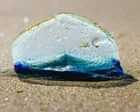
Appledore, Devon: By-the-wind sailors have been washed up in great numbers this summer. I stumble on a single one of these bright blue beauties
Amid the hot grit of the estuarine beach, a cool light glints. Not the habitual shade of mussel shells, nor even the shimmer of sea glass, this is a blue so bright that at first I mistake it for a kind of plastic, perhaps the discarded part of a pair of goggles.
I’m about to pick it up when something prompts me to pause, mid-swoop; an inkling that this is not synthetic, but animal.
Looking closer, I see an intricate pattern of concentric circles like a carved inscription on a wave-blue disc. A translucent “sail” rises from the middle. This is the marine hydrozoan, Velella velella.
Like a portuguese man o’war, it is not a single animal, but rather collections of polyps working together. They feed on planktonic organisms using tentacles beneath their floating disc. The concentric circles are air chambers, aiding buoyancy. Largely harmless to humans, they don’t share the man o’war’s sting, but can still cause irritation if touched.
This pelagic species doesn’t swim, but instead uses its tiny sail to catch the wind and move with ocean currents, giving rise to its common name by-the-wind sailor. This evocative term, recalling maritime vernacular, highlights its sailing prowess, as do its other common names of purple sail, sea raft and little sail.
The distinctive blue of its disc comes from the carotenoid pigment astaxanthin. As well as providing camouflage against the ocean waves, these pigments can absorb and reflect harmful ultraviolet rays – particularly helpful when you travel along the surface of the sea rather than through its colder depths, and when temperatures are at a record high.
An occasional visitor to UK shores, mass by-the-wind sailor strandings have been reported along the Welsh coast and at St Bees in Cumbria this summer. Driven by strong winds, they more typically arrive in numbers during stormy winter weather, but their increased presence further inshore may be due to calmer waters and favourable winds.
Here, there is only one. Grounded, this listless sailor rests, startling in its blueness and veneer of coolness.
Under the Changing Skies: The Best of the Guardian’s Country Diary, 2018-2024, is available now at guardianbookshop.com