This content is provided by Exco Player and may use cookies or similar technologies. Please click 'Allow and Continue' below to load the content.
Your insider guide to living well in London, with trends and insider recommendations in fashion, wellbeing, travel, beauty and more.
I would like to be emailed about offers, event and updates from Evening Standard. Read our privacy notice.
The summer holidays are coming to an end and with it, the long, snaking queues at check-in desks around the capital’s airports, replaced by the regular thrum of the business travellers jetting off for meetings on the continent. But whether you flew out of Gatwick, Heathrow, Stansted, Luton or City airport this summer, you’ll have used up plenty of kerosene on your journey. That could soon be a thing of the past as aircraft manufacturers race to put the first commercially viable electric passenger planes into service.
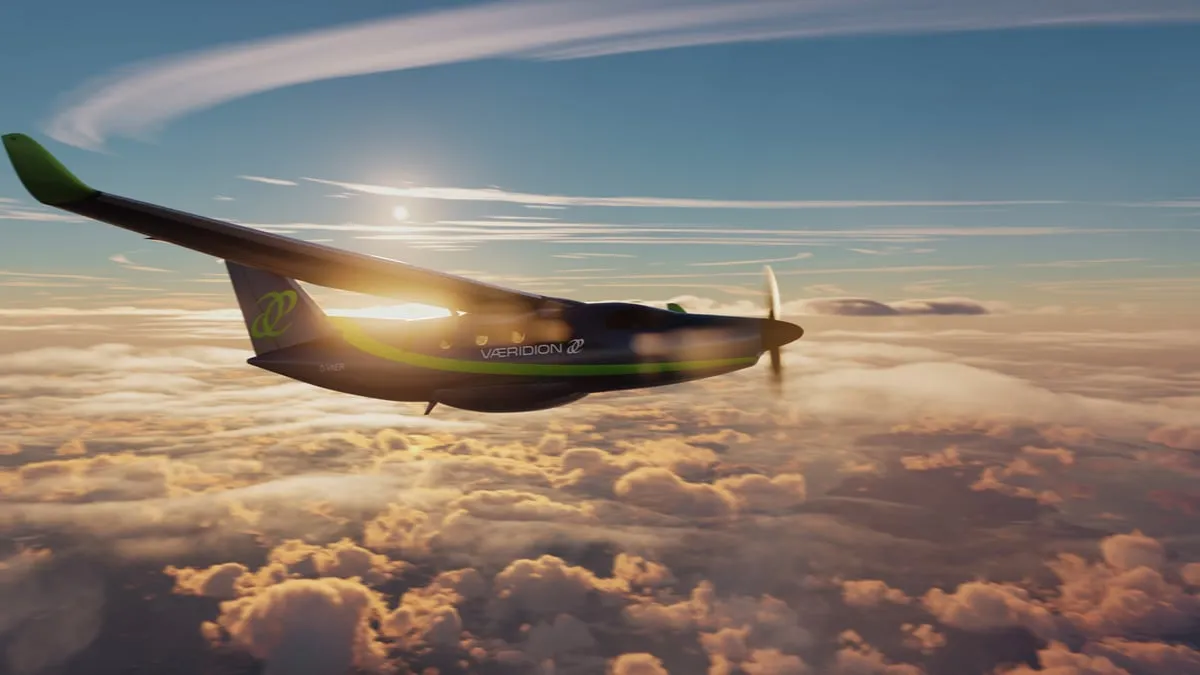
“It won’t be your next holiday,” says Otto Verhoeff, chief business officer of Vaeridion, a European company developing a nine-seat electric aircraft. But it could be the next one after that, depending on how often your family gets away. “As soon as possible is 2030.”
The battery-powered replacements won’t be swapped out for the Boeing or Airbus jets ferrying people to Lisbon or Madrid. The first generation will be much smaller, flying shorter distances and carrying a handful of passengers. But companies developing them believe routes between Britain and nearby European destinations are realistic within the next few years.
The plane can fly up to 550 kilometres — enough to take you from Heathrow to Düsseldorf.
The planes look a lot like traditional fuelled aircraft, but have larger wings — to house the batteries that can power the plane on its journey. Verhoeff says that based on the performance of batteries available today, the aircraft should be able to carry nine passengers, their luggage and two pilots for 400 kilometres. If the load is reduced to four passengers and one pilot, the plane can fly up to 550 kilometres — enough to take you from Heathrow to Düsseldorf. And battery technology is likely to improve in the remainder of the decade, meaning that range could rise further, as could potential passenger numbers on each flight.
Verhoeff suggests high-demand routes could include Dublin to Liverpool and Jersey to Cardiff, alongside London to Dublin and Amsterdam. And despite the current process where most travellers drive or take the train to major hub airports like Heathrow and Gatwick, electric aircraft need not necessarily use the giant airports most travellers currently funnel through. “There are 3,500 regional airports that can take this aircraft,” says Verhoeff. “A lot of these airports are currently not served by the traditional carriers.”
Vaeridion says it already has 132 aircraft lined up through letters of intent from eight companies across European countries — including the UK and Ireland. Around 80 per cent of those would be for passenger use, with the remainder used as cargo aircraft.
But getting an electric plane into the sky is only half the battle. “There’s been some really quite amazing progress in the past couple of years,” says Tom Taylor, aviation policy manager at environmental campaign group Transport & Environment. More efficient motors and designs incorporating batteries into wings have moved things forward quickly enough that Taylor believes electric aircraft could be carrying passengers on these kinds of journeys between 2030 and 2035 — provided the legislation keeps up.
“The technology is there and that’s fantastic, but actually making sure that it enters the mainstream requires legislation,” says Taylor. “It requires airports to be ready for electric flight. It requires the whole industry to kind of move with it.” For a start, airports will need somewhere to plug the aircraft in. Charging several planes between flights is at an altogether different scale from adding a row of electric car chargers to a supermarket car park. Taylor says the infrastructure needs to be installed — and paid for — before airlines can operate at scale.
The rules around aviation may also work against cleaner, greener flights. Airport charges are often linked to an aircraft’s weight. And the battery-based planes are heavier than their kerosene-burning equivalents. “You get perverse situations where electric flights are being charged more than a kerosene flight,” Taylor says.
Government could intervene to fix these rules and create the market for electric flight, including by mandating a proportion of all flights to and from airports use alternative fuels, such as electric or hydrogen-powered planes. An obvious way to do so would be on so-called public service obligation routes linking remote parts of Britain, including Scottish islands, where short flights are difficult to replace with another form of transport.
Private jets could provide another early proving ground for electric planes. Many private flights in Europe cover distances of around 500 to 800 kilometres — in that sweet spot for swapping out for electric, Taylor says — while their wealthy customers may be more willing to pay a premium for new technology.