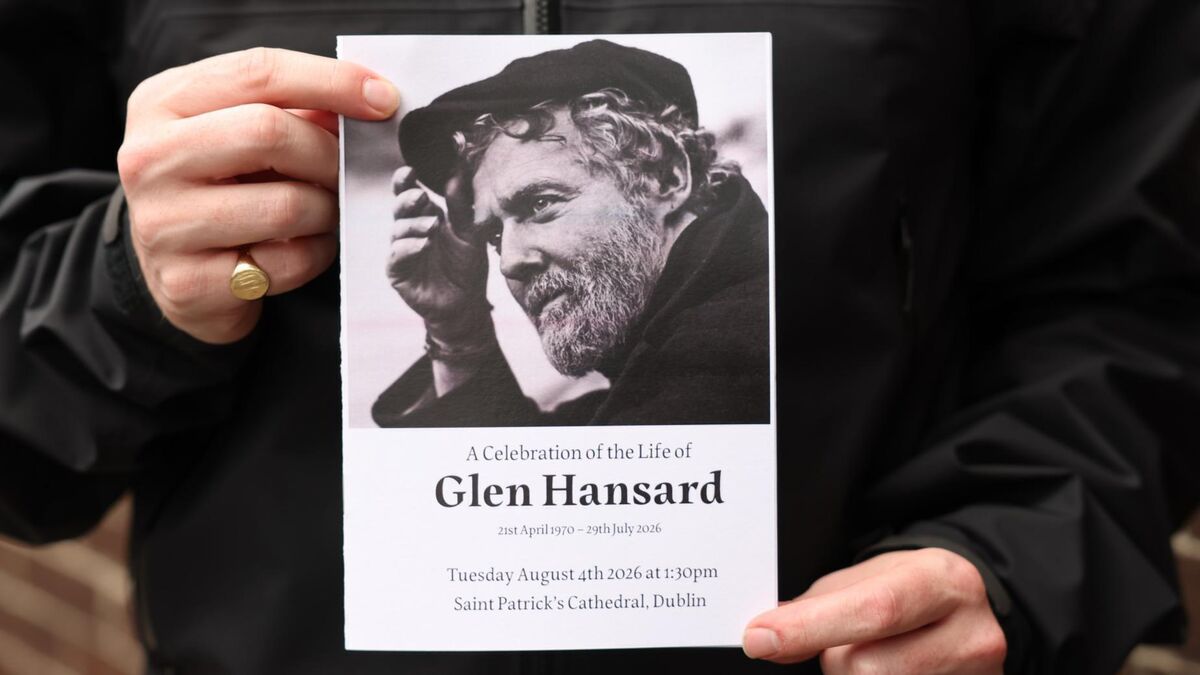
The Order of Service is held up ahead of the funeral of Glen Hansard at St Patrick's Cathedral in Dublin. The Oscar-winning Irish musician and activist died in a motorcycle crash last week. Picture date: Tuesday August 4, 2026. PA Photo. Photo credit should read: Damien Eagers/PA Wire
There is something about death that makes liars of us all. Not malicious liars, but human ones. Within hours of someone famous passing, the rough edges begin to disappear.
The awkwardness is airbrushed away. The contradictions soften. The stories become cleaner than the lives they describe. Before long, the artist has become a cultural icon, the writer a literary giant, the musician a national treasure.
We do not simply mourn them; we canonise them. And in those hours of posthumous veneration, we grieve a version of ourselves.
Quite the opposite. If music, writing, or art has helped you through your life (as it has helped me through mine), then losing its creator can feel surprisingly personal. It is entirely understandable to feel that way.
But I wonder if we have become less interested in remembering people than in preserving the versions of them we have carefully curated and filed away. Perhaps that says more about us than it does about them.
Glen Hansard’s death has prompted an extraordinary outpouring of affection. Much of it is entirely deserved in the context of what he meant to those who really knew him. To the rest of us, he was a character in a story.
Once remains one of the most affecting Irish films ever made. The music of The Frames became a soundtrack to countless lives.
For many people, Hansard wasn’t simply a musician, he was heartbreak, hope, and Dublin itself.
I loved his early music too. But I also remember sitting through concerts and finding myself increasingly distracted by the lengthy monologues between songs. They were intended, I guess, to be earnest, searching, and vulnerable. Anecdotes of humility.
Yet, over time, they began to feel strangely contrived.
With the arrival of Youtube, I realised many were simply variations on the same stories, retold to different audiences.
What struck me wasn’t insincerity so much as a profound need to connect; an almost desperate desire to be understood, loved, perhaps even needed. That isn’t a criticism so much as an observation. It also happens to be a profoundly human trait, common in many of us.
Yet the week after someone’s death is no longer a time for observations. It is a time for absolutes. Any complexity feels almost like an act of betrayal.
I’ve wondered the same about Shane MacGowan. When he died, Ireland quite rightly celebrated one of our greatest songwriters.