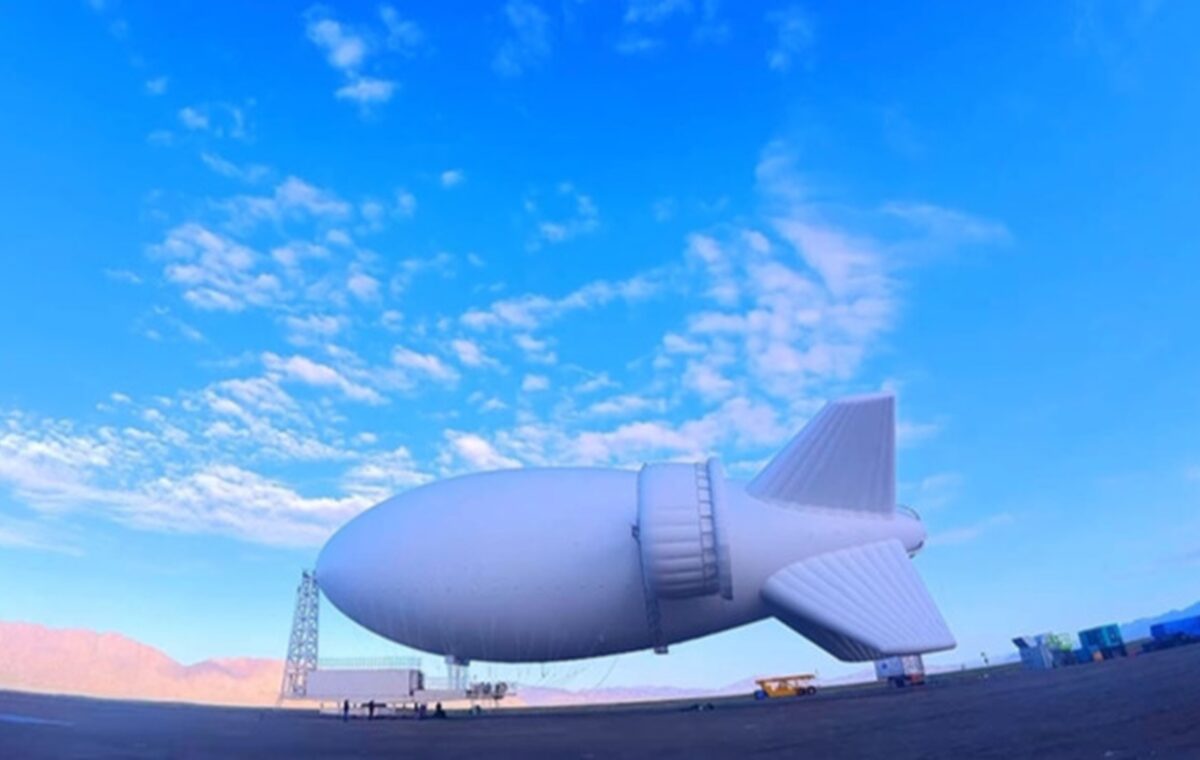
An airship the size of a football field just proved it can fly twice as high as its predecessor. It generates clean electricity from winds most turbines never reach. China's S4000 Stratosphere Airborne Wind Energy System completed a full flight test cycle at a base in Northwest China. That milestone marks the technology's shift from prototype testing toward real-world deployment.
The S4000 is an upgraded version of the S2000, a megawatt-class system that made global headlines in January. That earlier model became the first airborne wind turbine formally connected to a power grid.
The S4000 reaches a maximum operating altitude of 4,000 meters (13,123 ft), double the 2,000-meter ceiling of the S2000 model it replaces. That added height lets the system access stronger, steadier winds capable of powering most regions across China.
The test covered the system's entire operational cycle: ascent, station-keeping at altitude, power generation, and controlled recovery back to the ground. All performance indicators met required standards, according to the report. That confirms the system's reliability under complex, extreme high-altitude conditions.
Beijing-based Linyi Yunchuan Energy Technology developed the S4000. The company partnered with Tsinghua University's electrical engineering department and the Chinese Academy of Sciences' Institute of Aerospace Information Innovation on the project.
The company was founded by Dun Tianrui, who serves as its CEO.
The system uses helium buoyancy to lift a wind turbine assembly into the sky. There, it captures stronger and more consistent winds than ground-based turbines can reach. A tethered cable both anchors the system in place and carries the generated electricity back down to the ground. The company says this modular design allows the platform to be disassembled and relocated within 24 hours. That flexibility suits remote deserts, plateaus, and islands where conventional wind infrastructure is harder to build.
The S4000 is the fifth model in a lineage that began with the S500 in 2024. That first model reached 500 meters and generated 50 kilowatts of power. Successive versions, the S1000, S1500, and S2000, each pushed higher and more powerful. That progression culminated in the S2000's historic grid-connected test in January.
That test drew unusually wide attention after a Chinese foreign ministry spokesperson shared footage of the floating turbine on social media. The clip sparked online buzz over its unusual, UFO-like appearance. The S4000 can be directly integrated with mainstream power grids and carries a design service life of up to 20 years.
Developers now plan to push the technology even further with the S6000, targeted for testing in the third quarter of 2026. That model aims to fly beyond 6,000 meters, crossing into the stratosphere proper and testing the limits of how high airborne wind power can realistically climb.