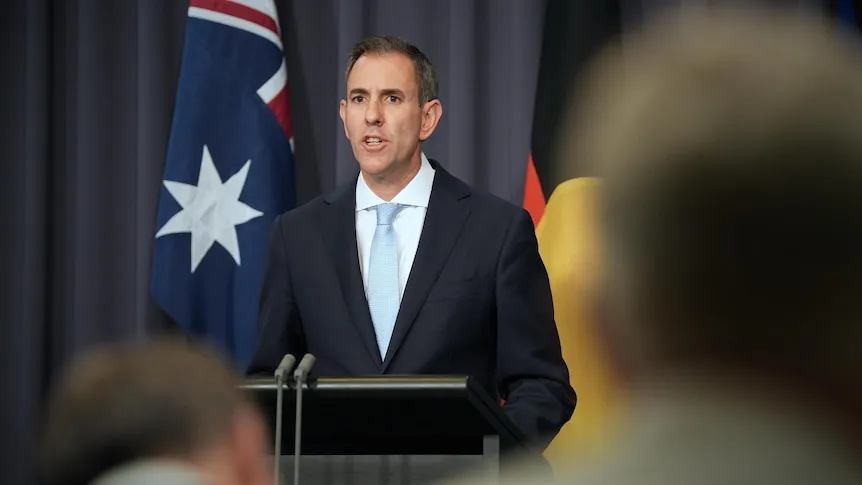
Jim Chalmers couldn't avoid the question on house prices when he fronted up for a press conference on the national accounts. (ABC News: Callum Flinn)
Welcome back to your weekly federal politics update, where Courtney Gould gets you up to speed on the happenings from Parliament House.
Jim Chalmers sits alone in a darkened press conference room, selfie camera on, chatting to his social media followers about the latest economic data.
But of course he wasn't asked any questions in his pre-filmed video. It was more an avenue for him to declare the economy was "robust" despite challenges from the Middle East war, point out more people are switching to EVs and that housing construction is up before he had to face reporters half an hour later.
He fronted up to the press conference for a tense back and forth where almost every single question was house prices.
When the government made the U-turn on its promise not to wind back negative gearing and the capital gains tax discount, it did so armed with Treasury forecasts. Growth, the budget papers said, would slow by 2 per cent over a number of years.
Property data firm Cotality this week flagged drops in every capital city in August, and predictions from the Commonwealth Bank that prices could drop as much as 13 per cent have some mortgage holders understandably worried.
Chalmers has largely brushed off movements in price as not unusual and backed in his department's forecast. "Buying a house is a long-term proposition," he said.
The major factor at play here is recent interest rate rises, he argued, not the government's tax changes.
That argument wasn't made easier for him either, after fellow frontbencher Matt Thistlethwaite declared on News24 (formerly Sky News Australia) there was "no doubt" the tax changes contributed to house prices falling.
"I think that's one of a number of reasons," Chalmers told ABC's Sally Sara when asked again this morning.
Thistlethwaite may have made the sell a little bit harder for Chalmers, but the treasurer named the "disturbing rubbish" pushed by social media algorithms as the thing making his job more difficult.
"Our society, our social cohesion, the way that we come at big problems including in my part of the shop in the economy is hampered, not helped, by the way algorithms are dominating people's day," Chalmers said.
It's a similar argument that's been put before by Prime Minister Anthony Albanese, who has said algorithms are fuelling polarisation. Albanese is supportive of the idea that Australians should have more control over what they are shown online.
Sign up to the ABC Politics newsletter with Courtney Gould