Central Queensland politicians are preparing to take a business case to Canberra to lobby for more investment in defence infrastructure.
It comes as the region hosts the army's largest collective training organisation with thousands of defence force personnel coming to the Shoalwater Bay Training Area.
Meetings with the federal government are slated for September, with the process expected to take years.
A new army vehicle has defence officials very excited.
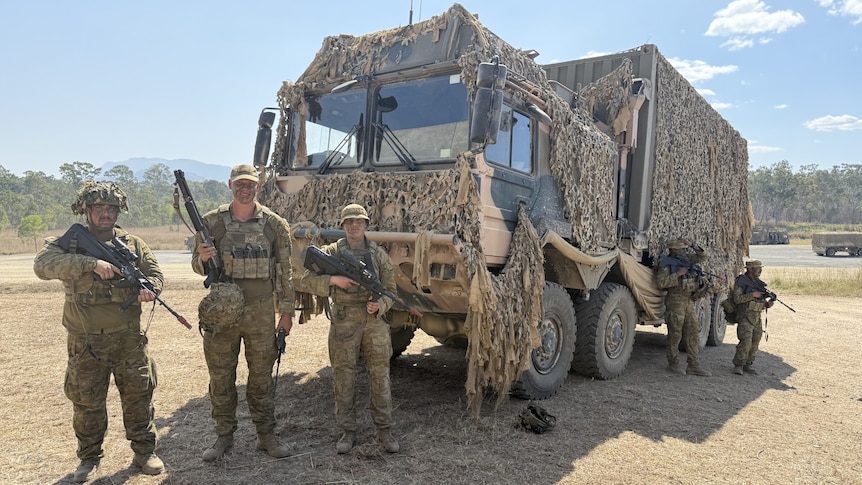
The Boxer Block II Combat Reconnaissance Vehicle has faced its most significant field test to date in central Queensland, after thousands of army personnel practised combat skills on a simulated battlefield with a live enemy, civilians and even a mock TV crew.
The Boxer Block vehicles are named after fallen soldiers. (ABC News: Jacob Gamble)
Lieutenant Colonel Thomas Johnson says the vehicle is bringing the army into the digital age.
"Its robustness, its mobility, the way it can communicate between the vehicles, as well as the ability for the enemy to really struggle to detect the vehicle … has been a significant advantage."
Lieutenant Colonel Thomas Johnson (left) and Major Scott Ferguson with the Boxer Block II. (ABC News: Jacob Gamble)
Sitting 80 kilometres north of Rockhampton, Shoalwater Bay Training Area has more than 450,000 hectares of dense bushland and sea.
It is one of the key assets within the region that a group of central Queensland politicians will be touting in Canberra next month, when they present a business case to the federal government for greater defence investment.
The Boxer Block II Combat Reconnaissance Vehicles were tested at Shoalwater Bay, as the region pushes for more defence investment. (ABC Capricornia: Jacob Gamble)
The business case includes a proposal to build a defence-logistics hub to repair and maintain machinery, a medical training centre to boost the number of local health professionals, and a submarine-support facility in Gladstone.
Rockhampton Mayor Tony Williams said it was about identifying the Defence Force's priorities and presenting solutions.
"If we get a stronger military and defence presence in the region, it just gives us so many more options there and buffers our local workforce."