This content is provided by Exco Player and may use cookies or similar technologies. Please click 'Allow and Continue' below to load the content.
It began as a small celebration of Caribbean culture — now the unity of old and new generations is pushing London’s biggest party ever forward
On an unsuspecting W10 backstreet, the party’s come early. Residents gawp from windows and balconies at a mini-parade of feather-clad bikini dancers and plumage-framed muscle men. Atop a food truck dispensing trays of sticky BBQ wings a sound system rattles windows with hip-shaking Caribbean soca sounds while, at the far end of the street, a drum troupe provides the beat for a trio of skipping stilt-walkers dressed as sentient totem poles.
This may only be a tiny taste of the full-blown event, laid on for a launch party in July, but Notting Hill Carnival 2026 is clearly itching to whack on its peacock headdress and spark up its 60th anniversary extravaganza.
“It’s exciting, the anticipation now, waiting for August to come,” says Gladwin Wright, mainstay of Carnival’s ska and reggae Gladdy Wax sound system since the late-1980s, speaking at the two-hour teaser event. “You get people spending their holiday in London at this time, from abroad. When I turn up [at Carnival] on Sunday morning, people make jokes, they say, ‘Gladdy, where you been, man? We’ve been waiting since last year!’.”
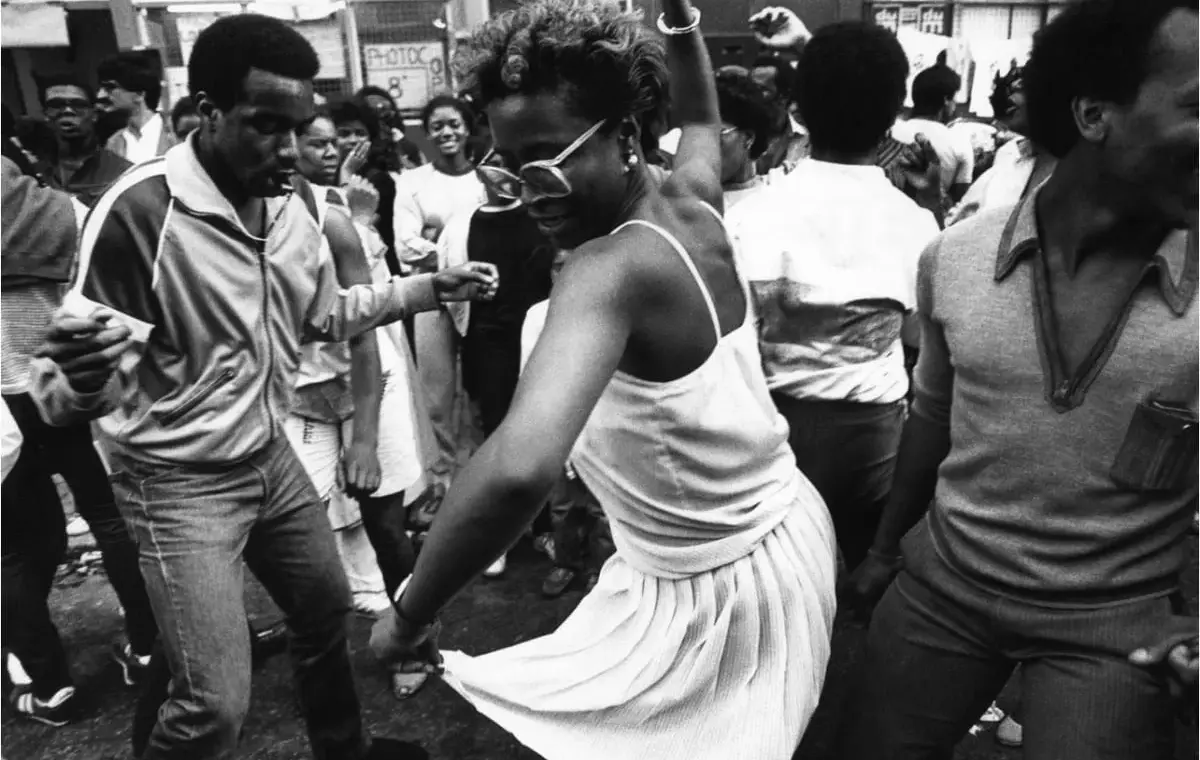
Drenched in the sensory overload of sound, colour and sonic vibration, it’s easy to see why Carnival — the capital’s biggest and brightest annual celebration of Caribbean culture for six decades — draws over two million people to the streets of Notting Hill each August bank holiday to hipsway along to its thumping sound systems, steelpan bands and exotic mas (short for masquerade) parades. “It is pure celebration,” says Tracy Palmer, veteran of the Jah Observer sound system. “It’s two days where you can forget the bills, forget the stress, forget that you had an argument with Tom, Dick or Harry, and just enjoy yourself.”
As some of its most prominent and pioneering figures gather in local community hub The Tabernacle to reflect on Carnival’s history and significance, there’s a real sense of pride in having seen it thrive and survive for six decades. This is, after all, a weekend of sheer joy born in defiance of hatred. In 1959, following race riots and tensions between local fascist strongholds and Windrush generation settlers in Notting Hill, which led to the murder of 31-year-old Antiguan Kelso Cochrane, journalist and activist Claudia Jones — dubbed the mother of Carnival — organised a steel band and calypso Mardi Gras to counteract disintegrating race relations in the UK.
That first event took place a few miles away at St Pancras Town Hall. Seven years later, the first parade around Notting Hill, itself in 1966, was a more spontaneous affair. Wanting to put on a carnival for the end of the school holidays, and to promote cultural unity in a divided area, activist Rhaune Laslett organised the Notting Hill Fayre and Pageant, featuring processions of children in Charles Dickens characters and bands of Irish pipers, New Orleans brass and Trinidadian steel drums.
“They put their pans round their neck and came through the streets playing music,” says long-time Carnival costume-maker and current board member Allysson Williams. “By the time they came to Ladbroke Grove, there were about 500 people following them. From then, it happened every August bank holiday.”
In 1973, new director Leslie “Teacher” Palmer obtained permission to introduce static sound systems around Ladbroke Grove, where floats of costume and steel bands from the Caribbean paraded for the first time, merging reggae, calypso and masquerade in a rush of sound and colour. But even by the time Williams and her husband Vernon launched their own mas band Genesis in 1980, bedecked in annual themed costumes depicting ancient Egypt, Africa or the Far East, the event was still somewhat wild at heart. “There was no route, there was no structure,” Williams remembers. “The bands just went everywhere, anywhere they wanted, and policemen would move the crowd aside. It was amazing.”
“The bands just went everywhere, anywhere they wanted, and policemen would move the crowd aside”
Many of the DJs and band members have fond memories of these relatively rule-free times. “It was colourful, friendly,” says Tracy Palmer of the Jah Observer sound system and a regular at Carnival since the 1970s. “Music all over the place. The houses around here, people used to be able to earn some money by cooking food, and if somebody said, ‘Can I use the toilet?’ their house was open, absolutely open.
“People used to have their own little dances in their houses. I used to go to one where the windows were blacked out with black rubbish sacks to make it look dark in the place.” For the young and old of west London’s Caribbean diaspora, Carnival became a two-day explosion not just of sound but of community; one huge, pulsing family they’d lose themselves in from childhood.
“It’s the melting pot of West Indian cultures,” says DJ Mark Ross, who has been playing hip-hop at Carnival for 39 years. “It was all about getting lost in the carnival as a little boy because it felt so safe. My mum used to dump me and my brother down here and we used to walk around and eat food, and then somebody would pick you up and take you where you’re supposed to go.” As it swelled in size over the 1980s, by necessity Carnival became more organised; its route fixed, its funding secured, strict timings and regulations introduced to allow the processions to flow smoothly and all bands to make it to the judging point before the judges went home. “It was just getting out of hand,” Williams says. “People were all over the place, and there was no rhyme or reason as to what happened, so it had to be organised in a more linear type of way.”
Security also became a priority, following riots and police hostility in the 1970s when the authorities hoped to prevent the then-unlicensed Carnival taking place altogether and a savage press sought to demonise an event that, according to a 2019 report, proportionally has no more arrests each year than many other major festivals. “Spiteful people,” Wright says, arguing that Carnival has survived such negativity because of the fundamentally positive power behind it. “They try to smear it. ‘Lock it down, lock it down.’ Because it’s a black people thing. But the positive can withstand all the negative they give it.”